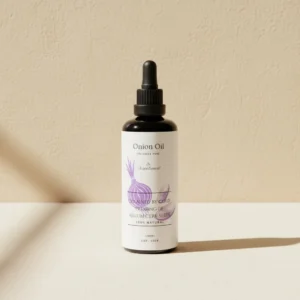
Allium cepa — cold-pressed onion seed oil with quercetin glycosides, flavonoids, and sulfur compounds for follicle resilience, scalp antimicrobial balance, and antioxidant skin protection
What is onion seed oil — seeds vs bulb, the critical distinction
The distinction between onion SEED oil and onion BULB preparations is important — they are different products with different compositions and application properties.
Onion bulb juice/extract: The form used in the 2002 clinical trial — directly applying liquid from the onion bulb to the scalp. Rich in quercetin, sulfur compounds, and volatile thiosulfinates responsible for onion’s strong pungent smell.
Cold-pressed onion seed oil (Azara Natural): Pressed from the seeds of Allium cepa — a different part of the same plant. Seeds concentrate quercetin glycosides, flavonoids, and sulfur-containing compounds in a lipid-compatible form, without the highly volatile thiosulfinates that make onion juice so pungent. The result: onion’s key actives in a more skin-appropriate, significantly less aromatic form. The cold pressing also preserves a fatty acid base — primarily oleic (~25%) and linoleic (~45%) acids — providing carrier conditioning alongside the botanical actives.
Key composition:
– Oleic acid (omega-9): ~25%
– Linoleic acid (omega-6): ~45%
– Quercetin and quercetin glycosides: primary active flavonoids
– Sulfur-containing compounds: supporting keratin integrity and follicle resilience
The scent is earthy and mildly pungent — distinctly different from fresh onion — and dissipates after absorption.
Traditional use: from ancient Egypt to Levantine medicine
Allium cepa has been cultivated for over 5,000 years — documented in ancient Egyptian, Sumerian, and Indian records. The Ebers Papyrus (circa 1550 BCE) documents onion preparations for medicinal use. Ibn Sina’s Al-Qanun fi al-Tibb includes onion preparations for hair conditions — noting its warming, circulation-stimulating properties on the scalp.
In traditional Middle Eastern and South Asian medicine — relevant to Azara Natural’s Levantine sourcing heritage — onion preparations for hair and scalp have been a consistent feature of household remedies for centuries. Traditional Syrian and Levantine hair oiling traditions include allium-based preparations alongside black seed and castor oil for hair loss and scalp conditions.
In Spain, cebolla has been a staple of traditional medicine — documented in Andalusian folk herbalism for skin and respiratory conditions. The specific seed oil extraction is a more contemporary precision of the same botanical tradition.
Key compounds and the clinical hair evidence
Quercetin and quercetin glycosides:
Quercetin is a flavonoid with documented antioxidant, anti-inflammatory, and antiproliferative activity. In hair and scalp context, its antioxidant protection at the follicle level reduces oxidative stress damage to follicle stem cells — relevant to age-related thinning and follicle miniaturization. Quercetin is also a documented tyrosinase inhibitor contributing mild brightening activity to skin.
Sulfur compounds:
Allium species are among the richest plant sources of organic sulfur compounds. Sulfur is structurally essential to keratin — the protein forming the hair shaft. Cysteine (the sulfur-containing amino acid) forms the disulfide bonds giving hair its structural integrity. Topical sulfur compound application supports keratin integrity and reduces hair fragility.
Hair and scalp benefits
Follicle environment support:
Based on the 2002 trial evidence extrapolated to the seed oil’s similar active profile, onion seed oil supports the follicle environment through antioxidant, anti-inflammatory, and sulfur-based keratin support mechanisms. Twice-weekly scalp application is the evidence-consistent protocol.
Dandruff and scalp microbiome:
Antimicrobial sulfur compounds and quercetin’s anti-inflammatory activity address both the microbial (Malassezia) and inflammatory components of dandruff — complementary to laurel bay and black seed.
Hair strength and breakage reduction:
Sulfur compound support for keratin disulfide bond integrity translates to more structurally resilient hair — reduced mechanical breakage, improved flexibility, and better retention between cuts.
Scent management:
Apply in the evening before washing; blend with lavender macerate (5–10 drops) to moderate the aromatic profile. Scent dissipates after washing.
Azara Natural's Onion Seed Oil is cold-pressed from Allium cepa seeds — concentrating quercetin glycosides and sulfur compounds in a stable lipid vehicle. Formulated into the Hair Care Blend. Available individually for scalp treatment and anti-inflammatory skincare.
Get Azara Natural Onion Seed OilFrequently Asked Questions
Cold-pressed onion seed oil has a notably milder scent than onion bulb juice — earthy and slightly pungent rather than sharply onion-like. Practical management: apply in the evening before your next morning wash; blend with 5–10% lavender macerate to soften the profile; ensure thorough shampooing after treatment. The scent largely dissipates within the first hour of application as the oil absorbs, making it more manageable than its reputation suggests.
No — these are meaningfully different products. Cold-pressed onion seed oil is extracted mechanically from Allium cepa seeds — a precise lipid extraction of the seed’s phytochemical content. Onion extract is typically aqueous or ethanolic from the bulb — higher in water-soluble sulfur compounds and volatile thiosulfinates. Onion-infused oils are bulb material steeped in carrier oil — different compound profile and more intensely pungent. Each delivers different relative concentrations of actives, making them different products for different applications.
The most cited evidence is the 2002 Journal of Dermatology RCT — onion juice produced significantly greater regrowth than tap water in alopecia areata patients (86.9% vs 13.3%). This is for alopecia areata (autoimmune patchy loss) with bulb juice specifically. Cold-pressed onion seed oil concentrates the same quercetin and sulfur compound families in a practical leave-on form. Its scalp support mechanisms — antioxidant follicle protection, keratin-supporting sulfur, anti-inflammatory calming — are relevant across hair loss types. Consistent twice-weekly scalp massage is the evidence-consistent protocol.