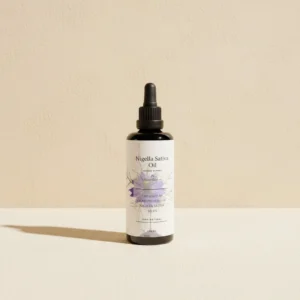
Nigella sativa — Syrian-origin cold-pressed black seed oil with the highest thymoquinone concentration available, documented across 2,000+ peer-reviewed studies for anti-inflammatory, antimicrobial, and antioxidant activity
What is Nigella sativa — and why Syrian origin matters
Nigella sativa is an annual flowering plant in the Ranunculaceae family, native to southwestern Asia, the eastern Mediterranean, and northern Africa. In English it is known as black seed, black cumin, kalonji, or fennel flower; in Spanish as comino negro, semilla negra, or nigella; in Arabic as habba sawda or habbat al-barakah (“the blessed seed“).
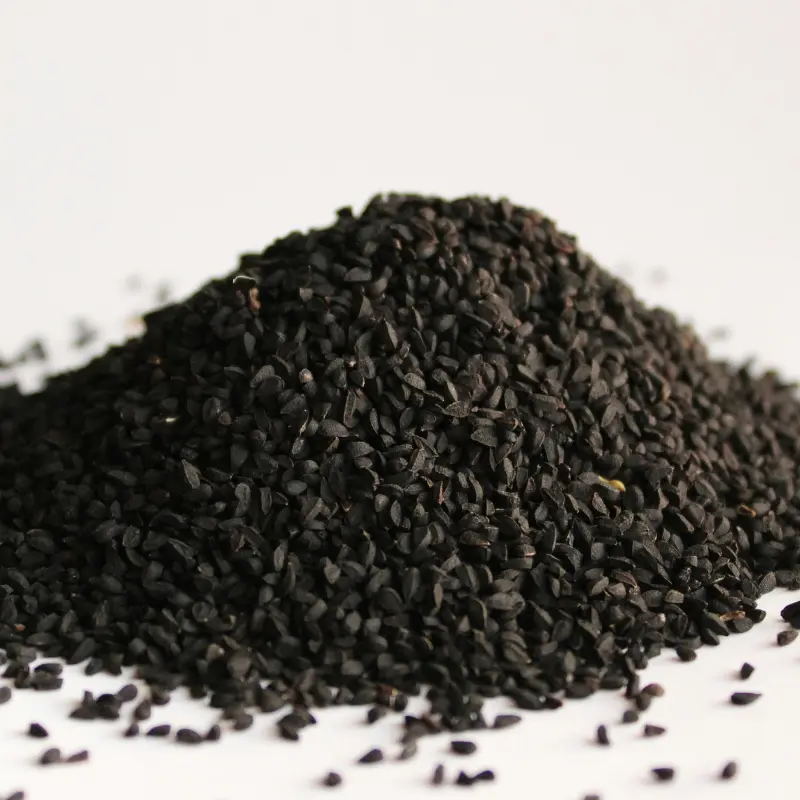
The plant grows 20–30 cm tall with finely divided leaves and delicate pale blue-white flowers. After flowering, it produces inflated seed capsules containing numerous small, angular, intensely black seeds — from 1–1.5mm in size — with a rough surface, oily white interior, and a distinctive aromatic pungency described as combining black pepper, oregano, and slight bitterness.
Why Syrian origin matters:
Thymoquinone concentration in Nigella sativa oil varies significantly by geographic origin — influenced by soil composition, climate, altitude, and traditional cultivation practices. Syrian black seed, grown in the Levantine highland conditions of Syria, is occupying the third highest thymoquinone content in analytical studies after Ethiopian and Egyptian. Since thymoquinone is the primary compound responsible for most of the oil’s studied biological activity, origin is not a marketing variable — it is a functional quality determinant. Azara Natural sources specifically from Syria for this reason.
Cold pressing:
Cold pressing from raw, uncleaned seeds preserves thymoquinone at its natural concentration. Heat extraction degrades thymoquinone. Solvent extraction may leave residues that compromises both safety and active compound integrity. Unrefined cold-pressed Nigella sativa oil has a dark amber to brownish colour, a distinctive strong aromatic scent, and a slightly bitter, peppery taste — characteristic of high thymoquinone and volatile compound content.
Thymoquinone: the compound that explains 2,000 studies
Thymoquinone (2-isopropyl-5-methyl-1,4-benzoquinone) is a quinone — a class of organic compounds found in relatively few plant sources at therapeutically meaningful concentration. In Nigella sativa, it is present at 0.5–1.5% of the oil’s total composition depending on origin, with Syrian seed at the higher end of this range.
What thymoquinone does — confirmed across published research:
Anti-inflammatory mechanism:
Thymoquinone inhibits NF-κB — the master transcription factor that regulates the expression of pro-inflammatory genes. NF-κB inhibition reduces the production of inflammatory cytokines including IL-1β, IL-6, and TNF-α. This is the same general pathway targeted by some pharmaceutical anti-inflammatory compounds, through a different mechanism. For skin, this translates to reduced redness, swelling, and inflammatory reactivity — directly relevant for acne, psoriasis, eczema, and rosacea.
Antimicrobial activity:
Thymoquinone has documented activity against multiple dermatologically relevant pathogens: Staphylococcus aureus (implicated in infected eczema and acne), Pseudomonas aeruginosa, Candida albicans, and Malassezia species (the primary fungal genus in dandruff and seborrheic dermatitis). This makes black seed oil specifically relevant for acne, scalp conditions, and skin prone to recurrent infections.
Antioxidant protection:
Thymoquinone is a potent free-radical scavenger — neutralising oxidative stress from UV radiation, pollution, and metabolic processes that degrade collagen and elastin. For a market like Spain with high annual UV exposure, this antioxidant protection at the skin’s surface is directly relevant to managing photoaging.
Linoleic acid (omega-6) at 55–60%:
Black seed oil’s second major therapeutic component. Linoleic acid is deficient in the sebum of oily and acne-prone skin — topical application helps rebalance sebum composition, reducing the overproduction that feeds C. acnes bacteria. This mechanism, combined with thymoquinone’s direct antimicrobial activity, makes black seed oil a particularly targeted choice for oily, acne-prone, and congested skin.
Skin benefits: acne, eczema, psoriasis, and anti-aging
Acne-prone and oily skin:
Black seed oil addresses acne through three simultaneous mechanisms that no single pharmaceutical typically covers: antimicrobial activity against C. acnes, anti-inflammatory reduction of the inflammatory response to bacterial presence, and linoleic acid rebalancing of sebum composition. A clinical study published in the Journal of Dermatology & Dermatologic Surgery found that topical black seed oil produced a significant reduction in acne lesion count compared to control — making it one of the few botanical oils with direct acne clinical trial evidence.
Eczema and psoriasis:
Thymoquinone’s NF-κB inhibition directly addresses the inflammatory cascade driving both eczema flares and psoriasis plaques. Several studies have demonstrated significant improvement in eczema severity scores following topical black seed oil application. For psoriasis, the anti-inflammatory and antimicrobial mechanisms together address both the inflammatory hyperproliferation and the microbial component.
Anti-aging and antioxidant protection:
Black seed oil’s thymoquinone + vitamin E antioxidant combination provides comprehensive oxidative protection at the skin surface. Consistent application protects collagen and elastin from free radical degradation, supporting structural skin integrity over time. For the Spanish and European market where Mediterranean UV exposure is sustained across long summer seasons, this antioxidant layer is particularly relevant.
Sensitive and reactive skin:
The combination of anti-inflammatory and barrier-supporting properties makes black seed oil appropriate for sensitive skin types, despite its strong aromatic character. Start with a small amount to assess individual skin tolerance.
Hair and scalp benefits
Dandruff and seborrheic dermatitis:
Thymoquinone’s antimicrobial activity against Malassezia species addresses the primary microbial driver of dandruff. Combined with its anti-inflammatory mechanism that reduces scalp inflammation, black seed oil targets both the organism and the inflammatory response it generates — making it one of the most mechanistically targeted botanical oils for scalp conditions.
Hair loss and thinning:
NF-κB activation is implicated in follicle miniaturisation and inflammation-driven hair loss. Thymoquinone’s NF-κB inhibition supports the scalp environment against the inflammatory processes that contribute to progressive thinning. Clinical studies have documented reduced hair loss and improved hair density with regular black seed oil scalp application.
Scalp microbiome balance:
Black seed oil’s selective antimicrobial activity — active against pathogenic species while being compatible with the scalp’s commensal microbiome — makes it appropriate for scalp microbiome rebalancing without the broad-spectrum disruption of pharmaceutical antifungal shampoos.
Application: Apply 5–10 drops to scalp sections, massage firmly for 5 minutes. Leave 30–60 minutes before washing. Twice weekly for established conditions; once weekly for maintenance. Black seed oil has a strong scent — apply the evening before washing to allow the scent to dissipate.
Black seed oil in massage: Middle Eastern tradition meets modern anti-inflammatory science
Black seed oil has a documented history in Middle Eastern massage and therapeutic body oiling traditions — particularly in Arab, Turkish, and Persian medicinal practice where it was used as a warming, anti-inflammatory body oil applied with firm massage strokes for joint pain, muscle tension, and skin conditions.
Traditional therapeutic massage applications:
In Islamic medicine (Tibb al-Nabawi), black seed oil was applied to affected body areas through massage for inflammatory joint conditions, rheumatic pain, and skin conditions. This traditional use aligns well with the modern phytochemical understanding of thymoquinone’s NF-κB inhibition and anti-inflammatory mechanism — the empirical practice and the scientific mechanism match.
Anti-inflammatory body massage:
At 20–30% in a base carrier (sweet almond or sesame oil), black seed oil contributes thymoquinone’s anti-inflammatory activity to the massage formulation. For clients with inflammatory skin conditions (psoriasis, eczema, rosacea), incorporating black seed in the massage oil reduces the inflammatory reactivity of treated skin during and after the massage. The anti-inflammatory compounds are active at the skin surface throughout the session.
Scalp massage (most effective single application):
Scalp massage with black seed oil combines: thymoquinone’s antimicrobial activity against Malassezia (dandruff) and S. aureus, anti-inflammatory NF-κB inhibition reducing scalp inflammation, and the mechanical circulation stimulation of scalp massage itself. This is arguably black seed oil’s most targeted single application — addressing multiple dandruff and hair loss mechanisms simultaneously. Apply 5–10 drops neat or in a blend to scalp sections, massage firmly for 5–10 minutes.
How to identify genuine cold-pressed black seed oil
– “Odourless black seed oil” or “deodorised black seed oil” = refined, thymoquinone-depleted
– Pale yellow or colourless black seed oil = refined
– Mild or neutral-scented black seed oil = processed
– Prices significantly lower than genuine cold-pressed versions may indicate refined product
Colour: Dark amber to brownish — the characteristic colour of unrefined Nigella sativa oil. Light yellow or golden “black seed oil” has been refined or is not genuine.
Scent: Distinctive, strong, aromatic — described as combining black pepper, oregano, and slight bitterness. An odourless or mildly scented “black seed oil” has been deodorised (refined) or adulterated.
Taste: A small amount on the tip of the tongue should taste distinctly bitter and slightly peppery — characteristic of thymoquinone presence. Neutral-tasting black seed oil lacks thymoquinone at meaningful concentration.
Origin disclosure: Syrian, Egyptian, and Ethiopian origins are among the highest thymoquinone sources. Ask for the botanical origin certificate. Unlabelled “black seed oil” without origin disclosure cannot be verified for thymoquinone content.
Packaging: Dark glass, UV-protecting. Black seed oil’s thymoquinone is relatively stable compared to highly polyunsaturated oils, but UV protection remains important for overall quality preservation.
The specific difference for black seed:
Buying refined black seed oil for its therapeutic properties is buying a product stripped of the primary compound responsible for those properties. It is the equivalent of buying decaffeinated coffee for the caffeine effect — the delivery vehicle is there, the active is not. Cold-pressed, unrefined, dark amber, strongly aromatic black seed oil from a disclosed geographic origin is the only version that delivers what the research literature demonstrates.
Azara Natural's Black Seed Oil is cold-pressed from Syrian Nigella sativa seeds — the highest-thymoquinone origin — in UV-protecting dark glass. Unrefined. No additives. Syrian origin confirmed. The most complete version of the oil 2,000 studies have investigated.
Get Azara Natural Syrian Black Seed OilFrequently Asked Questions
Black seed oil (aceite de comino negro / aceite de nigella) is most specifically beneficial for acne-prone and oily skin, eczema and psoriasis, and inflammatory skin conditions — because its thymoquinone content delivers antimicrobial, anti-inflammatory, and antioxidant mechanisms that directly address the biology of these conditions. For general skin health, its combination of thymoquinone antioxidant protection and linoleic acid barrier support makes it broadly beneficial for most skin types. Its strong scent means some users prefer to use it in the evening or in blended formulations rather than as a standalone daytime facial oil.
Yes — all three names refer to the same oil from the same plant, Nigella sativa. In Spanish, you’ll find it labelled as aceite de comino negro, aceite de semilla negra, or aceite de nigella. In Arabic markets and traditional medicine contexts it is habba sawda or aceite de kalonji. The botanical identity is consistent regardless of the name. The quality variables that matter — origin, extraction method (cold-pressed), and thymoquinone content — are independent of the name used on the label.
Oral black seed oil capsules deliver thymoquinone systemically — through digestion and blood circulation — with potential systemic anti-inflammatory benefits. Topical cold-pressed black seed oil delivers thymoquinone directly to the skin surface and superficial tissue layers, where it acts at the site of application with higher local concentration than oral delivery achieves topically. The two routes are complementary rather than equivalent — topical application is more directly relevant for skin and scalp conditions; oral supplementation may contribute to systemic inflammatory and immune regulation. For skin and scalp conditions specifically, topical cold-pressed application is the more direct intervention.
Genuine cold-pressed black seed oil has a strong, distinctive aromatic scent — peppery, oregano-like, somewhat pungent. The intensity is directly related to thymoquinone content: a stronger scent generally indicates higher quality. To manage the scent: apply in the evening before bed rather than the morning; blend with other oils (sweet almond, chia, radish seed) at 20–30% black seed to 70–80% blended oils, which dilutes the scent while preserving meaningful active concentration; or apply to the scalp where the scent dissipates before morning. The scent reduces as the oil absorbs into skin — typically within 30–60 minutes of application.