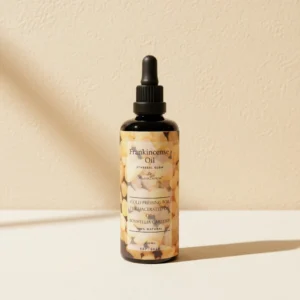
Boswellia carterii / serrata — cold-macerated frankincense resin extract delivering boswellic acids for MMP inhibition, fibroblast stimulation, and collagen-level anti-aging support — confirmed in a 2010 randomized double-blind clinical trial
Frankincense: the resin, the tree, and the critical extraction distinction
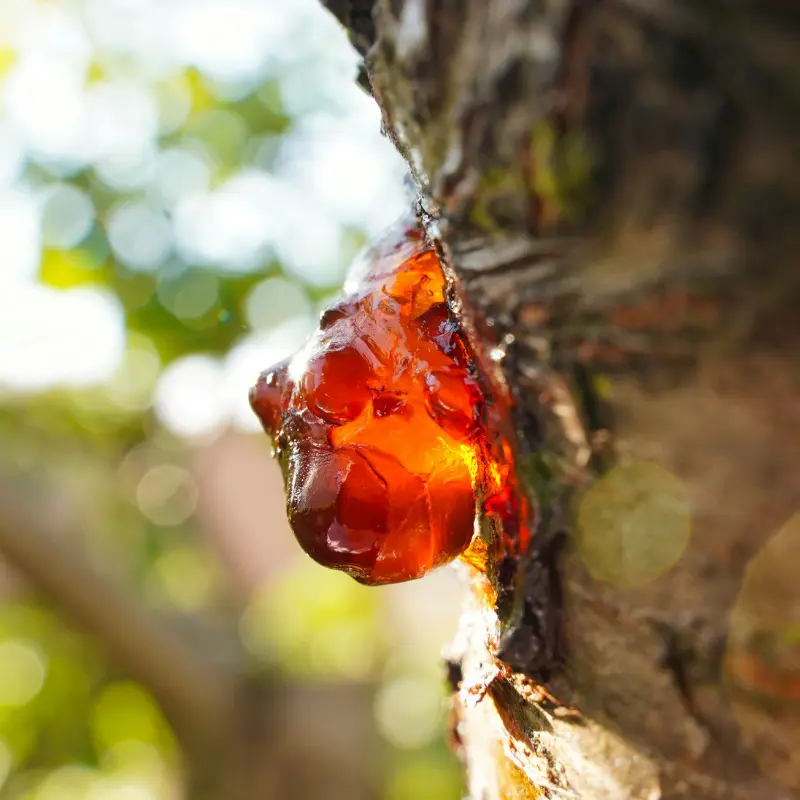
Frankincense is a resin produced by trees of the genus Boswellia — a group of shrubby trees native to arid regions of northeastern Africa (Somalia, Ethiopia, Eritrea) and the southern Arabian Peninsula (Oman, Yemen), with some species in India. The resin is obtained by making incisions in the bark, allowing the milky sap to flow out and harden into the amber “tears” that have been traded for over 5,000 years.
The principal Boswellia species used in cosmetics and natural medicine are:
– Boswellia serrata — native to India; the most extensively researched species for boswellic acid content; used in Ayurvedic medicine
– Boswellia carterii — native to Somalia and Ethiopia; the most commonly traded and historically significant for incense
– Boswellia sacra — native to Oman and Yemen; considered by many to produce the highest-quality aromatic resin
The extraction distinction that determines efficacy:
Steam-distilled frankincense essential oil:
High-temperature steam volatilises the aromatic fraction of the resin — primarily alpha-pinene, limonene, p-cymene, and other terpenes. These produce frankincense’s characteristic resinous, woody aroma. The boswellic acids — the non-volatile, high-molecular-weight triterpenes with documented anti-aging clinical evidence — do not carry over in meaningful concentrations during steam distillation. They remain in the spent resin material after distillation.
Cold-macerated frankincense resin extract (Azara Natural’s approach):
The frankincense resin (not plant material, specifically the resin) is cold-infused in a carrier oil base. This process extracts both aromatic compounds AND the non-volatile boswellic acid fraction. The result is an oil that contains boswellic acids — the clinically relevant active compounds — in a skin-compatible lipid vehicle.
This distinction is not a minor technical detail — it is the difference between a product that contains the compounds the research supports and one that primarily contains their aromatic relatives.
Ancient heritage: from the Incense Route to modern dermatology
Frankincense was among the most valuable commodities of the ancient world — rivalling gold and silk at the height of the incense trade. The Boswellia resin’s use spans virtually every ancient civilization: ancient Egypt (documented in the Ebers Papyrus, circa 1550 BCE, for skin and wound preparations), ancient Greece and Rome (burnt in temples and used medicinally), the ancient Levant (the Islamic Medicine), traditional Chinese medicine (ru xiang), Ayurveda (shallaki, one of the most important Ayurvedic botanicals), and traditional Arab medicine documented by Ibn Sina.
The Old and New Testaments mention frankincense repeatedly — as one of the three gifts of the Magi to the newborn Jesus, as a component of the holy incense of Exodus, and throughout the Psalms. Islamic tradition similarly documents its medicinal and spiritual use. Frankincense remedies appear in the Syriac Book of Medicine.
In Spain, frankincense (incienso or olíbano in Spanish) remains recognized in traditional pharmacy and religious practice. The Boswellia resin continues to be burned in Catholic and Orthodox church services across Spain and Europe as part of an unbroken 2,000-year tradition.
The clinical evidence: what the research actually confirms
The Pedretti 2010 randomized double-blind split-face study (Planta Medica):
This is the most important clinical reference for topical boswellic acids. The study applied 0.5% boswellic acid cream to one side of the face and control to the other for 30 days. Results, confirmed by non-invasive diagnostic measurement:
– Significant improvement in photoaging score
– Measurable reduction in fine lines and wrinkle depth
– Improved skin roughness and texture
– Changes in echographic parameters consistent with collagen remodeling in the dermis
Mechanism — dual collagen action:
Boswellic acids inhibit matrix metalloproteinase (MMP) enzymes — the enzymes that degrade existing collagen and elastin in aging skin. Simultaneously, they stimulate fibroblast activity, supporting new collagen and elastin synthesis. This dual mechanism — inhibiting degradation while supporting synthesis — directly addresses the primary structural mechanism of skin aging.
NF-κB inhibition — anti-inflammatory mechanism:
Boswellic acids, particularly AKBA (acetyl-11-keto-β-boswellic acid), are documented NF-κB inhibitors — the same anti-inflammatory mechanism as pharmaceutical NSAIDs, but through a different receptor pathway and without their gastrointestinal risk profile. For inflammatory skin conditions including rosacea, acne, and eczema, this NF-κB inhibition is directly relevant.
Skin benefits: anti-aging, anti-inflammatory, and skin tone
Fine line and firmness improvement:
Boswellic acid MMP inhibition and fibroblast stimulation produce the anti-aging effects confirmed in the Pedretti trial. For facial skin showing early structural aging — fine lines around the eyes, nasolabial area, and forehead — consistent frankincense resin macerate application supports the structural skin environment over the 30-day cell turnover cycle.
Anti-inflammatory skin calming:
NF-κB inhibition reduces the pro-inflammatory cytokine production driving redness, reactivity, and inflammatory skin conditions. For rosacea-prone skin — common in fair-skinned European populations — frankincense’s anti-inflammatory mechanism is particularly relevant.
Scar appearance support:
The same collagen-remodeling mechanisms relevant to fine lines are relevant to scar tissue remodeling. Early post-healing scar tissue is rich in disorganized collagen; the MMP inhibition and fibroblast stimulation of boswellic acids support the gradual reorganization of scar collagen over months of consistent application.
Skin tone and texture:
Toning and astringent properties of the resin extract contribute to a more even, refined-looking skin surface. Traditional Levantine use of frankincense preparations for maintaining skin tone and complexion reflects a mechanism now partially confirmed in the structural dermatology research.
Frankincense oil in massage: anti-inflammatory and grounding
Frankincense has been used in ceremonial and therapeutic contexts for over 5,000 years — a duration that in itself suggests its aromatic and calming properties have been found consistently valuable across cultures and traditions.
Anti-inflammatory therapeutic massage:
For massage targeting inflamed joints, arthritic areas, or skin conditions with an inflammatory component, frankincense resin macerate at 15–20% in a carrier blend adds boswellic acid’s NF-κB inhibitory mechanism to the massage application. This is complementary to but different from the warming anti-inflammatory mechanism of ginger, camphor, or black pepper — frankincense inhibits the inflammatory pathway rather than warming the area.
Grounding and meditative massage:
The woody, resinous aroma of frankincense has a well-documented effect on breathing and psychological state — traditionally described as “slowing and deepening the breath” and promoting meditative calm. In aromatherapy massage contexts, this aromatic quality supports the relaxation response and the nervous system shift from sympathetic to parasympathetic engagement.
Facial massage (anti-aging):
Frankincense resin macerate in a facial massage carrier — combined with rose or damask hydrosol — creates an anti-aging facial massage medium that delivers boswellic acid to the dermal collagen environment through both direct absorption and the massage-enhanced skin penetration.
Massage types most suited to frankincense macerate: Facial anti-aging massage, meditative/spiritual massage, joint and anti-inflammatory massage, aromatherapy massage, scar tissue massage.
Essential oil vs resin extract: what each is, what each is best for, and the skin claim question
Steam-distilled frankincense essential oil
Contains the volatile aromatic terpene fraction — primarily alpha-pinene (35–50%), limonene, p-cymene, beta-caryophyllene, and other terpenes. Produces frankincense’s distinctive resinous, woody aroma. Does NOT contain boswellic acids at clinically meaningful concentrations — they are large, non-volatile triterpenes that remain in the spent resin after distillation.
Best for: aromatherapy, grounding meditation practice, diffusion, diluted massage where aromatic intent and the terpene anti-inflammatory mechanism (particularly from beta-caryophyllene’s CB2 activity) are the goal. For joint massage at 1–2% dilution in a carrier, the terpene anti-inflammatory activity provides real benefit — different from but complementary to boswellic acid’s NF-κB inhibition. The honest skin.
Price: €15–40 for 10ml of genuine Boswellia carterii or serrata essential oil from reputable suppliers.
Cold-macerated resin extract (Azara Natural)
Frankincense resin cold-infused in a carrier oil — extracting both aromatic terpene compounds AND the non-volatile boswellic acid fraction (the clinically relevant anti-aging actives). More complete phytochemical profile than essential oil, more skin-appropriate concentration, directly applicable as a leave-on product without dilution concerns.
Best for: anti-aging facial care (fine lines, firmness support), body firming routines, inflammatory skin conditions (rosacea, eczema), scar tissue support, joint and inflammation-targeted massage, and any application where the Pedretti trial’s documented boswellic acid effects are the intended benefit. This is the form where the clinical anti-aging evidence actually applies — daily leave-on use, appropriate for all skin types including sensitive and mature.
Price: €25–64 for 50–100ml. More expensive than a basic carrier oil, reflecting the resin material cost and extended maceration time — significantly less expensive than clinical RSCE preparations or pharmaceutical boswellic acid formulations.
Azara Natural's Frankincense Oil is cold-macerated from Boswellia resin — delivering boswellic acids in a skin-appropriate carrier. The form containing the compounds the 2010 Pedretti randomized trial confirmed for fine line and collagen remodeling support. Formulated into the Facial Care Blend and Body Care Blend.
Get Azara Natural Frankincense OilFrequently Asked Questions
Cold-macerated frankincense resin extract is most specifically beneficial for anti-aging skin support — fine line appearance, skin firmness, and structural skin health — through its boswellic acid content. A 2010 randomized double-blind clinical study confirmed these effects at 0.5% boswellic acid concentration over 30 days. It is additionally anti-inflammatory through NF-κB inhibition — relevant for rosacea-prone, reactive, and inflammatory skin conditions. Its toning astringency supports an even, refined skin surface appearance. It is not a replacement for pharmaceutical retinoids for aggressive photoaging intervention, but provides collagen-level structural support through a completely different and independently documented pathway — with no vitamin A accumulation risk, no EU restriction concern, and appropriate for all skin types including pregnancy (though always consult a healthcare provider).
No — they are meaningfully different products. Frankincense essential oil (from steam distillation) contains primarily volatile terpenes (alpha-pinene, limonene, p-cymene) — the aromatic fraction of the resin. It contains minimal boswellic acid content because boswellic acids are large, non-volatile molecules that do not carry over in steam distillation. Azara Natural’s frankincense oil is a cold macerate of the frankincense resin — extracting both aromatic compounds and boswellic acids into a carrier oil. This is the form containing the compounds that the 2010 Pedretti randomized clinical trial documented for anti-aging skin effects.
Frankincense resin macerate does not work through vitamin A pathways and carries none of the retinoid-related pregnancy contraindications. NF-κB inhibition through boswellic acids also has a different risk profile from pharmaceutical anti-inflammatory medications. As with all skincare during pregnancy, the appropriate approach is to consult your healthcare provider or midwife before using new products. The general absence of the specific contraindications associated with retinoids and some essential oil compounds makes frankincense macerate a relatively lower-risk option — but the standard caution applies and professional guidance is always appropriate during pregnancy.