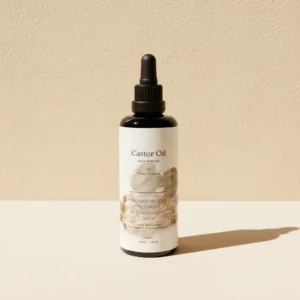
Ricinus communis — cold-pressed castor oil with 85–90% ricinoleic acid, nature's most concentrated source of this unique hydroxy fatty acid for hair growth, scalp health, and deep skin conditioning
What is castor oil — the chemistry that makes it unique
Castor oil is extracted by cold pressing the seeds of Ricinus communis — a plant native to eastern Africa and the Indian subcontinent, now cultivated across tropical and subtropical regions including parts of southern Spain and the Mediterranean.
The defining characteristic of castor oil is its fatty acid profile — unlike any other commonly used plant oil:
Ricinoleic acid: 85–90%
Ricinoleic acid (12-hydroxy-9-cis-octadecenoic acid) is a hydroxy fatty acid — a fatty acid with a hydroxyl group (-OH) attached to its carbon chain.
This hydroxyl group is responsible for:
– Castor oil’s extraordinary viscosity (thicker than any other botanical oil)
– Its high polarity, making it unusual among oils in its ability to draw moisture
– Its documented antimicrobial activity — the hydroxyl group disrupts bacterial and fungal cell membranes
– Its anti-inflammatory mechanism — ricinoleic acid activates EP3 prostaglandin receptors, modulating the inflammatory cascade
Important correction from common descriptions
Ricinoleic acid is frequently mislabelled as “omega-9” in natural beauty content. This is inaccurate. It is a hydroxy fatty acid, classified separately from omega fatty acids due to the hydroxyl group modification. Its biological activity comes from this hydroxyl group — not from an omega designation.
Remaining composition:
– Linoleic acid (omega-6): 3–5%
– Oleic acid (omega-9): 2–4%
– Stearic acid: 1–2%
– Palmitic acid: 1%
– Vitamin E (tocopherols): present in cold-pressed unrefined versions
Appearance:
Pale yellow to golden, very viscous — the most viscous of all common botanical oils. Cold-pressed unrefined castor oil has a mild, characteristic scent. Odourless versions have been refined.
Historical use: from ancient Egypt to Ayurveda and European tradition
Castor oil has one of the longest documented histories of any botanical oil in existence.
Ancient Egypt (3000 BCE onwards):
Castor oil was found in Egyptian tombs dating to 4000 years ago. The Ebers Papyrus — one of the oldest medical texts in existence, dating to approximately 1550 BCE — documents its use as a topical oil for skin protection and healing. Cleopatra is recorded as using it in eye preparations.
Ayurveda:
Ricinus communis — known as Eranda in Sanskrit — is one of the 10 most important plants in Ayurvedic pharmacology. Used for both topical skin and hair treatment and oral preparations for digestive health and joint support.
European folk medicine:
In Spain (aceite de ricino) and across Mediterranean Europe, castor oil has been used for centuries as a topical treatment for dry skin, scalp conditions, and hair strengthening. It remains one of the most commonly sold individual plant oils in Spanish pharmacies and natural health stores — its use deeply embedded in household medicine traditions.
Industrial and pharmaceutical use:
Castor oil’s unique chemistry made it valuable in industrial lubricants, pharmaceutical excipients (it is a listed ingredient in many EU-approved pharmaceutical preparations), and cosmetic formulation globally. Its safety profile at cosmetic concentrations is among the most extensively documented of any botanical ingredient.
Skin benefits: hydration, antimicrobial, wound healing
Deep conditioning and moisture retention:
Ricinoleic acid’s hydroxyl group makes castor oil highly hygroscopic — it draws moisture from the environment toward the skin surface. This humectant property, combined with its occlusive viscosity, makes castor oil one of the most effective botanical oils for very dry, cracked, or compromised skin areas: heels, elbows, cuticles, and chapped lips. Applied alone, castor oil’s viscosity can feel too thick for full facial application — blended with a lighter oil (sweet almond, radish seed) at 10–20%, it delivers deep conditioning without residue.
Antimicrobial activity:
Ricinoleic acid has documented activity against a range of bacteria and fungi relevant to skin conditions. Studies confirm activity against Staphylococcus aureus (implicated in infected eczema and acne), Candida species (relevant to skin fungal conditions), and Malassezia (the fungus implicated in dandruff and seborrheic dermatitis). This makes castor oil specifically relevant for scalp conditions, nail care, and skin prone to microbial imbalance.
Anti-inflammatory mechanism — EP3 receptor activation:
Ricinoleic acid activates prostaglandin EP3 receptors, modulating the inflammatory pathway. This is the same general principle as some pharmaceutical anti-inflammatory compounds — but through a botanical, topically-applied mechanism. The result for skin: reduced redness, swelling, and reactivity in inflammatory skin conditions including acne and rosacea.
Wound healing:
Castor oil forms a protective film over wound sites — documented in pharmaceutical wound care applications. It reduces bacterial exposure to healing tissue and maintains moisture at the wound surface, both of which support faster healing. Traditional use for minor cuts and burns across Mediterranean folk medicine reflects a mechanism now confirmed in pharmacological research.
Hair and scalp benefits: growth, dandruff, strength
Scalp circulation and follicle environment support:
The massage required to apply castor oil to the scalp stimulates local microcirculation — improving blood flow to follicle bases and supporting the nutrient delivery that healthy follicle function requires. Ricinoleic acid’s anti-inflammatory properties reduce the chronic low-grade scalp inflammation that contributes to follicle miniaturisation and hair thinning.
Antimicrobial scalp action:
Castor oil’s activity against Malassezia — the fungal genus implicated in dandruff and seborrheic dermatitis — makes it one of the few botanical oils with a documented mechanism for dandruff management. Applied as a pre-wash scalp treatment consistently, it reduces the microbial load that drives flaking and scalp inflammation.
Hair shaft conditioning and shine:
Ricinoleic acid’s hygroscopic properties draw moisture to the hair shaft while the oil’s viscosity forms a protective surface coating. The result: improved hair flexibility (reducing breakage), higher light reflection from a smoother cuticle surface (visible shine), and reduced frizz from moisture-sealed shaft structure.
Application for hair:
Castor oil should not be applied neat to the hair lengths due to its viscosity — it is difficult to remove without aggressive shampooing. For scalp treatment: apply 10–15 drops to the scalp sections and massage firmly for 5–10 minutes. Leave 1–2 hours minimum (overnight produces better results). For lengths: blend 1 part castor oil with 2–3 parts sweet almond or radish seed oil before applying to avoid heaviness and difficult removal.
Important note:
Castor oil should not be applied to skin undiluted as a primary facial moisturiser — its viscosity and film-forming properties can trap debris in pores. Always dilute with a lighter carrier oil for facial and body applications.
Castor oil in massage: lymphatic drainage, packs, and therapeutic blends
Castor oil has a distinctive and well-documented place in therapeutic massage — different from most carrier oils because its role is rarely as a standalone full-body massage carrier, but rather as a specialised therapeutic component with specific traditional and evidence-supported applications.
Castor oil packs (abdominal massage therapy):
One of the oldest therapeutic applications of castor oil in Ayurvedic and naturopathic medicine. A generous amount of castor oil is applied to the abdomen, covered with a warm cloth (traditionally flannel), and left for 30–60 minutes. Traditional use: digestive support, liver function, lymphatic drainage stimulation, and uterine health support. The warmth from the cloth pack amplifies the ricinoleic acid’s anti-inflammatory and prostaglandin EP3 receptor effects locally. This application is used therapeutically by naturopathic practitioners across Spain and Europe.
Lymphatic drainage massage:
Castor oil’s viscosity and anti-inflammatory ricinoleic acid properties make it suitable for manual lymphatic drainage massage — applied to lymph node areas (neck, armpits, groin) in the gentle, slow, rhythmic movements of lymphatic drainage technique. Its film-forming properties maintain contact throughout the session.
Deep tissue and targeted therapeutic massage:
For very dry, cracked, or chronically tight areas — the soles of the feet, elbows, hands, lower back — castor oil applied at full concentration with deep, slow massage strokes delivers conditioning, anti-inflammatory, and antimicrobial benefits directly to the target tissue. Its viscosity provides sustained contact and slow absorption that keeps the active compounds in contact with tissue throughout a longer massage session.
As a component in massage blends (5–15%):
Blended with lighter carrier oils, castor oil adds conditioning richness and therapeutic depth to massage formulations without the impracticality of using it alone across a full body. The Azara Natural Hair Care Blend and Muscle Care Blend incorporate castor oil for this reason — its ricinoleic acid benefits are active during the massage application, contributing anti-inflammatory and circulatory support.
Full-body massage carrier: Not recommended as a standalone full-body carrier — too viscous for comfortable large-area application and difficult to remove without aggressive washing. Always blend for full-body work.
Massage types most suited to castor oil: Lymphatic drainage massage, castor oil packs, deep tissue on targeted areas, scalp massage, foot massage, hand and nail massage.
Cold-pressed vs refined castor oil: ricinoleic acid vs the complete profile
Castor oil presents a more nuanced refined-vs-cold-pressed picture than most botanical oils — because ricinoleic acid, the primary active, is a hydroxy fatty acid that is more chemically stable than polyunsaturated omega-3 or omega-6 fatty acids. This means refining degrades ricinoleic acid less severely than it degrades ALA in linseed oil. However, the difference is still significant — just in different compounds.
Pharmaceutical-grade refined castor oil (aceite de ricino puro in Spanish pharmacies):
– Colourless and odourless by design
– Ricinoleic acid largely preserved (80–85%) — the refining process removes impurities but the hydroxy fatty acid structure is relatively stable
– Vitamin E (tocopherols) significantly reduced or absent
– Minor phytochemicals (polyphenols, pigments) removed
– Primarily intended for pharmaceutical oral use (laxative) and industrial applications
– Safe for topical cosmetic use but lacks the full profile of cold-pressed versions
Cold-pressed unrefined castor oil:
– Pale golden colour — characteristic of intact carotenoid and phytosterol content
– Ricinoleic acid at 85–90% — the same mechanism, with the additional benefit of…
– Vitamin E (tocopherols) — antioxidant protection for both skin and the oil’s own stability
– Minor phenolic compounds — small but present, contributing complementary antioxidant activity
– Characteristic mild scent — evidence of intact volatile aromatic compounds
The specific difference for castor:
Refined castor oil retains its core active (ricinoleic acid) but loses the supporting cast of vitamin E and minor phytochemicals. For purely moisturising and antimicrobial applications, pharmaceutical castor oil is functional. For applications where vitamin E skin protection and the complete phytochemical profile are relevant (sensitive skin care, anti-aging applications, hair care seeking full botanical benefit), cold-pressed is the appropriate choice.
Hexane-extracted castor oil:
A further step below refined — solvent extraction using hexane produces the highest yield but potentially leaves solvent residues and removes the most phytochemicals. Avoid for cosmetic use where food-grade or cosmetic-certified cold-pressed is available.
How to identify genuine cold-pressed, unrefined castor oil
Colour: Genuine cold-pressed unrefined castor oil is pale yellow to golden — never colourless. Colourless castor oil has been refined (bleached), removing vitamin E and some beneficial compounds.
Viscosity: Cold-pressed castor oil is the most viscous of all common botanical oils — it pours slowly, stretches between fingers, and does not flow freely. Watery or thin castor oil has been diluted or adulterated.
Scent: A mild, characteristic scent — slightly earthy. Odourless castor oil has been refined. Strongly unpleasant scent indicates rancidity.
Purity test: Place a drop between thumb and forefinger and rub — genuine castor oil leaves a tacky, sticky film. This is the ricinoleic acid’s hydroxyl group creating its characteristic skin feel. Castor oils that feel like standard light oils on skin have been adulterated.
Packaging: Dark glass for cold-pressed versions. The ricinoleic acid content is relatively stable to oxidation compared to polyunsaturated oils, but vitamin E and other minor compounds benefit from UV protection.
Azara Natural's Castor Oil is cold-pressed from Ricinus communis seeds — unrefined, preserving the vitamin E and full ricinoleic acid content in UV-protecting dark glass. Used in the Hair Care Blend and Muscle Care Blend for its antimicrobial, anti-inflammatory, and deep conditioning properties.
Get Azara Natural Castor OilFrequently Asked Questions
Castor oil does not directly stimulate hair follicle biology in the way pharmaceutical minoxidil does — there is no clinical trial showing castor oil alone produces the same follicle-level changes as clinical hair growth treatments. What is accurately documented: ricinoleic acid’s anti-inflammatory properties reduce the scalp inflammation that contributes to follicle miniaturisation; its antimicrobial activity against Malassezia improves the scalp microbiome environment for healthy follicle function; and the physical massage required for scalp application improves local microcirculation. These mechanisms create conditions more favourable to healthy hair retention and growth — but castor oil works on the scalp environment, not directly on follicle biology. Consistent use (twice weekly scalp treatment) over 2–3 months is required to assess its effect.
Castor oil should not be applied neat to the face as a primary moisturiser — its extreme viscosity can trap debris in pores and cause congestion in oily or acne-prone skin types. It is well-suited for spot application on very dry areas (under-eye, lip line, dry patches), where its deep conditioning and anti-inflammatory properties are beneficial. Blended at 10–20% with lighter oils (sweet almond, chia seed, radish seed), it contributes conditioning without the congestion risk. For the scalp and hair it can be used at higher concentrations as a pre-wash treatment.
These are two distinct products with different compositions. Cold-pressed castor oil is extracted mechanically from raw seeds without heat — preserving the pale colour, vitamin E content, and the ricinoleic acid’s native form. Jamaican Black Castor Oil (JBCO) is produced by roasting the seeds before pressing, which produces an ash-containing oil with a dark brown colour and distinctive scent. The roasting changes the oil’s pH and introduces different compounds. Cold-pressed is gentler and more appropriate for skin applications; JBCO is typically used specifically for hair and scalp, where some users prefer its scent and traditional formulation. Azara Natural produces cold-pressed castor oil.
Yes — castor oil is one of the most widely used botanical oils for eyelash and eyebrow conditioning, and its safety profile for this use is well-established from decades of cosmetic use. Apply a very small amount with a clean mascara brush or cotton swab to lash roots and brow hairs before bed. The ricinoleic acid conditions the lash shaft, reduces brittleness, and the anti-inflammatory properties support the follicle environment at the lash line. There is no clinical evidence that castor oil produces dramatic lash lengthening — but consistent conditioning visibly improves lash and brow health over weeks of regular use.