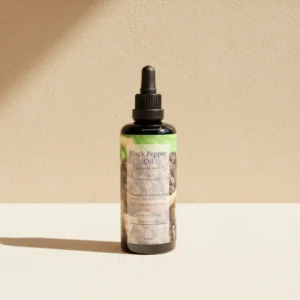
Piper nigrum — cold-macerated black pepper oil with piperine, beta-caryophyllene, and documented vasodilatory and anti-inflammatory activity for scalp circulation, skin vitality, and topical warmth
Black pepper macerate vs. essential oil — why the method matters
There are two fundamentally different ways to extract beneficial compounds from black peppercorns (Piper nigrum), and the difference is significant for skin and hair applications.
Steam-distilled essential oil: High-temperature steam volatilises and carries over the aromatic terpene fraction — primarily limonene, beta-caryophyllene, pinene, and other terpenes. The resulting essential oil is highly concentrated, highly aromatic, and contains these volatile terpene compounds at high concentration. It requires significant dilution before skin application (typically 1–2% maximum in a carrier) and should not be applied near the eye area. Some piperine and non-volatile compounds are left behind in the distillation process.
Cold maceration: Crushed peppercorns are immersed in a premium carrier oil at controlled temperature for an extended period. This process extracts both volatile and non-volatile compounds — including piperine, beta-caryophyllene, limonene and other terpenes, and carrier oil fatty acids from the peppercorn itself. The result is a gentler, more complete botanical extract than the essential oil alone:
– Piperine preserved — the primary alkaloid with documented vasodilatory and anti-inflammatory activity
– Beta-caryophyllene preserved — a sesquiterpene with CB2 receptor activity and documented anti-inflammatory potential
– Lower irritation risk — the concentration is inherently lower than essential oil, making it more appropriate for leave-on skin and scalp applications
– Carrier oil base — the fatty acids from the carrier provide conditioning alongside the peppercorn actives
This is why the distinction between macerated oil and essential oil matters clinically, not just commercially.

Key compounds and documented mechanisms
Piperine:
The principal alkaloid in black pepper, responsible for its characteristic pungency and the majority of its studied biological activity:
– Vasodilatory effect: A controlled clinical study published in the Journal of Complementary and Integrative Medicine demonstrated that topical application of black pepper essential oil significantly improved vein visibility and palpability in patients — a direct clinical measure of peripheral vasodilation. Improved peripheral blood flow from topical piperine application has direct relevance for scalp circulation (supporting follicle blood supply) and skin vitality.
– Anti-adipogenic effect in hair follicle stem cells: A 2024 study published in Applied Biological Chemistry found that piperine inhibits adipogenesis in hair follicle stem cells by suppressing PPARγ activity — a mechanism linked to scalp sebum regulation. This suggests piperine may help regulate scalp sebum overproduction, though human hair growth trials for macerated black pepper oil specifically remain limited.
Beta-caryophyllene:
A sesquiterpene that activates CB2 (cannabinoid type 2) receptors in the skin — associated with anti-inflammatory and analgesic effects. CB2 receptor activation has been linked to reduced skin inflammation in multiple dermatological studies. Beta-caryophyllene is shared with clove and black pepper among the most commonly studied CB2-active botanical terpenes.
Terpenes (limonene, pinene):
Antioxidant and mildly antimicrobial terpene compounds that contribute to the oil’s warming aromatic character and provide complementary antioxidant activity at the skin surface.
Fatty acids from carrier and peppercorn:
The carrier oil base provides lipid conditioning — the specific fatty acid profile depends on the carrier used in maceration.
Skin benefits: circulation, antioxidant protection, and vitality
Stimulation of peripheral microcirculation:
The piperine-driven vasodilatory effect increases blood flow to the skin’s capillary network — producing the characteristic warming sensation on topical application and, more importantly, improving oxygen and nutrient delivery to the skin. For skin that appears dull, sluggish, or lacking in radiance — common in colder months across Spain and Europe — improved peripheral circulation directly addresses the biological cause.
Antioxidant protection:
Piperine, beta-caryophyllene, and the terpene fraction collectively provide antioxidant protection against oxidative stress at the skin surface. Studies on human dermal fibroblasts have found that black pepper extracts support tissue remodelling and may contribute to collagen preservation — though the specific evidence for macerated oil on this endpoint in human clinical trials is preliminary.
Anti-inflammatory activity:
The combination of piperine’s documented anti-inflammatory mechanisms and beta-caryophyllene’s CB2 receptor activation creates a botanical anti-inflammatory profile relevant for reactive, inflamed, or redness-prone skin. This is a complementary mechanism, most appropriate as part of a multi-ingredient formulation rather than a standalone treatment for inflammatory skin conditions.
In massage applications:
Sports massage, circulation massage, warming massage, muscle recovery massage, lymphatic drainage (lower limbs), scalp massage, pre-workout preparation massage. Black pepper macerate is particularly effective in massage blends where its warming vasodilatory effect adds active circulatory benefit to the mechanical benefits of massage itself. The combination produces improved tissue perfusion that outlasts the massage session. This is the rationale for its inclusion in the Azara Natural Muscle Care Blend.
Circulation and lymphatic massage:
For clients presenting with poor peripheral circulation — common in older adults, sedentary individuals, or those with circulatory complaints — black pepper macerate in the massage oil provides active vasodilatory support alongside the circulatory mechanical benefits of massage. Applied to the legs in upward effleurage strokes, the combination addresses both the mechanical and pharmacological aspects of circulation support.
Warming massage for joint stiffness:
The warmth generated by piperine combined with the massage action creates a therapeutic thermal environment for stiff joints and tight muscle groups. This is the rationale for black pepper’s inclusion in the Azara Natural Muscle Care Blend alongside ginger, camphor, and mustard — multiple warming mechanisms working together rather than relying on a single compound.
Scalp massage:
Black pepper macerate at 10–15% in a scalp oil blend adds active circulatory stimulation to scalp massage — potentially enhancing the follicle-supporting circulation benefits beyond what a standard scalp massage alone achieves.
Azara Natural's Black Pepper Oil is cold-macerated from Piper nigrum peppercorns — preserving piperine, beta-caryophyllene, and the full terpene fraction in a skin-appropriate base. Formulated into the Relaxing Massage Blend, Muscle Care Blend, and Intimate Massage Blend for its documented circulatory and anti-inflammatory properties.
Get Azara Natural Black Pepper OilFrequently Asked Questions
Black pepper essential oil is produced by steam distillation and contains a highly concentrated volatile terpene fraction — primarily beta-caryophyllene, limonene, and pinene. It is intense, requires significant dilution before skin use, and some compounds (including some piperine) are left behind in the distillation process. Black pepper macerated oil is produced by cold infusion of peppercorns in a carrier oil, extracting both volatile and non-volatile compounds including piperine, terpenes, and carrier fatty acids. The macerate is gentler, more appropriate for leave-on skin use, contains a broader spectrum of peppercorn compounds, and is better suited to daily topical applications than the essential oil.
Black pepper macerate contributes two specific and documented mechanisms to massage blend formulations: piperine-driven peripheral vasodilation and anti-inflammatory activity from beta-caryophyllene’s CB2 receptor engagement. In the context of a massage, these mechanisms add physiological benefit beyond the conditioning role of the carrier oils — making the massage more effective for circulation support and tissue relaxation than a carrier-oil-only formulation would be.
Black pepper macerated oil — as opposed to concentrated essential oil — is suitable for skin application at the concentrations used in formulated products and blended applications. The maceration process produces a gentler concentration than essential oil distillation, with lower risk of sensitisation or irritation. Perform a patch test on the inner forearm 24 hours before first use. Those with very sensitive skin or known sensitisation to spiced botanicals should start with a small amount on a less sensitive area. Do not apply near the eye area. Avoid use on broken, sunburned, or acutely inflamed skin where the vasodilatory warming effect may cause additional discomfort.
Black pepper macerated oil primarily supports peripheral circulation, provides antioxidant protection, and delivers mild anti-inflammatory activity at the skin surface. Its piperine content has a documented vasodilatory effect — confirmed in a clinical study where topical black pepper application improved measurable circulatory markers. For skin, this translates to improved radiance, warmth, and a more vital-looking complexion. It is best used as a component of a multi-ingredient formulation — in massage blends, warming oils, or scalp treatments — rather than as a standalone facial oil, where its aromatic intensity may be too pronounced for daily leave-on use.