You have more microorganisms on your skin than there are stars in the Milky Way. Most of them are keeping you healthy — and most skincare products are slowly killing them
What the skin microbiome actually is — and what it does for you
The term “skin microbiome” refers to the complete community of microorganisms that live on and in the skin — bacteria, fungi, viruses, and archaea — along with their collective genetic material. In healthy skin, these microorganisms exist in a balanced ecosystem, with each species occupying specific niches based on the skin’s temperature, moisture content, pH, and lipid availability.
The most abundant bacterial species on healthy skin include Cutibacterium acnes (formerly Propionibacterium acnes) in sebaceous zones, Staphylococcus epidermidis across most skin surfaces, and Corynebacterium species in moist areas. On the scalp, the Malassezia genus of fungi plays a significant role — it is the primary microorganism involved in dandruff and seborrheic dermatitis when population balance shifts.
What does this ecosystem actually do?
A comprehensive 2025 review published in Molecules, which searched PubMed, Web of Science, Scopus, and Google Scholar through August 2025, identified the following functions of a balanced skin microbiome:
Barrier defence: Commensal bacteria produce antimicrobial peptides (AMPs) that inhibit the colonization of pathogenic organisms — including Staphylococcus aureus, the bacterium associated with atopic dermatitis flares. Staphylococcus epidermidis, in particular, produces bacteriocins that actively compete with and suppress S. aureus.
Immune regulation: The skin microbiome educates the skin’s immune cells — dendritic cells, T-cells, mast cells — establishing a calibrated response that distinguishes commensal organisms from genuine threats. A depleted or dysbiotic microbiome produces an under-educated immune system that overreacts to harmless stimuli: the mechanism behind sensitive, reactive skin.
pH maintenance: Commensal bacteria metabolize sebum into short-chain fatty acids that maintain the skin’s slightly acidic pH (4.5–5.5). This acid mantle is directly antimicrobial — most pathogens cannot thrive in it. Disrupting the microbiome disrupts the pH. Disrupting the pH disrupts the microbiome. The two are inseparable.
Skin aging regulation: A 2025 comprehensive review published in Annals of Dermatology, confirmed that microbiome composition shifts measurably with aging — including reductions in microbial diversity and increases in dysbiotic species — and that these shifts contribute directly to age-related skin changes through inflammatory and barrier-function pathways.
Dysbiosis: what goes wrong and what causes it
Dysbiosis is the term for microbial imbalance — when the diversity and relative populations of the skin microbiome shift away from their healthy baseline. The same 2025 Molecules review identifies the consequences of dysbiosis with remarkable specificity: it contributes to inflammatory and infectious skin diseases and accelerates skin aging. Dysbiosis has been documented as accompanying or driving acne vulgaris, atopic dermatitis (eczema), psoriasis, rosacea, seborrheic dermatitis, and even photoaging.
What causes dysbiosis in skin?
The 2025 review separates causes into exogenous and endogenous:
Exogenous (external) causes:
Cosmetics with antimicrobial preservatives — parabens, phenoxyethanol, benzyl alcohol, formaldehyde-releasing compounds — reduce microbial diversity with every application. They are designed to kill microorganisms in the bottle; they do not become selectively beneficial on the skin. Synthetic fragrances have demonstrated selective antimicrobial activity that disrupts microbiome composition. Harsh sulfate surfactants strip the sebum that commensal bacteria metabolize as food. Anti-pollution skincare with broad-spectrum antimicrobial actives shares this problem.
Endogenous (internal) causes:
Psychological stress is one of the most significant and under acknowledged drivers of skin microbiome disruption. Cortisol release during stress alters skin barrier function, pH, and sebum composition — all of which are environmental inputs that the microbiome depends on for stability. Hormonal fluctuations shift sebum volume and composition, directly affecting the Cutibacterium and Malassezia populations that feed on sebum. Aging reduces microbial diversity as skin physiology changes. Diet, gut microbiome composition, and antibiotic use (oral or topical) all contribute.
The practical implication: most people are disrupting their skin microbiome multiple times daily with the products they apply, in the genuine belief that they are caring for their skin. The disruption is invisible — it doesn’t show up as an immediate reaction. It shows up over months and years as increasing sensitivity, reactive skin, recurring breakouts, and accelerated aging.
How unrefined cold-pressed botanical oils support — rather than disrupt — the skin microbiome
Cold-pressed botanical oils interact with the skin microbiome in a fundamentally different way from preservative-containing emulsions. This difference comes down to their composition and what they don’t contain as much as what they do.
No synthetic antimicrobial preservatives. Single-phase botanical oil products require no water-phase preservation — the most common source of microbiome-disrupting preservatives in conventional skincare. Without water, bacteria cannot grow in the product, so no preservative is needed. The skin receives a lipid-only input that the microbiome’s commensal organisms recognise as compatible with their sebum-based environment.
Selective antimicrobial activity, not broad-spectrum disruption. Some botanical oils contain compounds with documented antimicrobial properties that are selective rather than indiscriminate. Thymoquinone from black seed oil has demonstrated activity against pathogenic S. aureus and Malassezia while being compatible with commensal Staphylococcus epidermidis at cosmetically relevant concentrations — a meaningfully different profile from synthetic broad-spectrum antimicrobials. Lauric acid from cold-pressed coconut oil has documented activity against C. acnes and S. aureus, again with differential effects compared to commensal species. Ricinoleic acid from castor oil contributes antimicrobial and antifungal properties relevant to scalp Malassezia balance.
As a Free Gift from Azara Natural try this blend for a couple of months twice a week. The optimal formulation to balance the scalp microbiome without causing yeast overgrowth is (70%) Sweet almond or Jojoba or MCT oil, (15%) Black Seed oil, (10%) Castor oil, and (5%) Coconut oil.
Lipid provision the microbiome can use. Commensal skin bacteria — particularly Cutibacterium acnes and Malassezia species — metabolize skin lipids as their primary energy source. Cold-pressed botanical fatty acids, being structurally compatible with sebum, integrate into the skin’s lipid environment in ways that support rather than starve the commensal population.
Barrier reinforcement that protects the microbiome’s habitat. The skin microbiome depends on specific barrier conditions — pH, moisture, lipid availability — to maintain population stability. Cold-pressed oils that reinforce the lipid bilayer through fatty acid integration preserve these conditions. A stronger barrier means a more stable microbial habitat.
This is not a claim that botanical oils are probiotic. They are not depositing live bacteria onto the skin.
What they are is microbiome-compatible: they provide lipid inputs, selective antimicrobial activity against specific pathogens, and barrier support — without the broad-spectrum microbial disruption that preservative-containing products produce with every application.
The scalp microbiome: the most neglected ecosystem in hair care
Everything above applies equally — and arguably more urgently — to the scalp.
The scalp microbiome is distinct from the facial and body skin microbiome due to the scalp’s high density of sebaceous glands, a warm, semi-occluded environment (particularly under hair), and specific fungal populations. Malassezia is the dominant fungal genus — it is universally present on healthy scalps and becomes problematic only when population balance shifts, when the wrong species dominates, or when the scalp’s lipid composition changes in ways that support its overgrowth.
Dandruff and seborrheic dermatitis are primarily microbiome-mediated conditions. They are not failures of cleanliness — they are failures of microbiome balance, often triggered or exacerbated by the very anti-dandruff products used to treat them. Most anti-dandruff shampoos use zinc pyrithione or selenium sulfide — broad-spectrum antifungals that temporarily suppress Malassezia at the cost of disrupting the entire scalp microbial ecosystem. The condition frequently returns when treatment stops because the root microbiome imbalance has not been resolved.
Botanical oils with documented Malassezia-relevant antimicrobial activity — black seed oil’s thymoquinone, laurel bay oil’s 1,8-cineole, castor oil’s ricinoleic acid — address the scalp microbiome differently: through selective antimicrobial action that reduces the pathogenic species load without the indiscriminate disruption of broad-spectrum antifungals.
This is the formulation logic behind the Azara Natural Hair Care Blend’s choice of these specific ingredients for its scalp oil phase.
Azara Natural's cold-pressed botanical oils are single-phase, water-free formulations — no synthetic preservatives, no antimicrobial additives, no synthetic fragrance. Compatible with the skin's lipid environment and microbiome by composition rather than by label claim. Explore the full range of individual oils and formulated blends.
Explore the Botanical Oil RangeFrequently Asked Questions
Skin dysbiosis means the skin’s microbial ecosystem has shifted out of its balanced baseline — not necessarily fewer microorganisms, but a different distribution of species, often with pathogenic or inflammatory species overrepresented relative to commensal ones. There is no simple at-home test. The practical signals: chronically sensitive or reactive skin that responds to stimuli it previously tolerated; recurring inflammatory breakouts that don’t respond consistently to topical treatments; persistent redness, rosacea-like flushing, or skin that feels perpetually “irritated” without a clear trigger; dandruff or seborrheic dermatitis that returns after treatment stops. None of these alone confirms dysbiosis, but a pattern of reactive, imbalanced, or cyclically problematic skin is consistent with it. Simplifying your skincare routine — fewer antimicrobial preservatives, no synthetic fragrance, fewer actives — and supporting the barrier with compatible botanical lipids is the most practical starting point.
It depends on the product format. Single-phase botanical oil products — with no water content — require no preservatives because bacteria, mold, and yeast cannot grow without water. This is the preservation advantage of oil-only products: their stability is inherent in their water-free composition. The stability concern for oil-only products is oxidation, not microbial contamination — and that is addressed by appropriate packaging (dark glass), vitamin E content, and storage conditions. Water-containing natural products (emulsions, gels, aloe-based products) do require preservation even with natural formulation, and responsible natural brands use reviewed, lower-risk preservatives such as phenoxyethanol or rosemary extract rather than parabens or formaldehyde-releasers. The safest category for microbiome-sensitive skin is water-free: pure cold-pressed oil blends applied to the skin without emulsifiers, surfactants, or antimicrobial preservatives.
Yes — but it takes time and consistency. The skin microbiome has a degree of resilience: it tends to return toward its individual baseline when disruptive inputs are reduced. The process involves removing microbiome-disrupting products (particularly those with synthetic fragrances and antimicrobial preservatives), simplifying the routine to the minimum effective number of products, strengthening the skin barrier (which is the microbiome’s habitat), and allowing the microbial ecosystem time to rebalance — typically weeks to months rather than days. There is currently no approved topical probiotic product for skin that delivers demonstrated lasting microbiome benefits through live bacterial application. The more evidence-supported approach is removing what disrupts the microbiome and supporting the conditions it needs to self-regulate: intact barrier, compatible lipids, and appropriate pH.
No — and the differences are significant. The face’s sebaceous zones (T-zone, around the nose) are dominated by Cutibacterium species that metabolize sebum. The dry areas of the forearms and legs are dominated by Staphylococcus and Corynebacterium. The scalp has a particularly high Malassezia presence due to its dense sebaceous glands. Moist areas like the armpits and groin have different fungal and bacterial profiles entirely. This is why a product appropriate for facial skin is not automatically appropriate for the scalp, and vice versa: the microbiome you’re interacting with is a different ecosystem, with different dominant species and different lipid and pH requirements. The botanical oils best suited for scalp microbiome support (black seed, castor, laurel bay) differ from those best suited for facial microbiome-compatible care (chia, radish seed, damask rose).
Yes — through two mechanisms. The first is direct: diet influences sebum composition, which is the primary food source for the skin microbiome’s commensal bacteria. A diet high in refined sugars and processed fats alters sebum lipid profiles in ways that benefit pathogenic species over commensal ones. The second is indirect: the gut microbiome and the skin microbiome communicate through the gut-skin axis — a bidirectional relationship in which gut dysbiosis contributes to skin inflammation and microbiome disruption. Fermented foods, dietary fibre (which feeds beneficial gut bacteria), omega-3 fatty acids (which reduce systemic inflammation), and adequate zinc (which supports barrier function and immune regulation at the skin level) are the most evidence-supported dietary interventions for skin microbiome health.
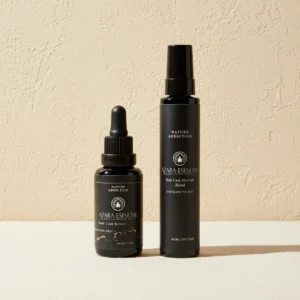
✦ Featured Product
Scalp & Hair Vitality Elixir — Oils & Botanical Mist
40,00 € inc. VAT
View Product →