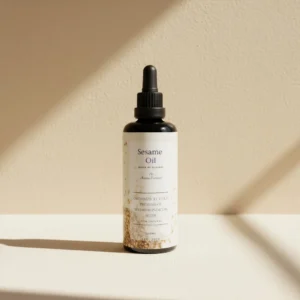
Sesamum indicum — cold-pressed sesame seed oil with sesamol, sesamin, and sesamolin lignans for extraordinary oxidative stability, UV-protective antioxidant support, deep skin conditioning, and hair cortex penetration
What is sesame oil — composition and the lignan distinction
Sesamum indicum L. is an annual flowering plant in the Pedaliaceae family, cultivated across tropical and subtropical Asia, Africa, and the Middle East. The seeds contain approximately 50% oil by weight — one of the highest oil-content cultivated seeds.
Cold-pressed sesame oil composition:
– Oleic acid (omega-9): 35–45%
– Linoleic acid (omega-6): 39–47%
– Palmitic acid: 8–10%
– Stearic acid: 5–6%
– Vitamin E (tocopherols): moderate content
– Sesamol: phenolic antioxidant produced from sesamolin — primary compound responsible for sesame oil’s extraordinary stability
– Sesamin: lignan with anti-inflammatory, antioxidant, and UV-protective properties
– Sesamolin: lignan that converts to sesamol and active compounds — present in significant quantities in cold-pressed versions only
Why the lignans make sesame oil unique:
Most polyunsaturated oils (linseed, chia, rosehip) have limited shelf lives due to rapid oxidation of their omega content. Sesame oil’s lignans — particularly sesamol — are potent antioxidants that protect the oil’s own fatty acids from oxidative degradation. This gives sesame oil an unusually long shelf life (12–18 months unopened, 6–12 months opened) relative to its polyunsaturated content, without any synthetic preservative. Cold-pressed unrefined sesame oil preserves the full lignan content; refined versions have significantly reduced lignan concentrations.
5,000 years of documented use: from Babylon to Levantine tradition
Sesame appears in the oldest written records of human civilisation. The Assyrian creation myths reference sesame wine; the Ebers Papyrus documents sesame oil for medicinal preparations; Hippocrates prescribed sesame for fatigue; Dioscorides documented it for skin and hair in De Materia Medica. The track record spans from the earliest writing systems to contemporary research.
In Ayurveda, sesame oil (tila taila) is the reference oil for abhyanga (traditional oil massage) — classified as warming, penetrating, and rasayana (life-extending). The therapeutic massage tradition using sesame oil in Ayurveda reflects the same penetrating properties documented in modern hair science.
In the Islamic medicine tradition relevant to Azara Natural’s Levantine heritage, sesame oil (duhn al-simsim) appears in Ibn Sina’s formulations for skin, hair, and body care. The Levantine tradition of using sesame in both food and medicine makes it particularly authentic as part of Azara Natural’s Syrian-origin botanical range.
In Spain, ajonjolí (sesame) was introduced during the Moorish period and remains embedded in Spanish cuisine — particularly in Andalusian and Canarian cooking — making it one of the most culturally familiar botanicals for Spanish consumers.
Skin benefits: UV protection, deep conditioning, and anti-inflammatory
UV-protective antioxidant activity:
Sesamin and sesamol have documented UV-absorbing properties — research has found sesame oil exhibits UV-protective activity, absorbing approximately 30% of UV radiation in vitro. This is not sunscreen — it does not meet SPF regulatory standards and cannot be used as a sunscreen substitute. As a supporting antioxidant layer applied beneath sun protection, sesame oil’s lignans provide meaningful oxidative protection against the free radical cascade initiated by UV exposure. For the Spanish market with sustained high UV exposure, this is a relevant additional benefit of consistent sesame use.
Deep conditioning for a wide range of skin types:
The balanced oleic/linoleic profile (~40% of each) makes sesame suitable for more skin types than high-oleic oils (which suit dry/mature) or high-linoleic oils (which suit oily skin). The oleic component provides deep sustained conditioning for mature and dry skin; the linoleic component contributes barrier support and sebum balancing for combination areas. One of the most genuinely multi-skin-type-appropriate carrier oils.
Anti-inflammatory skin calming:
Sesamin’s documented anti-inflammatory activity reduces surface skin reactivity and contributes to calming reactive conditions. Its penetrating properties deliver anti-inflammatory activity deeper into the epidermis than most carrier oils.
Antifungal relevance:
Sesamol has documented antifungal activity against Candida species and some Malassezia strains — relevant for fungal skin conditions and scalp microbiome balance.
Hair benefits: cortex penetration and documented shaft conditioning
Hair cortex penetration:
Sesame oil shares with coconut oil the documented property of penetrating the hair cortex. The 2003 Journal of Cosmetic Science study that confirmed coconut oil’s cortex penetration also studied sesame oil, finding meaningful uptake into the hair shaft. This makes sesame one of very few cold-pressed botanical oils with evidence-based claim to internal hair conditioning rather than surface-only coating.
Scalp circulation and Ayurvedic tradition:
Sesame oil’s warming oleic acid-rich composition combined with scalp massage provides the circulation benefits appropriate for follicle support. Traditional Ayurvedic scalp oiling practice — warming the sesame oil before application — reflects that temperature activation improves both the sensory experience and penetrating behaviour.
Antifungal scalp support:
Sesamol’s antifungal activity against Malassezia species contributes to scalp microbiome balance — complementary to laurel bay and black seed for dandruff management.
Application: Warm 8–12 drops between palms (optional, following Ayurvedic tradition) and apply to scalp sections, massaging for 5–10 minutes. Leave overnight or 1–2 hours before washing.
Sesame oil in massage: the Ayurvedic reference carrier
In Ayurveda, sesame oil is THE reference massage carrier — used in panchakarma and abhyanga as the primary oil. Its Ayurvedic classification as warming, penetrating, and rasayana aligns precisely with its documented oleic acid deep penetration and lignan antioxidant properties in modern phytochemistry — the empirical practice and the scientific mechanism match across 3,000 years.
Full-body Ayurvedic-inspired massage:
Sesame oil warmed to body temperature in full-body abhyanga strokes is the most traditional use of this oil. The warmth enhances penetration, oleic acid provides sustained conditioning, and lignan antioxidants protect both skin and oil throughout the session.
Anti-inflammatory therapeutic massage:
Sesamin’s anti-inflammatory activity makes sesame a functionally active carrier for massage on inflamed or arthritic areas — not merely a lubricant but an anti-inflammatory delivery vehicle. At 50–60% of the carrier blend with specific anti-inflammatory botanicals (turmeric, frankincense, black seed), sesame provides the most bioactive foundation available from a single carrier.
Sports and recovery massage:
Oleic acid’s deeper dermal penetration compared to lighter oils means sesame delivers other botanical actives in a massage blend more deeply into tissue. For sports recovery massage where tissue-level anti-inflammatory activity is the goal, sesame as primary carrier maximises the depth of active compound delivery.
Massage types most suited: Abhyanga and Ayurvedic massage, anti-inflammatory therapeutic massage, sports recovery, full-body relaxation, scalp massage, facial massage for mature/dry skin.
Cold-pressed vs toasted vs refined: three very different products, what each is best for, and price
Cold-pressed unrefined sesame oil (Azara Natural)
Mechanical pressing of raw sesame seeds without heat — preserving the full lignan content (sesamol, sesamin, sesamolin), vitamin E, and balanced fatty acid profile. Pale golden to light amber colour. Mild characteristic slightly nutty scent. Excellent shelf stability (12–18 months unopened) thanks to lignan self-protection.
Best for: all skin and hair applications, Ayurvedic massage, anti-inflammatory therapeutic massage, anti-aging facial and body conditioning, scalp treatment, and formulations where maximum phytochemical benefit is the goal. The most complete form of sesame oil for any therapeutic cosmetic application.
Price: €15–30 for 100–250ml of cold-pressed cosmetic-grade sesame oil. Well-priced for the quality and self-stability it delivers — one of the better-value botanical oils for comprehensive skin and hair benefit.
Toasted sesame oil — NEVER for skin use
Produced from roasted sesame seeds — the heat dramatically changes the aromatic profile (intensely nutty, smoky, dark amber colour). A culinary oil valued for flavour in Asian cooking. The roasting produces new aromatic compounds and partially alters the lignan profile.
Best for: cooking and food flavouring ONLY. Not appropriate for skin or hair applications — the toasting process makes it entirely unsuitable for cosmetic use. This is one of the most important distinctions in sesame oil: a consumer accidentally purchasing toasted sesame oil for cosmetic use will have a completely different and inappropriate product.
Price: similar to cold-pressed for culinary grade — but irrelevant for cosmetic purposes.
Refined sesame oil
Neutral, colourless, odourless. Lignan content significantly reduced through the refining process — the primary quality advantage of sesame (lignan-based stability and antioxidant activity) is largely lost.
Best for: cooking at high temperatures where neutral flavour is required. For cosmetic applications, the lignan removal makes refined sesame oil significantly less interesting than cold-pressed — it becomes a straightforward oleic/linoleic carrier without sesame’s unique phytochemical differentiation.
Price: lower than cold-pressed cosmetic grade. The price difference reflects the quality difference directly — refined sesame oil is noticeably less stable and less therapeutically interesting than cold-pressed.
Azara Natural's Sesame Oil is cold-pressed from Sesamum indicum seeds — preserving the complete lignan profile (sesamol, sesamin, sesamolin) alongside balanced oleic/linoleic conditioning. Formulated into the Facial Care Blend and Hair Care Blend. Available individually for Ayurvedic massage, anti-aging skin care, and hair cortex treatment.
Get Azara Natural Sesame OilFrequently Asked Questions
Colour: Pale golden to light amber — never dark brown or reddish (that is toasted). Never colourless (that is refined).
Scent: Mild, slightly nutty — characteristic of sesame but subtle. Intensely dark and smoky scent = toasted (never use for skin). Odourless = refined.
Shelf life: 18–24 months unopened for cold-pressed — longer than most polyunsaturated oils due to lignan self-protection. If sesame oil “goes off” unusually quickly, the lignan content may be low (refined or poorly cold-pressed).
Packaging: Dark glass for quality cold-pressed versions preserving lignan integrity from UV exposure.
Cold-pressed sesame oil (aceite de sésamo) is suited to mature, dry, combination, and normal skin. Its balanced oleic/linoleic profile (~40% of each) provides deep conditioning for dry and mature skin while contributing barrier support and sebum balancing for combination skin — making it one of the most genuinely multi-skin-type-appropriate carrier oils. Sesamin and sesamol lignans provide antioxidant and mild UV-protective support relevant to photoaging prevention, particularly valuable in Spain’s high-UV climate. For oily and acne-prone skin it works better as a blend component at lower concentration rather than standalone primary oil.
The key distinction is between cold-pressed/unrefined (appropriate for both cosmetic and food use) and toasted sesame oil (culinary only, never cosmetic). Cold-pressed sesame oil sold for food use and for cosmetic use are compositionally the same — both appropriate for skin and hair. The “cosmetic grade” designation primarily ensures skin safety standards (no pesticide residues, appropriate microbial limits) rather than indicating a fundamentally different product. Toasted sesame oil — the dark, intensely aromatic oil in Asian cooking — is produced by high-heat processing making it completely inappropriate for cosmetic application. This is the most important distinction to make when purchasing sesame oil.
Sesame oil’s lignans (sesamin, sesamol) have documented UV-absorbing properties in vitro — absorbing approximately 30% of UV radiation in laboratory testing. This is not SPF-rated UV blocking and cannot replace sun protection products. What it provides is a supporting antioxidant layer that reduces the free radical cascade from UV exposure at the skin surface. Applied as part of a daily routine under sunscreen, sesame oil’s antioxidant activity contributes to cumulative photoaging prevention. In Spain where UV index is among Europe’s highest across long summer months, this supporting antioxidant role is a practical and relevant benefit of consistent daily sesame oil use.