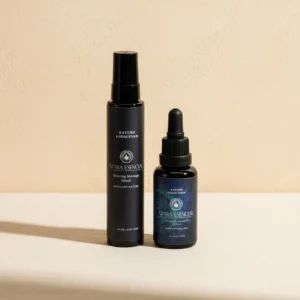
A two-step botanical ritual combining camphor, damask rose, peppermint, and anise — formulated to address stress-related tension through documented receptor pathways and 13 clinical trials
Why stress-related tension requires a physiological, not just psychological, approach
Physical tension is not simply the body version of mental stress — it is a distinct physiological state. Chronic stress activates the hypothalamic-pituitary-adrenal (HPA) axis, increasing cortisol and adrenaline secretion. These hormones shift the body into a sympathetic-dominant state: heart rate increases, muscle tone rises, blood flow is redirected away from peripheral tissues and toward core muscles, and fascia throughout the body tightens as part of the threat-preparation response.
The body does not automatically reverse this state when the stressor passes. Muscle holding and fascial tension can persist long after cortisol levels return to baseline — which is why sitting quietly after a stressful day rarely produces genuine decompression.
Effective unwinding requires inputs that directly engage the nervous system. Physical touch through massage mechanoreceptors signals safety to the nervous system and downregulates sympathetic tone. Specific aromatic compounds engage the olfactory pathway directly to the limbic system — the brain’s emotional regulation center — producing measurable physiological changes including reduced cortisol secretion and increased parasympathetic activity.
The Relaxing Massage Blend is designed to deliver both simultaneously: botanical mist first to begin the aromatic and skin-level response, oil blend second to sustain and deepen it through massage.
Why the two-phase sequence works: mist before oil
Skin has two absorption pathways: hydrophilic and lipophilic. Water-soluble aromatic compounds and lipid-soluble aromatic compounds access tissue through different routes and reach different receptor environments. A single-phase product compromises both.
The two-step ritual separates them deliberately.
Phase 1 — Distilled Water Mist: Applied first, the mist hydrates the skin surface and delivers water-soluble aromatic fractions that begin engaging the olfactory pathway immediately. Hydrated skin is measurably more permeable to the oil that follows — increasing transdermal absorption of the lipid-soluble active compounds in Phase 2.
The mist also serves a psychological function: it creates a sensory transition. The act of applying it — the scent, the cool mist, the deliberate pause — signals to the nervous system that the context has changed. This is not incidental. Ritual cues are processed by the limbic system and can initiate the physiological relaxation response before the pharmacological effects of the botanical compounds have begun.
Phase 2 — Oil Blend: Applied with firm, deliberate massage strokes immediately after the mist, the oil phase sustains and deepens what the mist began. The mechanical pressure of massage activates skin mechanoreceptors that signal the nervous system directly, while the oil’s botanical compounds continue engaging receptor pathways and releasing into the aromatic environment throughout the session.
Mist first. Oil second. Always in this sequence.
The receptor science: how camphor and peppermint interrupt physical tension
Camphor and peppermint are the two most scientifically characterized ingredients in the blend — and their mechanisms are now well understood at the molecular level.
Camphor (Cinnamomum camphora) activates TRPV3, a thermosensitive ion channel expressed predominantly in skin keratinocytes that detects warmth and warm-temperature compounds. This was first demonstrated by Moqrich et al. (2005) and confirmed in the Journal of Neuroscience. At higher concentrations, camphor additionally activates TRPV1. The practical effect of TRPV3 activation by camphor is a genuine warming sensation produced in keratinocytes — not a superficial surface warmth but a tissue-level thermal response that relaxes holding in the superficial fascia. Camphor also enhances local circulation, supporting delivery of the other botanical compounds during massage.
Important correction from the original post: Camphor’s primary skin receptor is TRPV3 (a warmth receptor), not TRPM8 (a cooling receptor). It does not directly activate TRPM8. This distinction matters because it correctly explains why camphor feels warming rather than cooling.
Peppermint / Menthol (Mentha arvensis) activates TRPM8 — the ion channel responsible for cool temperature detection in peripheral sensory neurons. This is one of the best-characterized receptor-ligand relationships in sensory biology, established in Nature (Bautista et al., 2007) and confirmed for analgesia specifically in a dedicated study published in Pain. TRPM8 activation by menthol produces a genuine cooling sensation that penetrates beyond the skin surface into underlying tissue, provides immediate sensory relief from tension, and — importantly — increases cutaneous blood flow through TRPM8-dependent activation of sensory nerves, as demonstrated by Craighead et al.
The combination of TRPV3 warmth (camphor) and TRPM8 cooling (menthol) creates the blend’s distinctive sensory opening — a complex thermal contrast that interrupts the habitual holding pattern of stressed tissue far more effectively than either sensation alone.
The rose evidence: 28 randomized controlled trials confirm the limbic response
Damask rose is the emotional anchor of this blend — and it is one of the most clinically documented aromatic botanicals in existence.
The claim in the original product description — that rose oil inhalation reduces salivary cortisol and sympathetic nervous system activity — is supported by a substantial evidence base. A 2017 review published in the Journal of Traditional and Complementary Medicine analyzed 13 clinical trials (772 participants) and found consistent evidence across studies for rose oil’s physiological relaxation effects, including reduction of sympathetic nervous system activity and cortisol-related endpoints.
A more recent systematic review and meta-analysis reviewed 38 studies on Rosa damascena across anxiety, sleep disturbance, and mood disorders, finding consistent evidence for decreased sympathetic nervous system activity and neurotransmitter modulation. The most comprehensive analysis to date — a 2025 meta-analysis of 28 randomized controlled trials — confirms the mood and sleep benefits of Rosa damascena aromatherapy across the largest dataset yet assembled.
The mechanism is direct: the olfactory pathway connects the nose to the limbic system via the olfactory bulb and olfactory cortex, bypassing the thalamic relay that most other sensory information passes through. Aromatic compounds reach emotional processing centers faster and more directly than almost any other input — which is why the scent of rose produces an almost immediate sense of emotional warmth and calm, before the cognitive mind has had time to process what’s happening.
Rose oil also contains over 300 identified aromatic compounds — which is why synthetic rose fragrance, composed of 20–30 synthetic molecules, consistently produces a different quality of response. The biological complexity of the real compound is part of what makes it effective.
Anise: the grounding note with documented muscle relaxant activity
Anise (Pimpinella anisum) is the counterbalance to peppermint’s brightness — where menthol clears and opens, anethole settles and grounds.
Anethole — anise’s primary bioactive compound — has documented antispasmodic and muscle relaxant properties. A study published in the Journal of Ethnopharmacology demonstrated that hydroalcoholic extracts of Pimpinella anisum produced concentration-dependent relaxation of smooth muscle through activation of the NO-cGMP pathway.
A comprehensive review of Pimpinella anisum’s pharmacological properties confirms antispasmodic, muscle relaxant, analgesic, antioxidant, and anti-inflammatory activity across the available literature.
In the context of a relaxation massage, this translates to a compound that complements the physical work of massage — helping the muscle tissue being addressed to release tension more readily, particularly in areas of chronic low-grade holding like the neck, jaw, and upper trapezius.
Aromatically, anise provides the warm, sweet base note that anchors the blend’s scent profile and creates the sense of safety and settling that genuine emotional release requires. The limbic system responds differently to grounding base notes than to bright top notes — the former supporting the nervous system’s shift from sympathetic to parasympathetic dominance.
The Ingredients
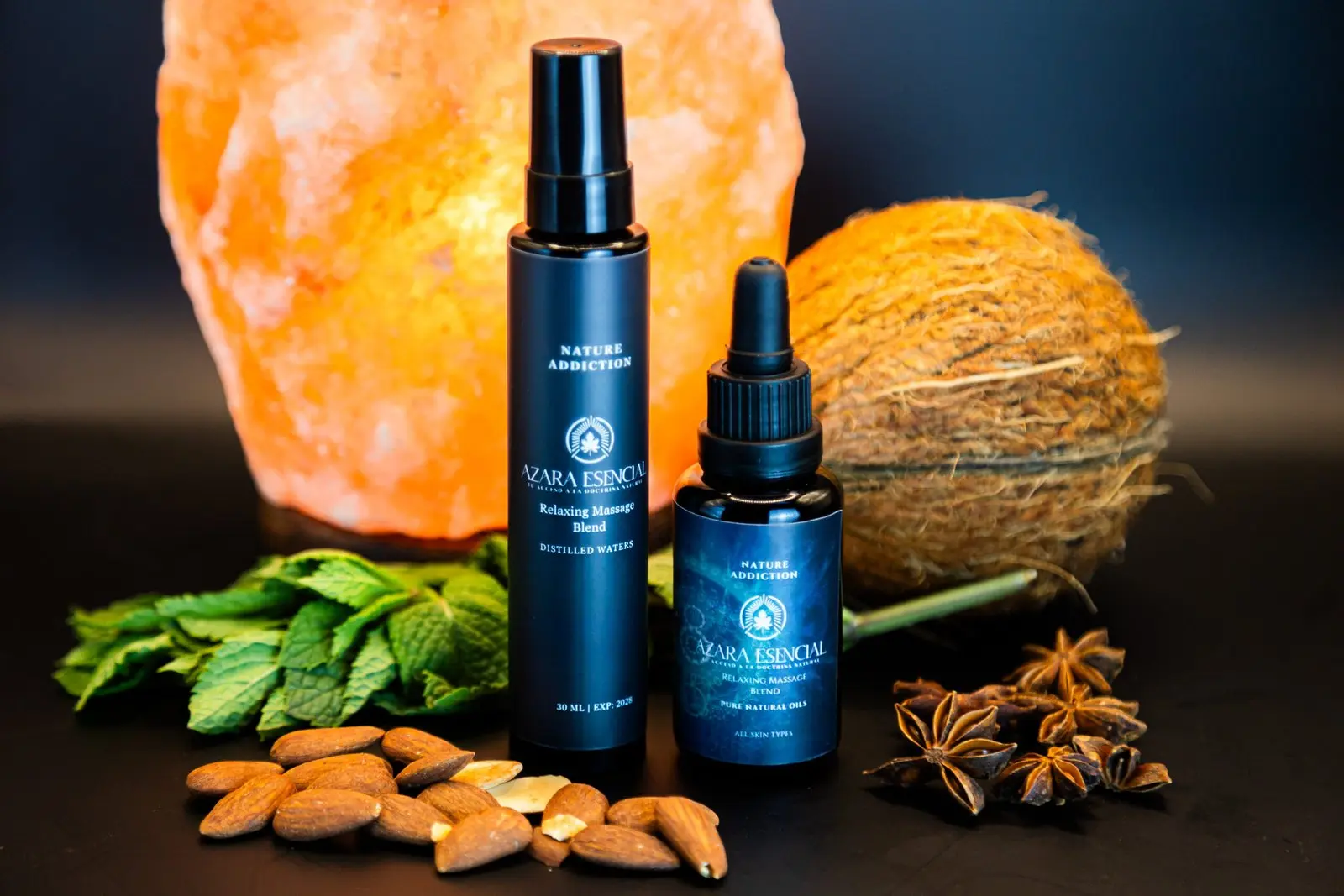
Relaxing Mist — Camphor Distilled Water
Cinnamomum camphoraInitiates the warming-clarifying sensory experience in a milder, water-phase form. Begins activating the TRPV3 warmth response in skin tissue before the oil arrives, preparing the tissue for the full camphor effect in Phase 2. Also increases skin permeability, improving oil absorption in the subsequent phase.
Relaxing Mist — Peppermint Distilled Water
Mentha piperitaProvides the mist's fresh, brightening top note with gentle astringent properties. The water-soluble menthol fractions deliver a mild TRPM8 cooling activation that refreshes the skin and begins the sensory shift from "daily life" to "ritual." Helps the skin shed the residue of the day — mentally and physically.
Relaxing Mist — Damask Rose Water
Rosa damascenaOne of the most documented hydrosols in botanical skincare. Its slightly acidic pH supports the skin's natural acid mantle while its water-soluble rose compounds immediately engage the olfactory-limbic pathway — the fastest route to emotional processing in the brain. Documented across 28 randomized controlled trials for mood and relaxation effects.
Relaxing Mist — Anise Distilled Water
Pimpinella anisumDelivers the warm, sweet grounding note of anise in a light aqueous form. Rounds the mist's aromatic profile, adding the base-note counterbalance to peppermint's brightness. Contributes its antispasmodic quality in the preparatory phase, setting the aromatic and physiological tone for the oil application that follows.
Massage Oil — Camphor Extract
Cinnamomum camphoraActivates TRPV3 — the warmth-sensing ion channel expressed in skin keratinocytes — producing a genuine tissue-level warming sensation confirmed in peer-reviewed receptor studies (Journal of Neuroscience, 2005 — PubMed: 16192383). Also activates TRPV1 at higher concentrations. Enhances local circulation and acts as a penetration enhancer for the other botanical compounds in the blend. The blend's primary tension-interruption compound.
Massage Oil — Peppermint
Mentha arvensisMenthol activates TRPM8 ion channels in cold-sensitive peripheral sensory neurons — one of the best-characterized receptor-ligand relationships in sensory biology. Produces a genuine cooling sensation penetrating beyond the skin surface, provides immediate sensory relief from tension, and increases cutaneous blood flow through TRPM8-dependent activation (PMC: 8791073). Creates the blend's bright, clear top note that signals the transition from stress to recovery.
Massage Oil — Damask Rose
Rosa damascenaThe emotional heart of the blend, with the strongest clinical evidence base of any aromatic botanical for relaxation. Rose oil inhalation reduces sympathetic nervous system activity and cortisol-related endpoints across 13 clinical trials reviewed. Contains over 300 identified aromatic compounds — the biological complexity synthetic fragrance cannot replicate. Provides gentle astringent and anti-inflammatory skin benefits alongside its aromatic effects.
Massage Oil — Anise
Pimpinella anisumAnethole — anise's primary compound — has documented antispasmodic and muscle relaxant activity via the NO-cGMP pathway. Complements the physical work of massage by supporting muscle tissue release. Its warm, licorice-like base note grounds the blend aromatically and supports the nervous system's shift from sympathetic to parasympathetic dominance.
Massage Oil — Sweet Almond Oil
Prunus amygdalus dulcisThe primary massage carrier — lightweight relative to its nutritive profile, rich in vitamins E and K, oleic acid, and linoleic acid. Closely mirrors the skin's natural lipid composition, absorbing effectively without sitting on the surface. Provides the ideal slip for long flowing massage strokes while conditioning the skin throughout. Hypoallergenic and appropriate for all skin types including sensitive.
Massage Oil — Cold-Pressed Coconut Oil
Cocos nuciferaThe secondary carrier, adding richness, body, and a protective surface layer that extends massage glide and prevents moisture loss during and after application. Contains lauric acid with mild antimicrobial properties supporting the skin microbiome. Warms and integrates seamlessly with the sweet almond base during massage friction, improving the overall absorption and feel of the blend.
The Ritual
Set the environment before you begin
Dim lighting, a quiet space, and 20–30 minutes of uninterrupted time significantly amplify the physiological relaxation response. The nervous system shifts from sympathetic to parasympathetic dominance more readily when environmental cues confirm safety. This is not aesthetic advice — it is physiology.
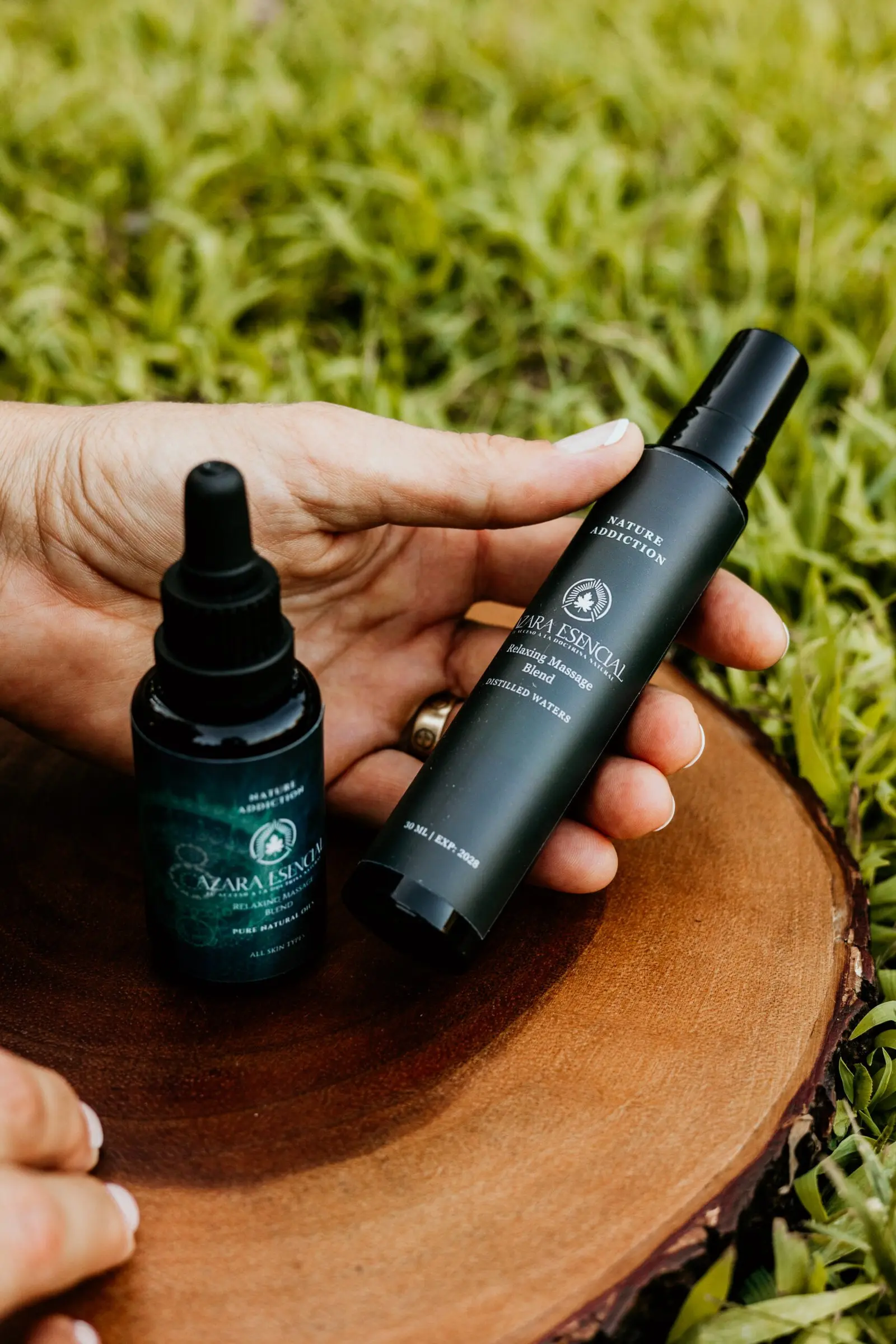
Spray the Relaxing Mist over the area to be massaged
Hold the bottle 20–25cm from the skin and apply evenly over the target area — neck, shoulders, back, feet, or full body depending on the session. The mist begins engaging the olfactory pathway and TRPM8/TRPV3 receptors immediately. Do not rub in — allow it to settle.
Inhale the mist aroma slowly and deliberately
Take 3–4 slow, deep breaths as the mist settles. This is not incidental. Deep breathing activates the vagus nerve and begins the parasympathetic shift. The simultaneous aromatic input from rose and peppermint engages the olfactory-limbic pathway during this most receptive moment.
Apply the Oil Blend and begin massage
Dispense 1–2 teaspoons for focused areas (neck and shoulders), more for a fuller body application. Apply to the mist-dampened skin and begin long, slow, firm strokes. The oil glides on mist-hydrated skin significantly more smoothly than on dry skin — and absorbs more effectively into prepared tissue.
Use slow, firm strokes — not fast or light
Slow, firm pressure activates Ruffini mechanoreceptors in the skin and fascia that signal the nervous system directly: slow touch = safe, slow down. Fast light touch has the opposite effect, increasing arousal. The speed of your strokes is part of the therapeutic mechanism — not just the comfort of the massage.
Focus additional time on chronic holding areas
The upper trapezius, the base of the skull, the jaw muscles, and the feet are the most common sites of stress-related tension holding. Give these areas 2–3 additional minutes each, using slow circular pressure. The camphor and anise compounds in the blend specifically support release in these areas during sustained massage.
Rest for 10–15 minutes after the session
The physiological relaxation response continues and deepens for 10–15 minutes after massage ends. Lying still in a quiet, warm environment allows the aromatic compounds to continue their limbic engagement and the nervous system to complete its shift to parasympathetic dominance. The quality of rest after the massage is part of the ritual's effectiveness.
The physiological relaxation response continues and deepens for 10–15 minutes after massage ends. Lying still in a quiet, warm environment allows the aromatic compounds to continue their limbic engagement and the nervous system to complete its shift to parasympathetic dominance. The quality of rest after the massage is part of the ritual's effectiveness.
Get Your Relaxing Massage BlendWhat to Expect
Frequently Asked Questions
Both, through entirely different receptor pathways. Camphor activates TRPV3 ion channels in skin keratinocytes — a warmth receptor — producing a genuine tissue-level warming sensation (Journal of Neuroscience, 2005 — PubMed: 16192383). Peppermint’s menthol activates TRPM8 ion channels in cold-sensitive peripheral sensory neurons — a cooling receptor (PubMed: 23820004). The combination produces the blend’s distinctive complex sensation: warmth and cooling simultaneously, which is physiologically distinct from either alone and more effective at interrupting habitual physical tension.
Both — and the two are not mutually exclusive. Rosa damascena is one of the most clinically studied aromatic botanicals for relaxation and mood. A 2017 review of 13 clinical trials (772 participants) found consistent evidence for physiological relaxation effects including reduced sympathetic nervous system activity (PubMed: 28748167). A 2025 meta-analysis of 28 randomized controlled trials confirms mood and sleep benefits across the largest dataset assembled to date (PMC: 12623198). The mechanism is direct: rose compounds engage the olfactory-limbic pathway, bypassing the thalamic relay and reaching emotional processing centers faster than almost any other sensory input. Its premium cost reflects genuine scarcity — several kilograms of petals per small volume of oil — and genuine therapeutic complexity.
Yes — unlike the Joint Care Blend which is targeted, the Relaxing Massage Blend is designed for broader body application including the neck, shoulders, back, chest, and feet. Use 1–2 teaspoons for focused areas and more for a full-body session. The sweet almond and coconut oil carrier base provides smooth, sustained glide appropriate for long massage strokes across large body areas.
Consult your healthcare provider before using products containing camphor, peppermint, or anise essential oils during pregnancy. All three have documented physiological activity and contraindications at certain concentrations in specific trimesters. This is not a cautionary generality — camphor in particular has specific pregnancy guidance that varies by concentration and trimester.
As often as needed. For general wellbeing and stress maintenance, two to three times per week creates a consistent physiological foundation and supports the development of the aromatic conditioning response. During high-stress periods, daily use is appropriate. The formula is gentle enough for frequent application on all skin types.
Yes — and this is part of its therapeutic value, not an incidental quality. The rose and anise base notes continue to release from the skin surface for a meaningful time after application, extending the limbic engagement and the calm state it supports. This is particularly useful for evening use before sleep — the ongoing aromatic presence supports the transition to deeper rest even after the physical session has ended.
Standard massage oils are formulated for comfortable application and skin conditioning — their aromatic additions (if any) are typically fragrance-grade, not therapeutically selected. The Relaxing Massage Blend is a two-phase system in which every ingredient is selected for a specific documented mechanism: TRPV3 receptor activation (camphor), TRPM8 receptor activation (menthol), limbic-pathway cortisol reduction (rose), and antispasmodic muscle relaxant activity (anise). The mist-before-oil sequence, the carrier oil selection, and the aromatic compound ratios are formulated to work together as a complete nervous system intervention — not as a pleasant carrier with added scent.