What the science says about the ingredients that actually work in anti-aging and acne serums — and how to tell them apart from expensive storytelling
Why good serums cost real money — and why some expensive ones don't deserve it
Serum pricing is not arbitrary — but it is also not honest across the board. Understanding what genuinely drives formulation cost separates worthwhile investment from luxury theater.
The real chemistry problem with vitamin C: Pure L-ascorbic acid is one of the most evidence-backed topical actives in dermatology — an antioxidant, collagen co-factor, and melanin inhibitor with decades of clinical research. It is also among the most unstable cosmetic ingredients in existence. Exposed to light and air, it oxidizes within weeks, turning orange-brown and losing all activity. An effective vitamin C serum requires a specific pH range (below 3.5 for L-ascorbic acid), airtight opaque packaging, and co-stabilizers — vitamin E and ferulic acid — that both extend shelf life and amplify the photoprotective effect. That chemistry and packaging is genuinely expensive to get right. A vitamin C serum in a clear glass bottle at €12 is almost certainly oxidized and inactive before you reach the halfway mark — regardless of the concentration stated on the label.
The encapsulation investment in retinol: Retinol’s initial adjustment period — dryness, redness, and flaking in the first four to six weeks — causes most people to abandon it before reaching the window of visible results. High-quality retinol formulations use microencapsulation technology that releases retinol gradually into the skin, reducing surface irritation while maintaining efficacy. That technology costs money. A well-formulated €150 retinol serum may genuinely outperform a poorly encapsulated €60 one.
The fairy dusting problem: There is a widespread industry practice of including a trendy or expensive active at a concentration so low it produces no measurable skin effect — purely to justify its appearance on the label and in the marketing. How to spot it: INCI ingredients are listed in descending order of concentration down to the 1% threshold, after which they can appear in any order. If a marketed active appears after the preservative (typically phenoxyethanol at ~1%), that ingredient is present at less than 1% — often far less — and for most actives, that is not enough to do anything. The ingredient is there for the label, not for your skin.
The ingredients with genuine research behind them
These are the actives where the clinical evidence is substantive — not cherry-picked studies, but consistent findings across multiple trials and years of dermatological use.
Vitamin C (L-ascorbic acid and derivatives): Neutralizes free radicals from UV and pollution that break down collagen and cause pigmentation. Acts as a co-factor in collagen synthesis — your skin requires it to rebuild structural protein. Clinical evidence supports measurable improvement in fine lines, coarse wrinkles, skin texture, and hyperpigmentation with consistent use over at least three months. The vitamin C / vitamin E / ferulic acid combination is among the most evidence-backed active combinations in topical skincare, with the trio demonstrating significantly enhanced photoprotective activity compared to any component alone. Effective concentrations: 10–20% for L-ascorbic acid; lower for stable derivatives (ascorbyl glucoside, sodium ascorbyl phosphate) which are gentler but require higher concentrations for equivalent activity.
Retinol (vitamin A): Has more published dermatological research behind it than almost any other topical ingredient. Accelerates cell turnover, clears congested pores, fades post-inflammatory marks, and with consistent use over months, stimulates fibroblast activity and measurable collagen production. The retinization period — four to six weeks of adjustment — is real and manageable with gradual introduction at low concentrations (0.025–0.05% to start, applied 2–3 nights per week). Daily SPF is non-negotiable during retinol use: photosensitivity is a documented and consistent side effect.
Peptides: Short amino acid chains that act as signaling molecules, instructing skin cells to produce more collagen, elastin, and other structural proteins. Matrixyl (palmitoyl pentapeptide-4) is the most studied signal peptide, with published clinical data demonstrating measurable reduction in wrinkle depth. Matrixyl 3000 (palmitoyl tripeptide-1 + palmitoyl tetrapeptide-7) is a commonly formulated, evidence-backed combination. Copper tripeptide-1 supports wound healing and barrier repair. Unlike retinoids, peptides are non-irritating and broadly suitable for sensitive skin — they work more subtly and over a longer timeline, but with consistency.
Hyaluronic acid: A polysaccharide naturally produced in the body, capable of binding extraordinary amounts of water in the skin’s intercellular matrix. Plumps, firms the surface, and supports barrier function. Important nuance: in low-humidity environments, topical hyaluronic acid can draw water from the skin’s deeper layers rather than from the ambient air — always seal with an occlusive product (a botanical oil or cream) applied immediately after. Multi-molecular-weight formulations — combining large molecules that work on the surface with smaller ones that penetrate deeper — are genuinely more effective than single-weight products and worth the additional cost.
Niacinamide (vitamin B3): Reduces sebum production, calms inflammatory acne, boosts ceramide production (strengthening the barrier), evens skin tone, reduces the appearance of enlarged pores, and decreases the rate of collagen glycation that makes aging skin progressively stiffer. A published clinical study comparing 4% niacinamide gel against 1% clindamycin antibiotic gel for acne found comparable efficacy — without the antibiotic resistance implications of topical clindamycin. Niacinamide is stable, non-irritating, compatible with essentially all other actives, and relatively inexpensive as a raw ingredient — making high price a less justifiable premium here than with vitamin C or retinol.
What doesn't belong in your serum
A well-formulated serum is as much about what it excludes as what it includes. These are the ingredients that contribute to price, texture, or marketing narrative without contributing to skin improvement — and some that actively create harm with consistent use.
Fragrance (synthetic and natural): Fragrance is one of the leading causes of cosmetic contact dermatitis. This applies equally to synthetic fragrance and to “natural” botanical fragrance — limonene (citrus), linalool (lavender), and cinnamal (cinnamon) are all EU-regulated fragrance allergens for precisely this reason. A leave-on serum applied daily to facial skin has no benefit from fragrance and carries genuine sensitization risk, particularly for reactive or barrier-compromised skin. Fragrance-free is the appropriate formulation choice for actives serums.
Drying alcohols: Ethanol, alcohol denat., and isopropyl alcohol produce the weightless, fast-drying, non-greasy feel that many users associate with a “light” serum. At high concentrations in leave-on products, they disrupt the skin barrier, cause progressive dehydration, and trigger compensatory sebum overproduction in oily skin types — the opposite of what an acne or anti-aging serum should achieve. If any of these appears in the first five ingredients of a serum, consider it a red flag. Note: fatty alcohols (cetyl alcohol, stearyl alcohol, cetearyl alcohol) are completely different compounds — emollients, not solvents — and are beneficial in skincare formulations.
Harsh preservatives: Parabens have documented estrogenic activity and bioaccumulate in human tissue — a legitimate concern for daily-use leave-on products even without established causation of specific harms. Formaldehyde-releasing preservatives (DMDM hydantoin, imidazolidinyl urea, quaternium-15) are a more straightforward concern: formaldehyde is a WHO-classified carcinogen in inhalation contexts, and these compounds release it slowly in the product over its shelf life. Modern formulation achieves effective preservation without either.
Phthalates in fragrance: Phthalates used as fragrance stabilizers and solvents are endocrine disruptors that frequently appear hidden under the umbrella term “fragrance” rather than being listed individually. Fragrance-free formulations eliminate this risk entirely — another reason fragrance exclusion matters beyond the sensitization concern.
Fillers before actives: Some serums place water, glycerin, and multiple emulsifiers in the first five positions before any active ingredient appears. This isn’t inherently wrong — water is a carrier, and the listed actives may still be at effective concentrations. But a serum where the first six ingredients are all structural base components and the “hero active” is ninth warrants scrutiny about concentration adequacy.
Where cold-pressed botanical oils fit — and where they don't
The honest answer is that cold-pressed botanical oils and evidence-based synthetic actives occupy different and largely complementary roles in a skincare routine. They are not competing categories — they serve different biological functions.
Where botanical oils are specifically stronger:
Barrier support and lipid biology. Cold-pressed oils composed of fatty acid families (oleic, linoleic, linolenic) are structurally compatible with the skin’s own lipid bilayer in a way that water-based serum formulations are not. They integrate with the stratum corneum, contributing to barrier composition rather than sitting on top of it. This is the most important function in skin health — barrier integrity determines how well everything else works, including your actives.
Antioxidant protection without instability problems. Thymoquinone from black seed oil, tocopherols from vitamin E-rich oils, and rosmarinic acid from rosemary macerate are antioxidants delivered in a stable lipid vehicle — unlike vitamin C, which requires complex stabilization chemistry to remain active. Their antioxidant activity is gentler and slower than pharmaceutical-grade vitamin C, but it is consistent and doesn’t degrade from the moment the bottle is opened.
Where synthetic actives are specifically stronger:
Cell turnover acceleration. No botanical oil delivers the cell renewal acceleration of retinol or prescription retinoids — rosehip’s beta-carotene provides supportive vitamin A activity, but it is not a pharmacological equivalent. If accelerated cell turnover for acne, hyperpigmentation, or advanced photoaging is the clinical goal, retinol or tretinoin is the evidence-based choice.
High-concentration specific mechanisms. A 15% L-ascorbic acid serum at the correct pH delivers collagen-synthesis and melanin-inhibiting activity at concentrations and through mechanisms that botanical alternatives don’t replicate. Niacinamide at 5% delivers sebum-regulatory and barrier-boosting activity at a measurable clinical dose.
The practical layering approach:
Apply water-based actives — vitamin C, niacinamide, retinol — to clean skin first and allow to absorb. Follow immediately with botanical hydrosol mist, then seal with a cold-pressed oil blend. The oil layer acts as both a barrier-supporting seal for the actives and a delivery vehicle for its own lipid-soluble botanical compounds. This approach gives you both pharmaceutical-grade active delivery and botanical structural support in the same routine — not as competing choices, but as sequential layers with different and complementary functions.
How to read through the marketing language on a serum
The skincare industry has developed a fluent vocabulary for implying things it cannot technically claim. Understanding the standard phrases removes most of their persuasive power.
“Clinically proven” has no standardized legal definition in EU or US cosmetic regulation. It typically means the brand conducted its own proprietary consumer perception study — often 20–50 participants over 4–8 weeks, not independently reviewed, not published. What “clinically proven” should imply — peer-reviewed, independently conducted trials at meaningful scale — is almost never what it means. Brands with genuine clinical backing name the study and link to it.
“Dermatologist tested” or “dermatologist approved” requires one dermatologist’s use or assessment of the product — and says nothing about the result of that assessment. One dermatologist finding a product non-irritating over two weeks of use does not constitute clinical validation of its efficacy claims.
“Up to X% improvement” is a statistical construction that reports the best outcome from the best participant in a study — not the average result. “Up to 47% reduction in fine lines” may mean one person in a self-assessed consumer panel reported that result. It says nothing about what most users will experience.
“Visible results in X days”: Genuine structural skin changes — collagen remodeling, barrier repair, cell turnover improvement — require weeks to months. “Visible in 48 hours” describes a surface hydration effect from humectants, not structural change. The promise is technically true and substantively misleading.
“Boosts collagen production”: Under EU cosmetics regulation, a product claiming a physiological mechanism — including collagen stimulation — is making a claim that approaches medicinal territory. Regulated brands write “appearance of firmness” or “skin looks firmer” rather than “stimulates collagen” — not because the underlying biology doesn’t support it, but because the regulatory language distinction is real and legally significant.
The most reliable alternative to parsing marketing language: read the INCI list, find the active you’re paying for, check where it appears in the list, and research whether the concentration range implied is consistent with published evidence for that ingredient.
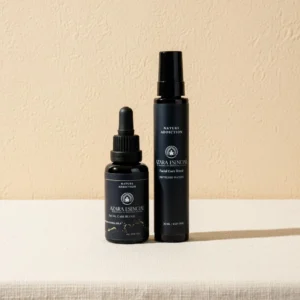
The Azara Natural Facial Care Set delivers a two-phase botanical ritual — hydrosol mist and cold-pressed oil blend — that complements active serum use by supporting barrier function, delivering lipid-soluble botanical actives, and sealing in the water-based actives applied before it. No synthetic additives. No preservatives. No fragrance.
Explore the Facial Care SetFrequently Asked Questions
No — but for specific ingredients, cost reflects real formulation challenges. Vitamin C (L-ascorbic acid) at effective concentrations requires pH-controlled formulation, co-stabilizers, and opaque airtight packaging that genuinely costs money to do correctly. Encapsulated retinol technology reduces irritation while maintaining efficacy — also a real cost. Peptides are expensive raw materials that degrade quickly in poorly formulated products. For these actives, there is a real cost floor below which quality cannot be maintained. But premium branding, luxury packaging, celebrity association, and “rare ingredient” storytelling add to price without adding to skin benefit. The INCI list is the tool for separating the two.
Yes — and this is one of the most effective layering approaches. Apply retinol to clean, dry skin in the evening and allow it to absorb for 20–30 minutes. Then apply a botanical hydrosol mist followed by a cold-pressed oil blend. The oil layer reduces the transepidermal water loss that contributes to retinol’s dryness side effects, supports barrier function during the retinization period, and delivers its own antioxidant and lipid-supportive compounds simultaneously. Many dermatologists recommend a moisturizing layer after retinol specifically to buffer irritation — a botanical oil performs this function while adding its own botanical benefit.
Clinical studies have used concentrations from 2% to 5% for acne management. The comparison study against 1% clindamycin used a 4% niacinamide gel. At concentrations above 10%, some users experience temporary skin flushing from niacin conversion — not harmful but uncomfortable. The 2–5% range covers the evidence-based window with minimal risk of adverse effects. Many products advertise “10% niacinamide” as a strength claim, but for most users the benefit-to-risk ratio of 4–5% is at least as good, with a lower flushing risk.
Retinol is a vitamin A derivative with decades of clinical research, working through retinoic acid receptor pathways to accelerate cell turnover and stimulate collagen production. It causes retinization (initial dryness and redness), increases photosensitivity, and is contraindicated during pregnancy. Bakuchiol is a meroterpene from Psoralea corylifolia with a different mechanism — it doesn’t work through retinoic acid receptors but has shown in studies to upregulate similar gene expression pathways, producing comparable improvements in wrinkles and pigmentation over 12 weeks with significantly less irritation. It is not a direct retinol replacement in terms of mechanism — but for those who cannot tolerate retinol (pregnancy, sensitive skin, rosacea), bakuchiol is a clinically supported botanical alternative, not a trend ingredient.
This is a real phenomenon, not a myth. Hyaluronic acid is a humectant — it draws water toward itself. Applied to skin in a low-humidity environment where the ambient air doesn’t provide adequate moisture, it can draw water from the skin’s deeper layers to the surface, where it then evaporates. The solution is sealing with an occlusive or semi-occlusive product immediately after: a botanical oil or cream applied while the skin is still damp from the HA product. In humid environments this is less of a concern. The layering principle — HA applied to damp skin, sealed with oil — is the correct protocol regardless of climate.
For different things. A cold-pressed botanical oil blend delivers barrier lipid integration, fatty acid support, antioxidant protection, and phytochemical activity at concentrations that are real and measurable — but through mechanisms that are slower and more structural than pharmaceutical actives. A vitamin C serum at 15% L-ascorbic acid delivers a specific antioxidant and collagen-synthesis mechanism at a clinical concentration that botanical alternatives don’t replicate at equivalent efficacy. The most complete approach combines both: evidence-based synthetic actives for the specific clinical goals they achieve well (cell turnover, high-dose antioxidant, sebum regulation) and botanical oils for the barrier support and structural skin health that synthetic formulations don’t address. They serve different functions — which is why the question “are natural serums as effective” depends entirely on what you’re comparing them for.