A two-phase botanical facial ritual combining frankincense resin extract, black seed, damask rose, chia, lupine, and avocado oils — with boswellic acid activity confirmed by a 2010 randomized clinical trial
What aging skin actually needs — and why single-ingredient products fall short
Facial skin aging is not a single process. It involves multiple simultaneous biological mechanisms: They you eat and what you eat, environmental exposure degrades collagen and elastin; chronic low-grade inflammation (inflammaging) accelerates structural breakdown at the cellular level; transepidermal water loss increases as the skin barrier weakens; fibroblast activity declines, reducing the production of new collagen and elastin; and cell turnover slows — from approximately 28 days in younger skin to 45–60 days in mature skin.
A product built around one active ingredient — even a well-documented one — addresses one of these processes. The others continue uninterrupted.
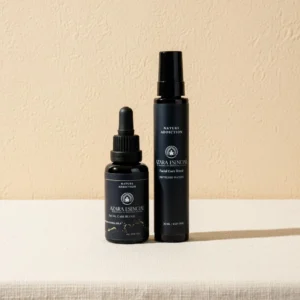
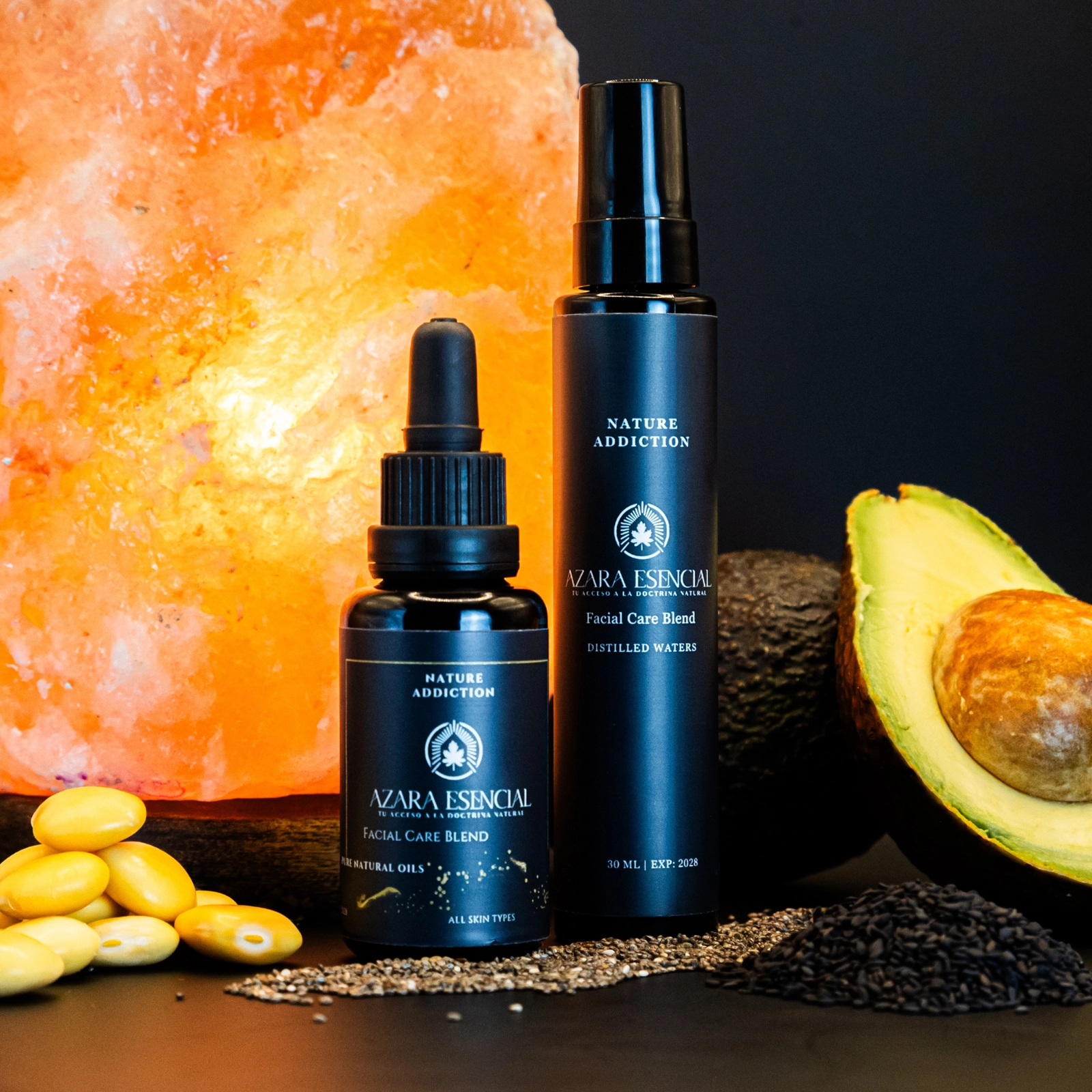
The Facial Care Blend is formulated across six cold-pressed botanical oils and seven botanical water extracts, each selected for a specific and documented mechanism. They work simultaneously, not in sequence with diminishing returns. The result is multi-mechanism skin support delivered in a single two-step ritual — hydrosol mist first, oil blend second.
Why the two-phase ritual works: hydrosol before oil
Facial skin responds differently to water-soluble and lipid-soluble compounds. They penetrate through different pathways, interact with different layers of the epidermis, and cannot be effectively combined into a single product without compromising both phases.
The two-step sequence exists for a specific physiological reason: damp skin is measurably more permeable to botanical oils than dry skin. Applying the hydrosol mist first hydrates the skin surface and creates the optimal absorption state for the oil that follows.
Step 1 — Hydrosol Mist: Applied to slightly damp skin immediately after cleansing. It delivers water-soluble botanical fractions including rose acids, lavender compounds, Boswellia water-soluble fractions, black seed antioxidants, myrrh sesquiterpenes, Acacia polysaccharides, and Cyperus brightening compounds. It tones, balances pH, and hydrates — creating an ideal surface for Step 2.
Step 2 — Oil Blend: Pressed into still-damp skin immediately after the mist, using upward massage movements. The oil delivers concentrated lipid-soluble actives — boswellic acids, thymoquinone, omega-3 and omega-9 fatty acids, lupine phytosterols, and fat-soluble vitamins A, D, and E — to the deeper layers of the epidermis. The oil phase also seals in the hydration from Step 1, preventing the water-soluble compounds from simply evaporating.
The frankincense distinction: why resin extract outperforms essential oil?
This is the most important formulation detail in the blend — and the most commonly misunderstood in the skincare industry.
Boswellic acids are pentacyclic triterpene compounds present in frankincense resin. They are the compounds with the strongest documented skin anti-aging activity, with peer-reviewed clinical evidence supporting their effects on fine lines, elasticity, and collagen remodeling. The key detail: boswellic acids are large, non-volatile molecules. They do not carry over in meaningful concentrations through steam distillation — the process used to produce frankincense essential oil.
The practical consequence: most “frankincense” skincare products use steam-distilled essential oil. They contain the aromatic terpenes (alpha-pinene, limonene) that give frankincense its distinctive scent, and they benefit commercially from the name’s association with luxury and traditional use. But they deliver minimal boswellic acid content — the compounds the clinical research actually supports.
This formulation uses frankincense resin extract specifically because the resin is where the boswellic acids are.
The clinical evidence: a 2010 randomized, double-blind, split-face study published in Planta Medica (Pedretti et al.) applied 0.5% boswellic acids topically for 30 days. Results included significant improvements in photoaging score, measurable reduction in fine lines, improved skin roughness, and — confirmed by non-invasive diagnostic techniques — a demonstrable increase in skin elasticity and changes in echographic parameters consistent with collagen remodeling. This is among the highest-quality evidence available for any topical botanical anti-aging ingredient.
The mechanism: boswellic acids inhibit the matrix metalloproteinase (MMP) enzymes that degrade existing collagen in aging skin, while simultaneously stimulating fibroblast activity to support new collagen and elastin production.
Inside the hydrosol mist: seven botanical waters, one prepared face
The hydrosol mist combines two steam-distilled floral waters with five targeted botanical extracts, each contributing specific water-soluble compounds that the oil phase cannot carry.
Damask Rose Hydrosol (Rosa damascena) provides immediate hydration, gentle astringency, and toning — creating a calm, even skin surface. Its water-soluble rose acids and phenylethanol compounds deliver the first layer of antioxidant protection and prepare the skin to receive the oil without diluting its concentration.
Lavender Hydrosol (Lavandula angustifolia) calms and balances the skin surface — particularly valuable for skin that carries stress-related redness, reactivity, or irritation. It creates an even, settled surface for the oil to work on and contributes linalool in its water-soluble form.
Black Seed Extract (Nigella sativa) delivers water-soluble antioxidant and clarifying fractions of black seed — including water-soluble thymoquinone derivatives — that complement the lipid-soluble thymoquinone delivered by the oil phase. Two delivery pathways for the same plant’s actives.
Frankincense Extract (Boswellia serrata) carries water-soluble Boswellia fractions into the preparatory phase, complementing the resin extract in the oil across both absorption pathways. Two phases of the same anti-aging ingredient.
Myrrh Extract (Commiphora myrrha) contributes restorative, barrier-supporting, and anti-inflammatory sesquiterpenes. Myrrh has one of the oldest documented uses in Middle Eastern skincare for skin repair and resilience — and modern analysis confirms antimicrobial and anti-inflammatory activity that supports skin comfort and accelerates barrier recovery.
Acacia Senegal Extract is a polysaccharide-rich botanical that creates a temporary smoothing and soft-focus effect on the skin surface — visibly reducing the appearance of texture and pore size immediately upon application. It also provides mild film-forming action that supports moisture retention throughout the day.
Cyperus Rotundus Extract (nutgrass) has documented melanin-inhibiting and skin-brightening activity. It targets the uneven tone and dullness that commonly accompany aging and sun exposure, contributing to a more consistent, radiant complexion with consistent ritual use.
The Ingredients
Hydrosol Mist — Damask Rose Water
Rosa damascenaImmediately hydrates, tones, and gently astringes the skin surface. Delivers water-soluble rose acids and phenylethanol compounds that provide antioxidant protection and prepare the skin to receive the oil phase. Creates the hydrated surface state that maximizes oil penetration in Step 2.
Hydrosol Mist — Lavender Water
Lavandula angustifoliaCalms and balances the skin surface — particularly valuable for stress-related redness, reactivity, or sensitized skin. Delivers water-soluble linalool that creates an even, settled surface for the oil phase. Anti-inflammatory and balancing in its water-soluble form.
Hydrosol Mist — Black Seed Extract
Nigella sativaDelivers water-soluble antioxidant and clarifying fractions of black seed — the water-phase complement to the lipid-soluble thymoquinone delivered by the oil. Two different absorption pathways for the same plant's anti-inflammatory and antioxidant compounds.
Hydrosol Mist — Frankincense Extract
Boswellia serrataCarries water-soluble Boswellia fractions into the preparatory phase — the mist-phase complement to the resin extract in the oil. Delivers Boswellia actives across both water-soluble and lipid-soluble pathways simultaneously, maximizing boswellic acid delivery to the skin.
Hydrosol Mist — Myrrh Extract
Commiphora myrrhaOne of the oldest documented ingredients in Middle Eastern skincare for skin repair and resilience. Delivers sesquiterpenes with anti-inflammatory and antimicrobial activity. Supports barrier recovery, skin comfort, and resilience — particularly in mature or stressed skin.
Hydrosol Mist — Acacia Senegal Extract
Acacia senegalA polysaccharide-rich botanical that immediately smooths skin texture and visibly reduces the appearance of enlarged pores. Creates a mild film-forming action that supports moisture retention. The ingredient responsible for the instant skin-smoothing effect felt immediately after applying the mist.
Hydrosol Mist — Cyperus Rotundus Extract
Cyperus rotundusDocumented melanin-inhibiting and skin-brightening activity. Targets the uneven tone and surface dullness that accompany aging and sun exposure. Contributes to a more consistent, radiant complexion with consistent ritual use — the brightening specialist of the mist formula.
Facial Oil — Frankincense Resin Extract
Boswellia serrataThe anti-aging anchor of the blend — formulated as resin extract (not essential oil) to deliver boswellic acids, the clinically active compounds. A 2010 randomized double-blind split-face study (Pedretti, Planta Medica) confirmed that topical 0.5% boswellic acids produced significant improvements in fine lines, elasticity, skin roughness, and photoaging score over 30 days. Mechanism: inhibits MMP enzymes that degrade collagen while stimulating fibroblast production of new collagen and elastin.
Facial Oil — Black Seed Oil
Nigella sativaRich in thymoquinone — a potent antioxidant and anti-inflammatory compound unique to black seed in this concentration — alongside linoleic acid, the essential fatty acid associated with healthy sebum composition and intact barrier function. Provides antioxidant protection against photoaging free radicals, supports a calmer complexion, and contributes to a more even skin tone. Particularly compatible with oily and combination skin due to its linoleic acid content.
Facial Oil — Damask Rose Oil
Rosa damascenaAstringent and anti-inflammatory in the oil phase — tones the skin, calms redness, and contributes to the luminous finish that users notice from first application. True rose oil contains hundreds of aromatic compounds that no synthetic fragrance can replicate, and delivers sensory quality alongside genuine skin benefit. Present in both the mist and oil phases, contributing across both absorption pathways.
Facial Oil — Chia Seed Oil
Salvia hispanicaOne of the richest plant sources of alpha-linolenic acid (ALA, omega-3) in existence — 60–65% concentration, higher than flaxseed oil. In a facial formulation, this matters: alpha-linolenic acid is a structural component of the skin's lipid barrier, and deficiency is directly associated with transepidermal water loss and sensitivity. Chia seed oil reinforces barrier integrity, improves moisture retention, and contributes to elasticity — at a lightweight texture that doesn't add heaviness to the blend.
Facial Oil — Lupine Seed Oil
Lupinus albusThe formulation's dedicated firming agent. Contains oligopeptides and phytosterols that support the extracellular matrix giving skin its structural resilience, and reduce the looseness associated with collagen loss. Works at a structural level that the other oils don't specifically target. Phytosterols additionally reinforce the skin barrier and contribute anti-inflammatory activity that improves overall skin comfort.
Facial Oil — Avocado Oil
Persea gratissimaThe deep nourishment base of the blend. Rich in oleic acid (omega-9), fat-soluble vitamins A, D, and E, and plant sterols — a combination that makes it one of the most penetrating and skin-compatible carrier oils known. Softens and conditions at depth, supports repair in dry or compromised skin, and delivers fat-soluble vitamins to the deeper layers of the epidermis. In a mature or dry skin formulation, avocado's richness is an asset — not a liability.
The Ritual
Cleanse your face and leave skin slightly damp
Do not dry completely after cleansing. The mist and oil both perform best on slightly damp skin — this is the physiological state that maximizes absorption of the botanical compounds in both phases.
Spray the Hydrosol Mist over your face and neck
Hold the bottle 20–25cm from your face and mist evenly over the face and neck. No need to rub in — Apply immediately after cleansing while skin is still warm and pores are open.
Allow the mist to settle for 10 seconds — do not rub
Let the botanical waters settle onto the skin surface. This allows the Acacia smoothing compounds and the rose and lavender toning compounds to adhere to the skin before the oil is applied over them.
Press 3–5 drops of the Oil Blend into still-damp skin
Dispense 3–5 drops onto your fingertips — not your palm — and press gently into the face and neck using upward movements. Pressing (not rubbing) prevents dragging and ensures the oil penetrates rather than sitting on the surface. Work from chin upward, from center outward.
Massage gently for 2–3 minutes
Light circular movements with fingertips across the face, focusing on areas of concern — fine lines, dullness, areas of tension. This stimulates microcirculation, warms the oil slightly for better absorption, and activates the lymphatic movement that supports skin clarity.
Use before bedtime consistently
The skin's cell renewal cycle is approximately 28 days. The anti-inflammatory and collagen-supportive botanicals in this blend require consistent presence over that cycle to produce visible structural change. Occasional use produces some benefit. Consistent daily use produces meaningful, cumulative improvement.
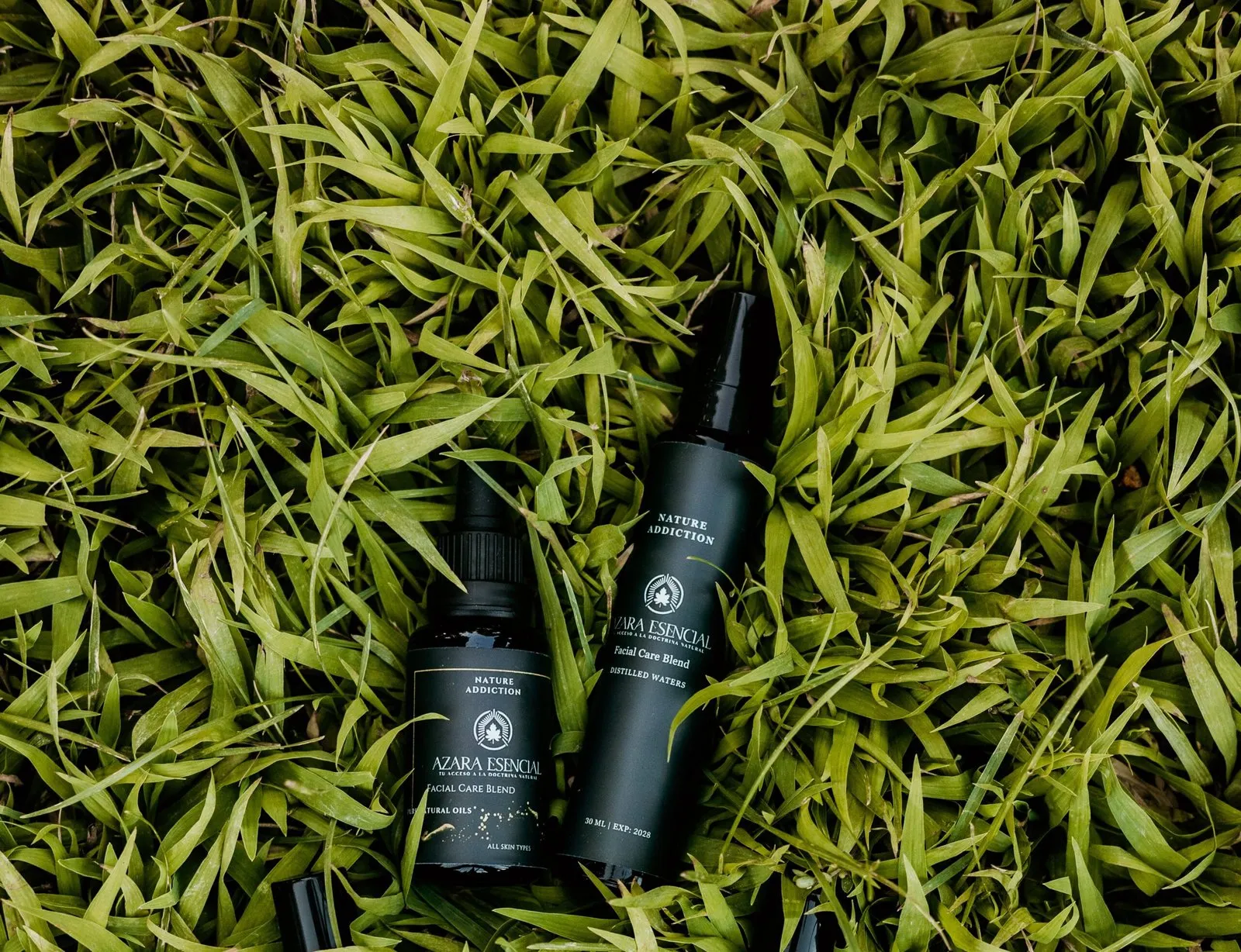
The Facial Care Blend is a complete two-phase system. The Hydrosol Mist and Oil Blend are designed to work in sequence — the mist delivers water-soluble botanical actives and prepares the skin, the oil delivers lipid-soluble actives into tissue that is primed to absorb them. The set contains both phases — everything needed to begin the ritual.
Get Your Facial Care SetWhat to Expect
Frequently Asked Questions
Boswellic acids — the compounds with the strongest documented skin anti-aging activity, including the 2010 Pedretti randomized clinical trial — are pentacyclic triterpenes present in the frankincense resin. They are large, non-volatile molecules that do not carry over in meaningful concentrations through steam distillation. Most “frankincense” skincare products use steam-distilled essential oil, which delivers aromatic terpenes but minimal boswellic acid content. This formulation uses resin extract specifically to deliver the compounds the clinical evidence actually supports.
Yes — with an important distinction. The Facial Care Blend is high in linoleic acid (omega-6) from chia seed and black seed oils. Linoleic acid is the fatty acid that oily skin is typically deficient in: when sebum is low in linoleic acid, the skin compensates by overproducing it. Topical linoleic acid actually helps regulate sebum production over time. Start with 2–3 drops rather than 5, applied to the damp-skin protocol, and the formula will not feel heavy or congesting.
Yes. Botanical oils and active serums occupy different functional roles and do not compete for the same pathways. Apply water-based actives — vitamin C serum, retinol, niacinamide — to clean skin first and allow them to absorb. Then follow with the Hydrosol Mist and Oil Blend. The oil phase seals and supports the actives without interfering with them. This layering approach gives you both the pharmaceutical-grade active and the botanical structural support simultaneously.
The product is classified as a cosmetic under EU regulation — not a medicine. EU cosmetic law requires that claims reflect what is observable rather than making pharmaceutical claims about physiological change. “Appearance of fine lines” describes what users consistently observe and report. The underlying botanicals — particularly boswellic acids and omega-3 fatty acids — have documented mechanisms for supporting the skin structures involved in fine line formation. The Pedretti 2010 clinical trial used non-invasive diagnostic measurement to confirm changes in elasticity parameters and echographic markers consistent with collagen remodeling. The language is regulatory; the mechanisms are real.
At 3–5 drops of oil per application and consistent daily use, the 30ml oil bottle typically lasts 6–8 weeks. The hydrosol mist, used more lightly per session, tends to last slightly longer. A single set covers the full 28-day cell turnover cycle — the minimum period for structural skin change — with room for continued use beyond it.
A genuine hydrosol is the condensate water produced during steam distillation of plant material — it contains the actual water-soluble aromatic acids, flavonoids, and bioactive compounds from the plant. Commercial rose water is typically diluted rose absolute in water, and most toners are water, alcohol, and fragrance with minimal botanical activity. The hydrosols in this mist are the genuine steam-distillation condensate — containing real plant compounds at physiologically appropriate concentrations, not diluted aromatic water with a botanical-sounding name.