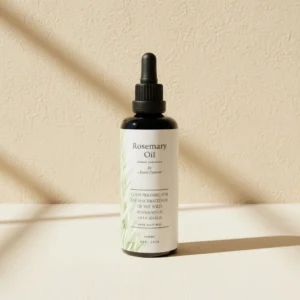
Rosmarinus officinalis — cold-macerated rosemary oil delivering rosmarinic acid, carnosic acid, and ursolic acid for scalp circulation, hair loss support, antioxidant skin protection, and anti-inflammatory scalp care
What is Azara Natural's rosemary oil — macerate vs essential oil
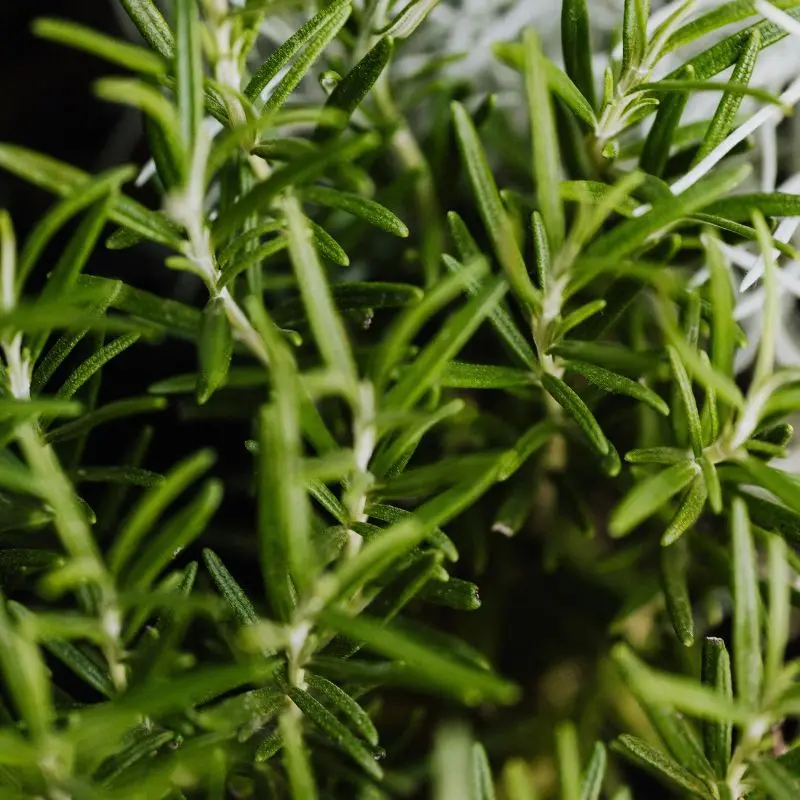
Rosmarinus officinalis L. (rosemary) is an aromatic perennial shrub of the Lamiaceae family, native to the Mediterranean basin — growing wild across Spain, France, Italy, and the coastal Levant. In Spain, romero is deeply embedded in culinary, medicinal, and religious tradition.
Azara Natural’s rosemary oil is produced by cold maceration — rosemary leaves and flowering tops cold-infused in a carrier corn oil over an extended period. This is a fundamentally different product from steam-distilled rosemary essential oil.
Cold maceration extracts:
– Rosmarinic acid — a phenolic acid with documented antioxidant and anti-inflammatory activity
– Carnosic acid and carnosol — diterpene antioxidants responsible for rosemary’s extraordinary oxidative stability
– Ursolic acid — a pentacyclic triterpene with documented 5-alpha reductase inhibitory activity relevant to androgenetic hair loss
– high quality corn oil base. The corn oil’s exceptionally high vitamin E content provides outstanding protection for rosemary’s heat-sensitive phenolic compounds — rosmarinic acid and carnosic acid — during maceration and storage. This is a deliberate formulation choice: the same antioxidant properties that make carnosic acid and carnosol valuable in the macerate are mirrored and reinforced by the corn oil carrier’s tocopherol content, creating a doubly antioxidant-stabilised product.
Steam distillation extracts primarily volatile terpenes: 1,8-cineole (20–50%), camphor (5–21%), alpha-pinene, camphene, borneol. Most of the non-volatile phenolic actives — rosmarinic acid, carnosic acid, ursolic acid — do NOT carry over significantly in steam distillation. They remain in the spent plant material.
For scalp and skin applications targeting anti-inflammatory and antioxidant mechanisms, the cold macerate delivers the more complete phytochemical profile. For aromatherapy where concentrated terpene activity is the goal, the essential oil serves a different and complementary purpose.
Mediterranean heritage: 2,000 years of documented use
Rosemary’s documented use in medicine and cosmetics spans over two millennia of Mediterranean civilisation. Dioscorides documented it in De Materia Medica (circa 65 CE) for its stimulating and circulation-promoting properties. In medieval Spain, rosemary preparations were documented in Arabic medicine translated through the Toledo School of Translators.
In 14th-century Hungary, “Hungary Water” — one of the earliest documented European perfumes — was based on rosemary extract, attributed with anti-aging and hair-strengthening properties and used across European courts including the Spanish court.
In contemporary Spanish pharmacy tradition, romero remains one of the most recognized natural health botanicals — available in virtually every Spanish farmacia and herbolario. Deeply familiar to Spanish consumers as a household remedy for circulation, memory, and hair health.
Key compounds and the minoxidil comparison study
Rosmarinic acid: Documented COX-1 and COX-2 inhibitor, potent free-radical scavenger, and relevant to scalp microbial balance.
Carnosic acid and carnosol: Diterpene antioxidants responsible for rosemary’s exceptional oxidative stability — providing both skin antioxidant protection and oil self-preservation.
Ursolic acid: A pentacyclic triterpene with documented 5-alpha reductase inhibitory activity — directly relevant to androgenetic hair loss by inhibiting the enzyme that converts testosterone to DHT at the follicle level. Also has NF-κB inhibitory and fibroblast-stimulating properties.
The minoxidil comparison — what the study actually found:
The 2015 SKIN med study randomized 100 patients with androgenetic alopecia to either 2% minoxidil or rosemary oil for 6 months. Hair count at 6 months was not significantly different between groups — equivalent efficacy. Rosemary group reported significantly less scalp itching.
Skin benefits: antioxidant protection, anti-inflammatory, and circulation
Antioxidant protection against photoaging:
Carnosic acid and carnosol’s antioxidant capacity is among the highest of any botanical — applied in the macerate, they provide sustained free-radical scavenging against UV and pollution-driven oxidative stress. For Spain’s high-UV Mediterranean climate, consistent rosemary application contributes meaningfully to cumulative photoaging prevention.
Anti-inflammatory skin calming:
Rosmarinic acid’s COX inhibition and NF-κB modulation reduce surface skin reactivity. For rosacea-prone and reactive skin — common in fair European complexions — rosemary macerate provides gentle anti-inflammatory support without the intense warming of more stimulating botanicals like mustard or camphor.
Circulation and skin vitality:
The 1,8-cineole fraction partially transferred during maceration provides mild vasodilatory activity — improving local skin microcirculation and contributing to the improved complexion radiance reported with consistent use.
Antimicrobial activity:
Rosmarinic acid and terpene fractions contribute antimicrobial activity against Malassezia, S. aureus, and other skin pathogens — relevant for acne-prone and scalp-challenged skin types.
Hair benefits: the evidence base
Androgenetic alopecia (pattern hair loss):
The SKINmed 2015 study establishes rosemary as the most evidence-supported botanical for pattern hair loss. Ursolic acid’s 5-alpha reductase inhibitory activity reduces DHT production at the follicle level — a mechanism complementary to but different from minoxidil’s vasodilation approach.
Telogen effluvium (stress-related shedding):
Rosemary’s anti-inflammatory and circulation mechanisms support scalp recovery following stress, hormonal shifts, or illness-triggered shedding — helping follicles return to active growth phase faster.
Scalp antimicrobial and dandruff:
Rosmarinic acid and terpene fraction contribute activity against Malassezia and S. aureus — relevant for dandruff and seborrheic dermatitis.
Application:
Apply 8–12 drops to scalp sections and massage firmly for 5–10 minutes. Leave 1–2 hours before washing with sulfate-free shampoo. Twice weekly for active hair loss concern; once weekly for maintenance. Blended with castor oil creates a particularly effective combination.
Rosemary oil in massage: circulation, muscle recovery, and scalp
Rosemary is one of the classic aromatherapy massage botanicals — historically used for its warming, stimulating, and circulation-promoting properties across European folk massage tradition.
Sports and muscle recovery massage:
The 1,8-cineole and camphor fraction contribute warming-stimulating effect during massage, improving local blood flow and providing mild analgesic activity. Rosemary macerate at 10–20% in a sweet almond or sesame carrier adds circulatory and anti-inflammatory support to sports massage. Well-suited for post-training recovery, leg circulation massage, and upper back and neck tension.
Scalp massage (primary application):
Rosemary is most effective in massage contexts on the scalp. Firm circular scalp massage combines: terpene-fraction circulation stimulation, ursolic acid’s 5-alpha reductase activity, anti-inflammatory rosmarinic acid, and the mechanical blood flow benefit of the massage itself — all simultaneously at the follicle level.
Cognitive and mental clarity massage:
Multiple studies confirm rosemary aromatherapy improves alertness, working memory, and speed of memory. For neck, shoulder, and temple massage on mentally fatigued clients, rosemary’s aromatic and physical tension-releasing combination is particularly effective.
Massage types most suited to rosemary macerate:
Scalp massage (primary), sports and circulation massage, muscle recovery, cognitive clarity massage, tension headache (temples/neck).
Essential oil vs macerate vs synthetic: what each is, best applications, and price
Steam-distilled rosemary essential oil
Concentrated volatile terpenes — 1,8-cineole (20–50%), camphor (5–21%), alpha-pinene. Minimal non-volatile phenolic actives (rosmarinic acid, carnosic acid, ursolic acid) since these don’t distil over.
Best for: aromatherapy diffusion, diluted scalp application for the circulatory terpene mechanism (1–3% in a carrier), muscle and circulation massage blends at appropriate dilution. For skin leave-on applications or daily scalp routines, it requires careful dilution — camphor content makes it inappropriate near the face undiluted. Very stimulating — not ideal in the evening for those sensitive to aromatic stimulation.
Price: €8–20 for 10ml of genuine Rosmarinus officinalis essential oil. Spanish and Provençal origins are most valued. Cheap unlabelled “rosemary oil” under €5 for large volumes is often adulterated with camphor or white camphor to replicate the scent.
Cold-macerated rosemary oil (Azara Natural)
Complete phytochemical infusion — non-volatile phenolics (rosmarinic acid, carnosic acid, ursolic acid) plus partial terpene transfer, delivered in a skin-appropriate carrier. A more complete botanical profile than the essential oil for skin-contact applications.
Best for: daily scalp treatment (the primary recommended use), anti-inflammatory skin care, antioxidant facial protection, sports recovery massage, and any application where consistent repeated skin contact is the goal. Benefits accumulate with regular use rather than depending on terpene volatility. Appropriate for daily use without dilution concerns.
Price: €20–40 for 50–100ml of quality cold macerate. More accessible for daily scalp use than managing essential oil dilution at every application.
“Rosemary oil” in mass market hair products
Highly variable quality. Many products add rosemary fragrance (synthetic 1,8-cineole and camphor-dominant profile) rather than genuine botanical material.
Check the INCI list: genuine macerate appears as “Rosmarinus officinalis leaf/flower extract” in a carrier oil.
Azara Natural's Rosemary Oil is cold-macerated from Rosmarinus officinalis — preserving rosmarinic acid, carnosic acid, and ursolic acid alongside the terpene fraction in a skin-appropriate carrier. Formulated into the Hair Care Blend. Available individually for scalp treatment and anti-aging skincare.
Get Azara Natural Rosemary OilFrequently Asked Questions
Colour: Dark green — reflecting chlorophyll and carotenoid content. Colourless or pale yellow without any green tint has been filtered of its phytochemical content.
Scent: Herbaceous, aromatic, distinctly rosmarinic — recognisably rosemary but gentler than essential oil’s sharp medicinal penetration. The aromatic quality confirms active compound transfer.
The 2015 SKINmed randomized controlled trial found rosemary oil equivalent to 2% minoxidil for hair count at 6 months in patients with androgenetic alopecia, with less scalp itching. This is the highest-quality evidence available for any botanical hair growth claim. Results require consistent use over at least 3–6 months. Rosemary is most evidence-supported for androgenetic (pattern) hair loss and telogen effluvium — less evidence exists for scarring alopecia or alopecia areata.
Not necessarily. Spanish farmacias typically sell rosemary essential oil (aceite esencial de romero) — the steam-distilled aromatic fraction requiring dilution before scalp application. Cold-macerated rosemary oil is a different product — already in a carrier, containing the non-volatile phenolic actives alongside the terpene fraction. Both are genuine rosemary products; they serve different applications. Farmacia essential oil: €6–12 for 10ml, dilute before use. Quality macerate: €20–40 for 50–100ml, apply directly to scalp.
Cold-macerated rosemary oil can be applied directly to the scalp without additional dilution — the carrier already provides appropriate concentration of actives. Rosemary essential oil should always be diluted (3–5 drops per teaspoon of carrier) before scalp application — camphor and 1,8-cineole at undiluted concentrations can cause irritation. Perform a patch test before first full application with any rosemary preparation.