
Why the shift toward natural cosmetics is not a trend but a convergence of skin science, toxicology, and formulation chemistry — with honest caveats included
Biocompatibility: the structural argument for botanical ingredients
The skin’s barrier is a lipid bilayer structure — a system of fatty acids, ceramides, cholesterol, and wax esters that regulate what passes through the skin and what doesn’t. Cold-pressed botanical oils contain the same lipid families that form this barrier, which is why they integrate with skin tissue rather than sitting on top of it.
Synthetic moisturizers typically work through a different mechanism: film-forming compounds (silicones, polymers, mineral oil derivatives) create an occlusive or semi-occlusive layer on the skin’s surface that slows water evaporation and produces an immediate softening effect. This is a valid function — but it’s surface-level rather than structural. When the film is washed away, the skin’s barrier composition is largely unchanged.
A study published in Dermatology and Therapy (2018) found that cold-pressed oils improve skin barrier function and hydration significantly more than synthetic moisturizers over time — a finding consistent with the mechanism of lipid integration versus surface occlusion.
The practical implication: cold-pressed oils don’t just make skin feel better. They contribute material to the barrier’s structural composition. Their effects compound with consistent use in a way that film-formers don’t.
The endocrine disruption concern: what the evidence actually says
This is an area where precision matters — the natural skincare space has a habit of overstating risk, and the synthetic skincare industry has a habit of understating it.
Parabens (methylparaben, propylparaben, butylparaben) are among the most widely used preservatives in cosmetics. They are inexpensive, effective, and have a long safety history at the concentrations used in individual products. The legitimate concern: they are classified as endocrine-disrupting chemicals (EDCs) with documented estrogenic activity. They accumulate in human tissue — detected in breast tissue, blood, urine, and breast milk. Researchers have found parabens at higher concentrations in malignant breast tumors than in benign tissue, though it is critical to be precise: causation between paraben exposure and breast cancer has not been established in human clinical evidence. What is established: they are EDCs, they bioaccumulate, and their long-term cumulative effects alongside other EDCs in daily personal care use remain inadequately studied.
Phthalates, used in synthetic fragrance and some plasticizers in cosmetic packaging, show a clearer risk profile: multiple studies link phthalate exposure to hormonal disruption, particularly affecting reproductive health.
Formaldehyde-releasing preservatives — DMDM hydantoin, imidazolidinyl urea, quaternium-15 — are classified as human carcinogens by the WHO in inhalation contexts. In leave-on skin products, the primary documented risk is sensitization and allergic contact dermatitis with repeated exposure.
No single use of any of these will harm most people. The concern is cumulative daily exposure across multiple products — moisturizer, serum, shampoo, body lotion — which is not captured by single-product safety assessments that regulators currently rely on.
<br />
"oil is for dry skin" is a marketing artifact — the biology is more specific than that.
Where natural cosmetics still need to be honest
The credibility of the natural cosmetics argument depends on being accurate about its limitations — not just its strengths.
“Natural” does not mean safe by default. Essential oils at improper concentrations are among the most common causes of cosmetic allergic contact dermatitis. Limonene (citrus), linalool (lavender), and cinnamal (cinnamon) are all documented skin allergies now regulated by EU fragrance legislation. The concentration at which a botanical compound becomes a sensitizer is a real formulation concern that serious natural brands must take as seriously as any synthetic chemist.
Stability is a genuine challenge. Highly polyunsaturated botanical oils — rich in omega-3 and omega-6 fatty acids — oxidize faster than synthetic alternatives. An oxidized oil produces free radicals that are skin-damaging. This is why packaging, storage conditions, and shelf life management matter in botanical formulation: dark glass, no heat exposure, and vitamin E-rich stabilizing oils blended in appropriate proportion are functional choices, not aesthetic ones.
“100% natural” claims should be examined. The word “natural” has no legal definition in EU or US cosmetic regulation. A product with one certified organic ingredient and 23 synthetic ones can legally include “natural” somewhere on its marketing materials. Reading the ingredient list is the only way to actually know what’s in a product.
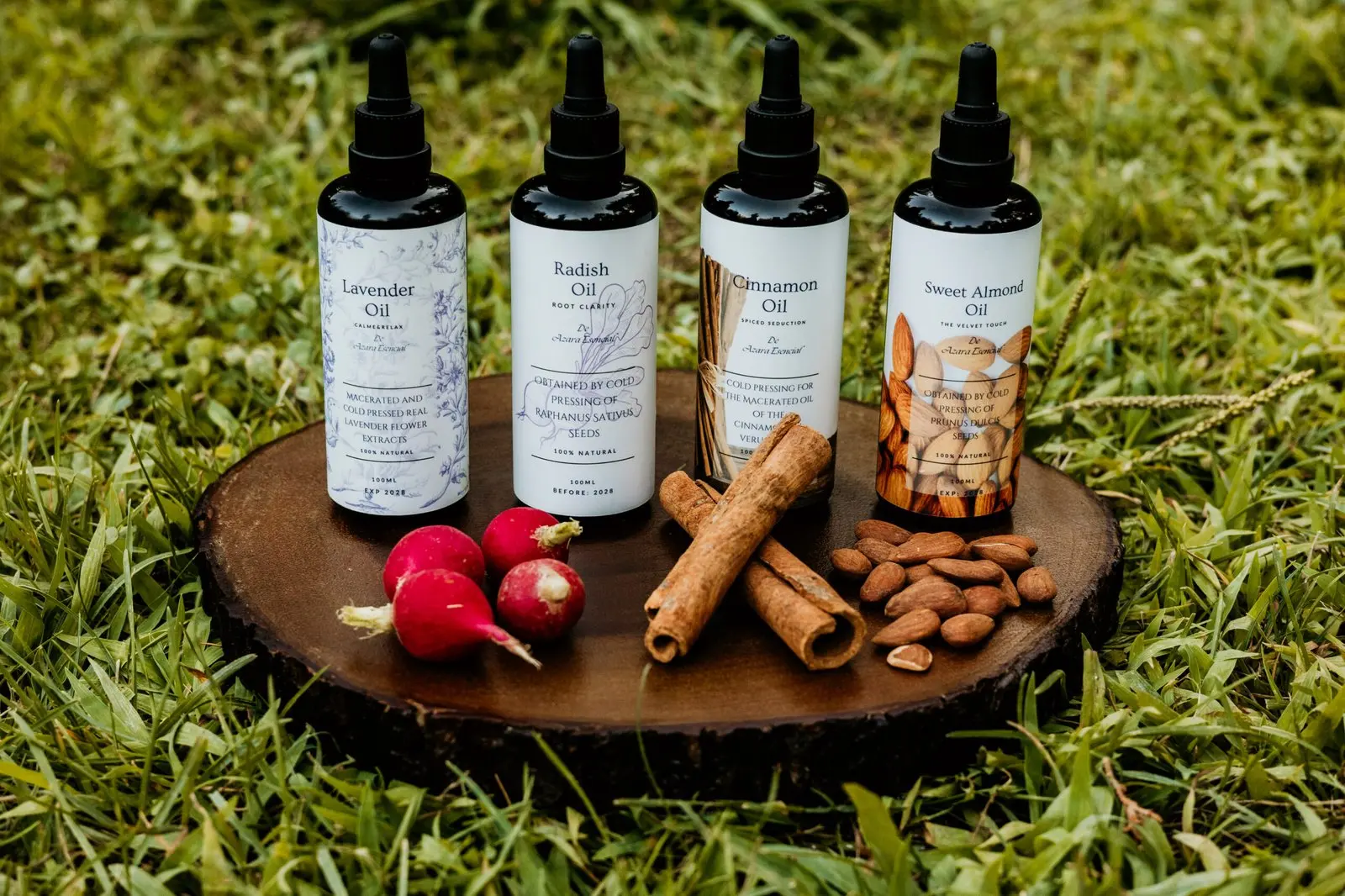
Azara Natural's two-phase botanical blends — formulated for face, body, hair, and targeted massage — contain cold-pressed and macerated oils with no synthetic additives, preservatives, or fillers. Every ingredient is listed by its full INCI name.
Explore the Beauty Care BlendsFrequently Asked Questions
No — both are regulated under EU Cosmetics Regulation 1223/2009, which applies the same safety assessment requirements regardless of ingredient origin. Every cosmetic product placed on the EU market must undergo a safety assessment by a qualified cosmetic chemist, and every ingredient must be listed by INCI (International Nomenclature of Cosmetic Ingredients) name. There is no separate “natural” regulatory category. What this means in practice: a natural product is not automatically safe, and a synthetic product is not automatically unsafe — both must meet the same baseline safety assessment standard.
All skin types — with the right oil selection. The fatty acid profile of the oil is what determines skin type compatibility, not the fact that it’s an oil. High-linoleic oils (black seed, chia, rosehip) are well-suited to oily and acne-prone skin because linoleic acid mirrors healthy sebum composition. High-oleic oils (avocado, macadamia) are better suited to dry and mature skin. Lightweight oils (radish seed, arugula) absorb rapidly and suit combination skin. The categorical belief that “oil is for dry skin” is a marketing artifact — the biology is more specific than that.
Cold maceration involves immersing plant material — flowers, roots, resins, bark — in a cold-pressed carrier oil for an extended period (several weeks), allowing the plant’s fat-soluble phytochemicals to transfer into the oil base without the application of heat. The result is an oil that carries both the carrier’s fatty acid profile and the infused plant’s active compounds — boswellic acids from frankincense resin, gingerols from ginger root, eugenol from clove bud. This is meaningfully different from standard extraction, which either heat-presses the seed material (destroying heat-sensitive compounds) or produces a steam-distilled essential oil (losing the non-volatile phytochemicals). Cold maceration preserves the full phytochemical complexity of the plant material.
Primarily marketing, in its current form. “Clean beauty” has no legal definition in any major cosmetic market. Brands use it to imply the absence of certain controversial ingredients — parabens, sulfates, synthetic fragrance — but there is no regulated list, no certification body with legal standing, and no threshold that must be met. Some brands use it meaningfully to describe genuinely simplified formulations; others use it to describe products that are largely synthetic with a few botanical additions. The only reliable check is reading the INCI ingredient list, understanding what each ingredient is, and forming your own judgment — rather than relying on any front-of-pack claim.