A practical, science-informed guide to switching your routine without triggering breakouts, sensitivity, or the confusion that makes most people give up
Why sudden transitions cause problems — and what to do instead
The skin’s microbiome, barrier composition, and sebum regulation are all calibrated to the routine you currently use. When you strip that routine away suddenly — removing familiar emulsifiers, preservatives, and synthetic skin-feel agents that your skin has adapted to — the skin can temporarily overreact. This is sometimes called the “purging” or “detox” phase. While there is a real phenomenon of skin adjusting to a new routine, the claims around “toxin expulsion” are not medically accurate. What actually happens: the skin’s sebum regulation, microbiome balance, and barrier function take time to recalibrate to new inputs.
The solution is a phased transition: introduce one new product at a time, over a period of two to four weeks per product. This gives your skin time to adapt to each change before the next one is introduced, and allows you to identify precisely which product causes any reaction — rather than having to guess when you’ve swapped everything simultaneously.
A practical order: start with the product you use most frequently and that stays on your skin longest. For most people this is a moisturizer or facial oil. Once that is established without adverse reaction, transition the next product.
Matching oil type to skin type: a fatty acid guide
The most common mistake in switching to botanical oils is choosing based on reputation or name recognition rather than fatty acid profile. Different skin types have different lipid needs, and choosing the wrong oil for your skin type is what produces the “oil doesn’t work for me” experience.
Oily and acne-prone skin: High-linoleic oils are the appropriate choice. Linoleic acid (omega-6) mirrors the composition of healthy sebum — and oily skin is frequently linoleic-deficient, which is why it overproduces sebum to compensate. Black seed oil (Nigella sativa), chia seed oil, and rosehip oil have high linoleic content and low comedogenic ratings. Applied in small amounts to slightly damp skin, they are generally well-tolerated even by oily skin types. Potassium alum — sometimes recommended for oily skin — is an astringent that temporarily tightens the appearance of pores but does not address sebum composition or production; it is not a sebum regulator.
Dry and mature skin: High-oleic oils — avocado, macadamia, sesame — are better suited because oleic acid is structurally closer to the lipid composition of mature and dry skin. These oils absorb more slowly and provide sustained conditioning. Avocado oil additionally delivers fat-soluble vitamins A, D, and E that support barrier repair in dry or aged skin.
Sensitive and reactive skin: Lavender macerated oil, violet extract, and chia seed oil’s anti-inflammatory omega-3 content are appropriate starting points. The key for sensitive skin is introducing one ingredient at a time and avoiding essential oil-heavy products initially — even natural essential oils at improper concentrations are among the most common cosmetic sensitizers.
Combination skin: Lightweight, fast-absorbing oils with balanced fatty acid profiles — radish seed oil, arugula (rocket) seed oil — work well because they absorb quickly without adding heaviness to oilier zones while still providing barrier support to drier areas.
The two-phase approach: why layering water before oil works
One of the most effective structural improvements to a natural skincare routine is understanding the sequencing principle: water-based products first, oil-based products second.
The skin absorbs water-soluble and lipid-soluble compounds through different pathways. Hydrosols — steam-distilled botanical waters containing the plant’s water-soluble aromatic compounds — applied to slightly damp skin deliver water-soluble botanical fractions that an oil cannot carry. The oil layer applied immediately after simultaneously seals in that hydration and delivers its own lipid-soluble actives.
This is the logic behind the two-phase ritual: hydrosol mist first, botanical oil second, applied in the post-shower window when skin is warm, damp, and maximally permeable. The two phases are not redundant — they deliver complementary botanical compounds through complementary absorption pathways.
What to expect: realistic timelines for natural skincare results
Managing expectations is where natural skincare advocacy most often fails — by either overpromising or being vague about timelines.
Days 1–7: Skin feel and comfort improve quickly with well-formulated botanical oils because barrier hydration and lipid support work at the surface level first. Immediate softness and improved texture are genuine and expected.
Weeks 2–4: Sebum regulation begins to shift. For oily skin types transitioning to high-linoleic oils, sebum overproduction typically begins to reduce within 3–4 weeks as the skin’s linoleic composition improves. Some purging of congestion can occur in this window as the skin’s lipid balance changes.
Week 4–8: Structural improvements — reduction in fine line appearance, improved skin tone, better barrier resilience — require at least one full cell turnover cycle (approximately 28 days) and often two before they become clearly visible. This timeline is consistent with the clinical evidence for botanical actives like boswellic acids and linoleic acid.
Month 3+: Cumulative effects from consistent use compound over time. The skin is a living adaptive system — consistent botanical support produces progressive improvement rather than a plateau.
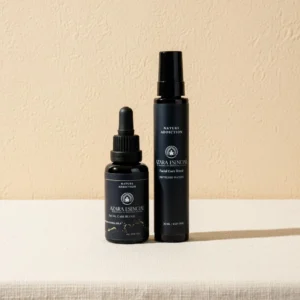
The Facial Care Set — botanical hydrosol mist and cold-pressed oil blend — is designed as a complete two-phase facial ritual and a practical entry point for transitioning to botanical skincare. Both phases together take two minutes and are formulated without synthetic additives, preservatives, or fillers.
Start With the Facial Care SetFrequently Asked Questions
Some adjustment is normal; whether it constitutes “purging” depends on what you mean. The skin’s microbiome, sebum composition, and barrier calibration all adjust when routine inputs change — this can produce temporary mild breakouts or sensitivity, particularly if you’re replacing a synthetic formulation that your skin had adapted to. True purging (accelerated cell turnover clearing existing congestion) is more associated with active ingredients like retinoids. What most people experience when transitioning to botanical oils is a 2–4 week recalibration period, not a dramatic purge. Transitioning one product at a time — rather than overhauling the entire routine — significantly reduces this adjustment.
Yes. Botanical oils work well as the final step in a skincare routine, layered over water-based actives like vitamin C serums, retinoids, or niacinamide. Apply water-based products first and allow them to absorb, then apply the oil to seal and support. The oil does not block the actives; it provides a lipid layer that complements rather than competes with them. This approach allows you to transition gradually — keeping your existing routine and adding botanical oils as the first new element — rather than replacing everything at once.
Comfort and skin feel improve quickly — usually within the first few uses — because the immediate barrier hydration and lipid support work at the surface level. Structural improvements (fine lines, tone, firmness) require consistent use over one to two full cell turnover cycles — approximately 4–8 weeks — before they become clearly visible. This is not a limitation unique to botanical oils; it is the timeline of skin biology. Any product claiming structural change in less than a week is addressing surface appearance, not skin structure.
Yes — a single well-chosen botanical oil is the simplest and most effective entry point to natural skincare. It replaces both moisturizer and serum with one product applied in one step, introduces only one set of new ingredients to track, and produces visible results quickly enough to build confidence before transitioning other products. For face, a high-linoleic oil for oily skin or a high-oleic oil for dry skin is the most appropriate starting point. For body, a multi-functional blend oil applied post-shower covers the largest surface area with the least effort.