
Most synthetic creams work at the skin's surface. Cold-pressed botanical oils work with its biology. Here's what that difference means in practice
What is actually in most synthetic skincare
Understanding common synthetic skincare ingredients requires separating established concerns from overclaimed ones. Both the natural skincare and conventional skincare industries have a history of exaggeration in opposite directions.
Parabens: Methylparaben, propylparaben, and butylparaben are widely used preservatives with documented estrogenic activity — they are classified endocrine-disrupting chemicals (EDCs) that bioaccumulate in human tissue, including breast tissue and blood. Researchers have detected parabens at higher concentrations in malignant breast tumors than benign tissue. The important caveat: a direct causal link between paraben exposure and breast cancer in humans has not been established in clinical evidence. What the evidence does confirm: they are EDCs, they bioaccumulate, and their cumulative effects across multiple daily-use products are inadequately studied by single-product safety assessments.
Phthalates: Used in synthetic fragrance and some plasticizers, phthalates show a clearer documented risk: multiple studies link exposure to hormonal disruption, particularly in reproductive health. They are already restricted in EU toy regulations and facing increasing cosmetic scrutiny.
Formaldehyde-releasing preservatives: DMDM hydantoin, imidazolidinyl urea, and quaternium-15 release small amounts of formaldehyde over time. Formaldehyde is classified as a human carcinogen by the WHO. In leave-on skincare products, the primary concern is sensitization and allergic contact dermatitis with repeated exposure — not acute toxicity from a single use.
Mineral oil and petroleum derivatives: Cosmetic-grade mineral oil has a low comedogenic rating in clinical testing — the claim that it suffocates pores is largely a natural skincare myth. The legitimate concern is different: mineral oil hydrocarbon contaminants (MOSH and MOAH — saturated and aromatic hydrocarbons) have been found to bioaccumulate in human fat tissue and liver. The aromatic fraction (MOAH) contains compounds under scrutiny for genotoxic potential. The European Food Safety Authority has flagged this, and regulatory attention continues.
Cyclic siloxanes: Silicones don’t clog pores — that specific claim isn’t supported by dermatological evidence. But research has shown that certain cyclic siloxanes (D4, D5, D6) can penetrate the skin barrier and accumulate in deeper tissue layers. The EU has already restricted D4 and D5 in wash-off cosmetics due to environmental persistence, and research into dermal accumulation is ongoing.
None of these ingredients causes acute harm at standard cosmetic concentrations in individual products. The concern is chronic cumulative exposure across multiple products, and the long-term effects of EDC combinations that no single-product safety assessment is designed to capture.
Why cold-pressed oils work differently — and where the real limits are
Cold-pressed botanical oils work with the skin’s existing biology rather than creating a synthetic film over it. The reason is structural: the fatty acid families in botanical oils — triglycerides, fatty acids, wax esters — are the same lipid families the skin’s barrier is made from. This allows them to integrate with the stratum corneum’s lipid bilayer through passive diffusion, contributing to the barrier’s structural composition rather than sitting on top of it.
This is why cold-pressed oil effects compound with consistent use: each application contributes to barrier lipid composition, and those cumulative contributions produce progressive structural improvement. Synthetic film-formers produce an immediate effect that disappears when the product is washed away; botanical oil integration accumulates.
The real limits: botanical oils have their own failure modes. Highly polyunsaturated oils (omega-3 and omega-6 rich) oxidize faster than saturated synthetic alternatives — an oxidized oil is skin-damaging rather than beneficial. Natural essential oils at improper concentrations are among the most common cosmetic allergens — “natural” does not mean non-sensitizing. And some synthetic ingredients — pharmaceutical retinoids, certain peptides, clinically validated active concentrations of vitamin C — simply do the work they do better than any botanical equivalent currently available.
How to make a practical switch: what to replace first
The most effective transition from synthetic to botanical skincare targets the products with the longest skin contact time first — leave-on products rather than rinse-off products — because contact duration determines how much of any ingredient the skin is exposed to.
Replace first: daily moisturizer or facial oil. This is the product with the longest daily skin exposure time. A well-chosen botanical oil blend applied to slightly damp skin after cleansing replaces both moisturizer and serum in a single step. Choose based on skin type (high-linoleic for oily skin, high-oleic for dry skin) rather than by brand name.
Replace second: body moisturizer. The body has the largest skin surface area and receives the least targeted care — yet the same principles apply. A post-shower oil ritual on slightly damp skin delivers more barrier benefit in two minutes than a body lotion applied to dry skin at any point in the day.
Keep or modify: cleanser and treatment actives. Oil cleansers using cold-pressed botanical oils are effective and gentle. Rinse-off products carry lower accumulated exposure risk than leave-on products, so this category is lower priority for transition. If you are using pharmaceutical-grade actives (retinoids, vitamin C at clinical concentrations), these can coexist with botanical oils — applied first, sealed in with the oil afterward.
The one-product-at-a-time rule: Do not replace your entire routine at once. Introduce one new product, use it alone for two to four weeks, observe your skin’s response, then add the next. This approach eliminates guesswork when reactions occur and gives your skin time to adapt to each new input before adding another.
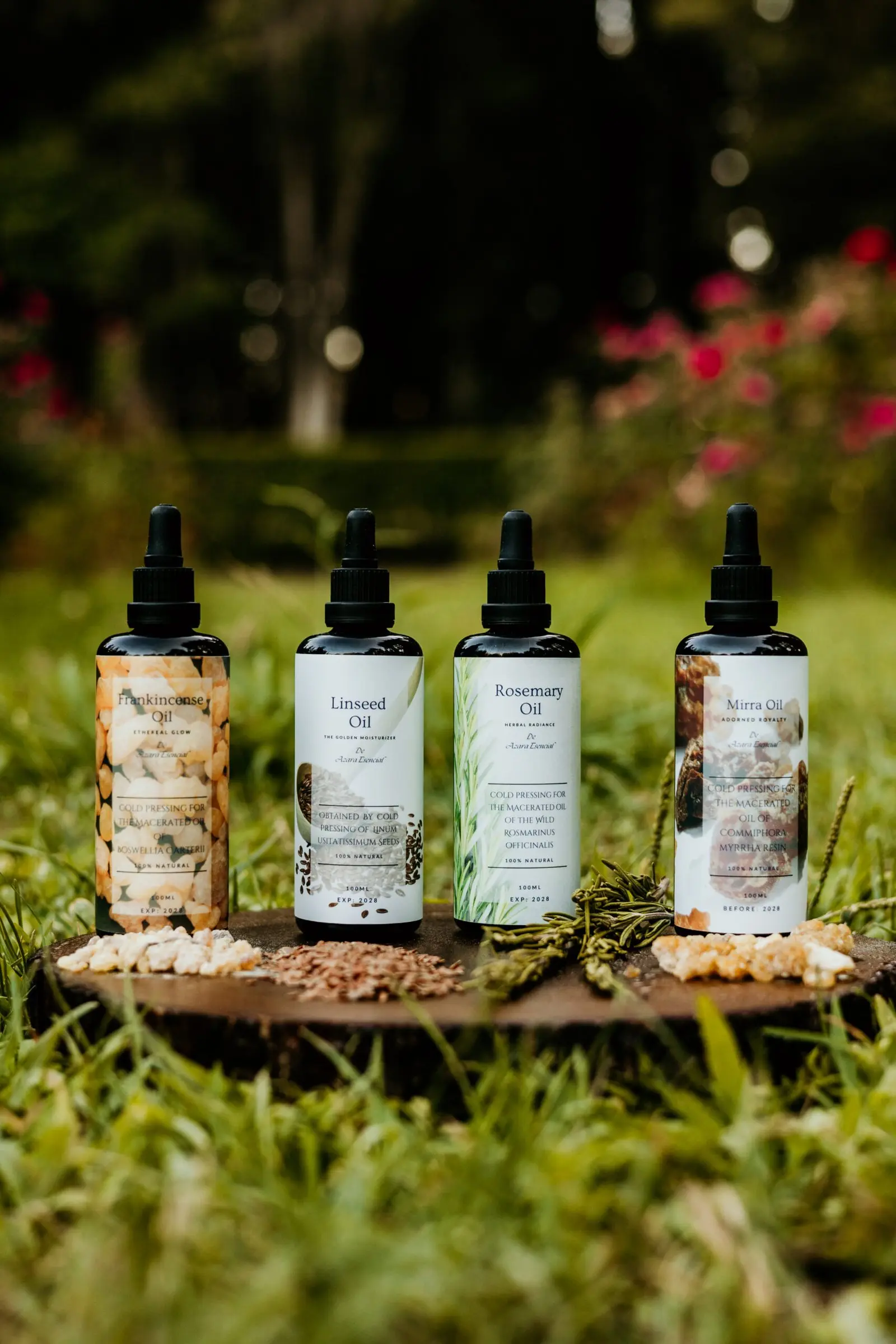
Azara Natural's cold-pressed and macerated oils contain no parabens, phthalates, synthetic preservatives, mineral oil derivatives, or synthetic fragrance. Every ingredient is a botanical oil produced by cold pressing or cold maceration — listed in full on every product.
Explore the Cold-Pressed Oil RangeFrequently Asked Questions
No — and that framing is one of the biggest sources of confusion in the natural beauty space. Synthetic ingredients span an enormous range: some are well-understood with long safety histories at cosmetic concentrations; others have documented concerns at cumulative exposure levels; and some (like pharmaceutical retinoids) are among the most effective skin actives available. The concern is not “synthetic = bad” but rather specific ingredient categories — endocrine-disrupting chemicals, bioaccumulative compounds, formaldehyde-releasing preservatives — whose risk profiles justify avoiding them when effective alternatives exist. Cold-pressed botanical oils provide those alternatives for the moisturization and barrier-support categories.
Not directly. Pharmaceutical retinoids work at concentrations and through receptor mechanisms that botanical vitamin A precursors (like rosehip’s beta-carotene) don’t replicate at equivalent efficacy. High-concentration vitamin C serums at clinical pH deliver antioxidant activity that botanical antioxidants provide more slowly. The appropriate approach: use botanical oils as the barrier support, lipid delivery, and general skin health foundation — and retain clinically validated synthetic actives where you specifically need their particular mechanism. They are complementary, not mutually exclusive.
No. Essential oils at improper concentrations are among the most well-documented causes of cosmetic allergic contact dermatitis. Limonene, linalool, cinnamal, and eugenol — all naturally occurring in botanical ingredients — are now listed as regulated fragrance allergens by the EU precisely because they cause sensitization at sufficient concentrations. “Natural” does not mean hypoallergenic. For sensitive skin, single-ingredient or minimal-ingredient cold-pressed oils (without essential oil additions) are the appropriate starting point — and patch testing on a small area before full use is always sensible.
Read the INCI ingredient list on the product’s label or website. Parabens appear as methylparaben, ethylparaben, propylparaben, butylparaben, or phenylparaben. Formaldehyde-releasing preservatives include DMDM hydantoin, imidazolidinyl urea, diazolidinyl urea, and quaternium-15. Phthalates typically appear as DEP, DBP, or DEHP — or are hidden within “fragrance/parfum” without specific disclosure. Cyclic siloxanes appear as cyclomethicone, cyclopentasiloxane (D5), or cyclohexasiloxane (D6). EU products sold after January 2025 are required to disclose over 80 fragrance allergens by name above threshold concentrations.