An interview with Jaafar Ghareeb, physiotherapist, chiropractor and co-founder of Azara Natural, on choosing the right oil for every kind of massage.
A real case: Ayman, 39, and a lower back that couldn’t carry the load
One of the cases that has stayed with me from my work in the clinic is a patient called Ayman, a 39-year-old man, married with two children.
Ayman worked in a coffee roastery, and his job required repeated physical effort, especially lifting and carrying sacks of coffee, which put a repeated mechanical load on the lumbar spine.
When he came to the clinic, his condition was chronic. After the medical and functional assessment, and the imaging he had with him, it turned out he had a herniated nucleus pulposus at the L3–L4 and L4–L5 levels of the lumbar spine.
I want to stop here on an important point. The term “slipped disc” is often used in a simplified way, but scientifically we are talking about a change in the disc between the vertebrae, which may come with a bulge or herniation of disc material and, in some cases, irritation of or pressure on nearby nerve structures. That’s why you can’t judge how severe a case is from the MRI alone; the imaging has to be linked to the symptoms and the clinical and functional examination.
What we did
The goal was never to give him a session or an oil and wait for a miracle. We had an organised treatment and rehabilitation programme based on repeated assessment, physiotherapy, improving movement, working on muscle function and adjusting the loads on his spine, while following his response over time.
Ayman started with regular sessions, twice a week, and the plan was adjusted according to his response, not a rigid schedule. During this phase we also used therapeutic massage with plant oils as part of the supporting programme. Among the oils we used were plant blends that included garden cress oil, sticky fleabane oil (known in the Levant as tayoun), and oils derived from frankincense and caper.
And here, too, I want to be scientifically clear: I am not saying these oils treated the herniated disc or returned the disc to its normal anatomical state.
After three months
After about three months of regular follow-up, the change was clear, clinically and functionally. His mobility improved, the symptoms that were limiting his activity decreased, and his daily performance became noticeably better. Most importantly, the later medical assessment led to him being released from the surgical plan that had been proposed at the time, with continued follow-up and rehabilitation.
Again, we must be precise: this does not mean that every patient with a herniated disc can avoid surgery. Some cases need surgical intervention, especially with significant or worsening neurological signs, certain cases of muscle weakness, or bladder or bowel control problems, signs that require urgent medical assessment. But Ayman’s case reminds us of something very important: a herniated disc on an MRI does not automatically mean the patient needs an operation. The decision depends on the full clinical picture, not on the word “herniation” in an imaging report.
Six more months of rehabilitation
After the initial improvement, we didn’t consider the job done. Ayman continued rehabilitation for six more months, because the goal wasn’t only to reduce pain but to restore function and reduce the risk of relapse, especially since his work involves carrying weights. A patient who lifts sacks of coffee needs more than a session to ease the pain: he needs to rebuild his capacity for movement and endurance, learn techniques for handling loads, and improve strength and motor control to match the demands of his job.
That’s where talking about oils becomes more scientific and more honest. The value of an oil isn’t in attributing everything to it, but in knowing when to use it, how to use it, what we can really expect from it, and what we cannot claim.
This is the essence of the treatment I believe in: we treat the person, not just the MRI.
Why Jaafar looks at the person before choosing the oil
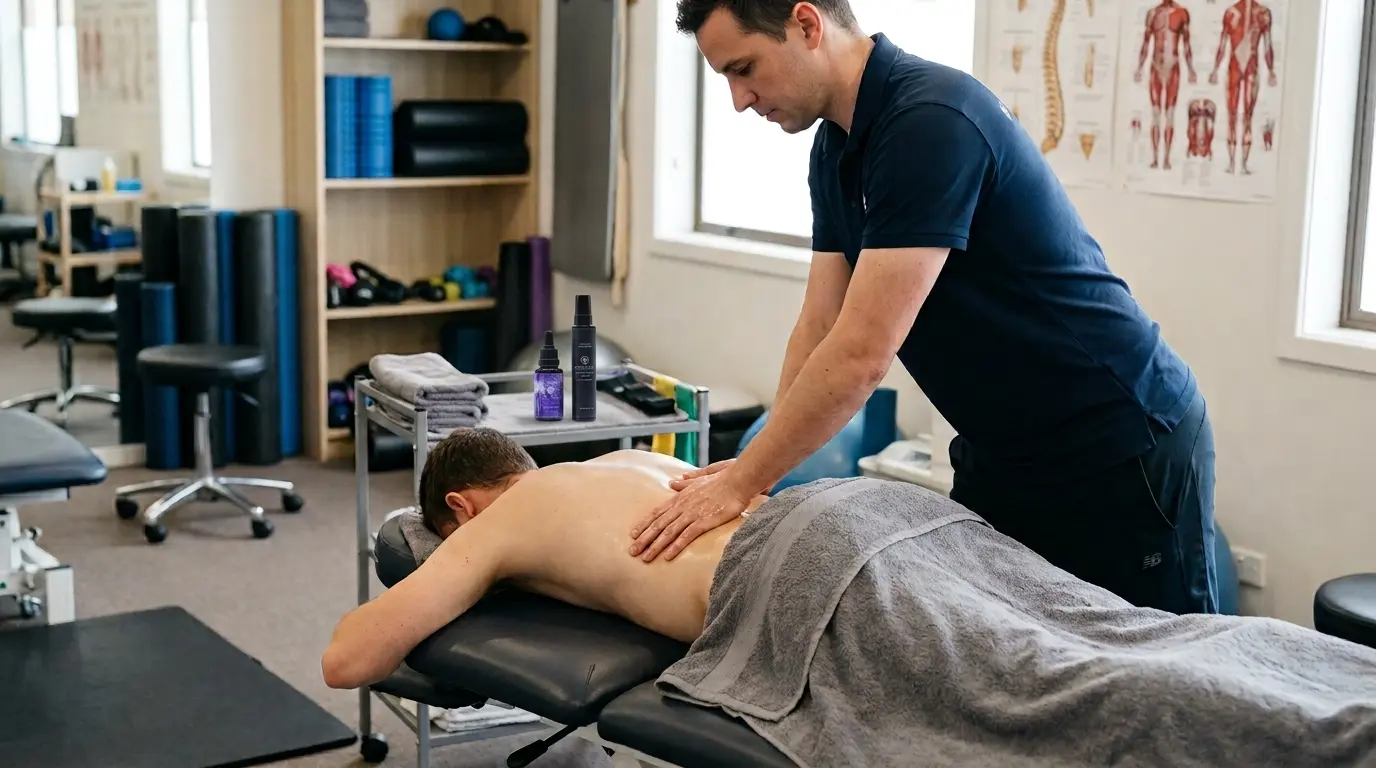
“One of the most important things I’ve learned in physiotherapy and in working with oils is that the patient doesn’t always come with the problem they think they have. Someone may say, ‘I have a spasm in my back muscle,’ while the underlying problem is linked to posture, repeated strain, limited movement, a joint issue, or a certain lifestyle. That’s why I always start by understanding the case before choosing the oil.”
Take someone with recurring tightness in the lower back after long hours of work or sitting. Before any oil, Jaafar wants to know:
- When does the pain start?
- Which movements make it worse?
- Does the pain spread to a limb?
- Is there numbness or weakness?
- What kind of work does the person do, and how do they sit?
- How much do they move during the day?
- Is there a previous injury?
- What eases the pain?
“After that, massage can be part of the plan, and the oil comes in to help carry out the technique. For me, that’s the difference between a good massage product and a product that claims to treat everything.”
Is there one best oil for massage?
“In my opinion, there’s no single oil we can scientifically call ‘the best massage oil’ for every case. Oil in a massage session is not the only therapeutic factor; it’s part of a complete, integrated system. Choosing the oil depends on the goal of the session, the massage technique, the area being massaged, the person’s skin, the length of the session, their age, their health, and even the temperature and friction needed during treatment.
The oil I prefer for a long relaxing massage may not be the right one for a strong sports massage or a session targeting tight muscles. And deep-tissue massage, or massage related to chiropractic work, calls for different oils than superficial or relaxing massage.
So the logical question becomes: what is the most suitable oil for this type of massage, and for this specific case?”
How Jaafar evaluates a massage oil
- Physical properties: viscosity, glide, absorption speed and how the oil behaves on the skin.
- Chemical properties: fatty acid composition, how easily it oxidises, the quality of the raw material, the degree of refining and the product’s stability.
- The skin side: Does it suit dry skin? Could it cause irritation? Does it contain concentrated aromatic substances? Is there a risk of allergy? “For example, you can’t use pepper, clove or cinnamon oil on irritated skin.”
- The functional goal: relaxation, sport, muscle work, joint massage, or skin care during the massage.
“That’s why an excellent oil in one case may be an average choice in another. Some people choose lavender oil for muscle tension or joint massage; it has many benefits, but in these cases it isn’t effective. I believe the best blend is the one that serves the goal, not the one with the most oils.”
Jaafar’s picks by goal
- Sports massage: “The priority is perfect glide, good skin penetration and excellent blood flow. We’d choose sesame or almond oil, with coconut oil, plus black pepper or ginger oil, to build the right system, along with magnesium oil extracted from magnesium salts.”
- Relaxation: “It’s natural to start with calming oils like lavender or rose, and peppermint.”
- Joints and the pain that comes with them: “The base of the therapeutic mix is garden cress oil or turmeric oil, depending on the case.”
What’s the best oil for muscle tension, back and neck pain?
“Here too, I don’t think one blend fits every case. With muscle tension or spasm, I usually prefer an oil base that lets the therapist work long enough without very fast absorption or excess friction. The blend can then be designed around the goal.”
For muscle-focused blends, Jaafar considers:
- Sesame oil
- Sweet almond oil
- Coconut oil, depending on the base needed
- Carefully measured amounts of warming oils such as black pepper, mustard, ginger and cinnamon
“Warming oils enhance blood flow, which helps ease muscle spasm and speed up recovery. I must also mention magnesium oil, because its effects show quickly, especially in chronic tension or spasm. One of the ways to release or ease spasms is dissolving magnesium salts in a bath, which helps the muscles relax.”
Jaafar’s warning: “Adding black pepper, mustard or ginger can give a clear warming sensation, but the feeling of heat is not a direct measure of how strong the effect is. So be careful when adding them. For non-professionals, it’s better to add just one of these oils, to avoid random overloading, because it can irritate the skin.”
Which oil for joints, older adults and athletes?
“These are three different groups, so I don’t like putting them in one mould.”
Older adults
“I give priority to safety, skin suitability, ease of massage, and avoiding very irritating blends. With age, the skin can become drier and more sensitive. Here we can use black seed oil in light concentrations, frankincense oil for its distinctive anti-aging quality, turmeric and garden cress oils, which suit the body’s joints, and castor or almond oil for good moisturising. With age, a joint-care oil or blend, especially for the knee, becomes essential in daily life. That’s what I’ve found in my practice: more than 60% of my patients over 45 had knee or lower-back problems.”
Athletes: before and after training
“For athletes, the goal may be different: warming the tissues, relaxing after training, making massage easier, or giving a refreshing or warming feeling. A product used before activity isn’t necessarily ideal after it.
Before activity, it’s important to prepare the muscles for effort. We’d use a warming oil like ginger or black pepper in light concentrations, with coconut or sesame oil and a small amount of frankincense oil. The blend should have a light viscosity before training, because the goal is different from other massage sessions.
After activity, we focus on bringing the body back to rest and easing the tension or strain from training. Here we might use different oils, like rose, lavender or even camphor, with oils that glide well and have useful properties, like linseed and almond.”
Massage around the joints
“We need to be more precise with terminology. Oil can be an excellent way to make massage around the area easier, but it doesn’t reach the joint in a way that means it ‘removes joint wear’ or ‘rebuilds cartilage.’ What it does is enhance blood flow, which matters for joints: the better their blood supply, the more pain and friction ease, and it contributes to better joint health.”
A good joint blend, in Jaafar’s view, should combine:
- An oil base with suitable glide
- Good stability in storage
- An acceptable scent
- No skin irritation
- Suitability for a long massage session
- Plant ingredients chosen for the goal, not just for the number of ingredients. “It’s common to find blends with many ingredients that offer little benefit.”
Carrier oil, essential oil or infused oil: what’s the difference?
“This is one of the topics where people get most confused when talking about natural oils.”
Carrier oil. “A stable plant oil, like sweet almond, sesame or jojoba, made of triglycerides. It’s used as a base for massage and to dilute essential oils, and as a fatty medium to carry and spread oil-soluble plant compounds. It contains fatty acids and phenolic compounds, and some carrier oils affect how a product spreads on the skin and give it its feel.”
Essential oil. “A concentrated aromatic substance, usually obtained from plant parts like leaves, flowers or wood, by distillation, or by pressing in some plants. It isn’t just a ‘strong plant oil.’ It’s a concentrated substance with a completely different chemistry, so I don’t treat it like almond or sesame oil. It can’t be used directly because of its strong properties; it must be diluted first. Direct use is dangerous: it can cause burns, allergy, irritation, and even phototoxicity or neurotoxicity, depending on the oil.
Follow the recommended dilution for each essential oil: around 0.5–1% for facial care, and 1–2% for full-body use. Always do an allergy test on a small area on the inside of the forearm: apply one diluted drop and wait 24 hours to make sure there’s no allergic reaction.”
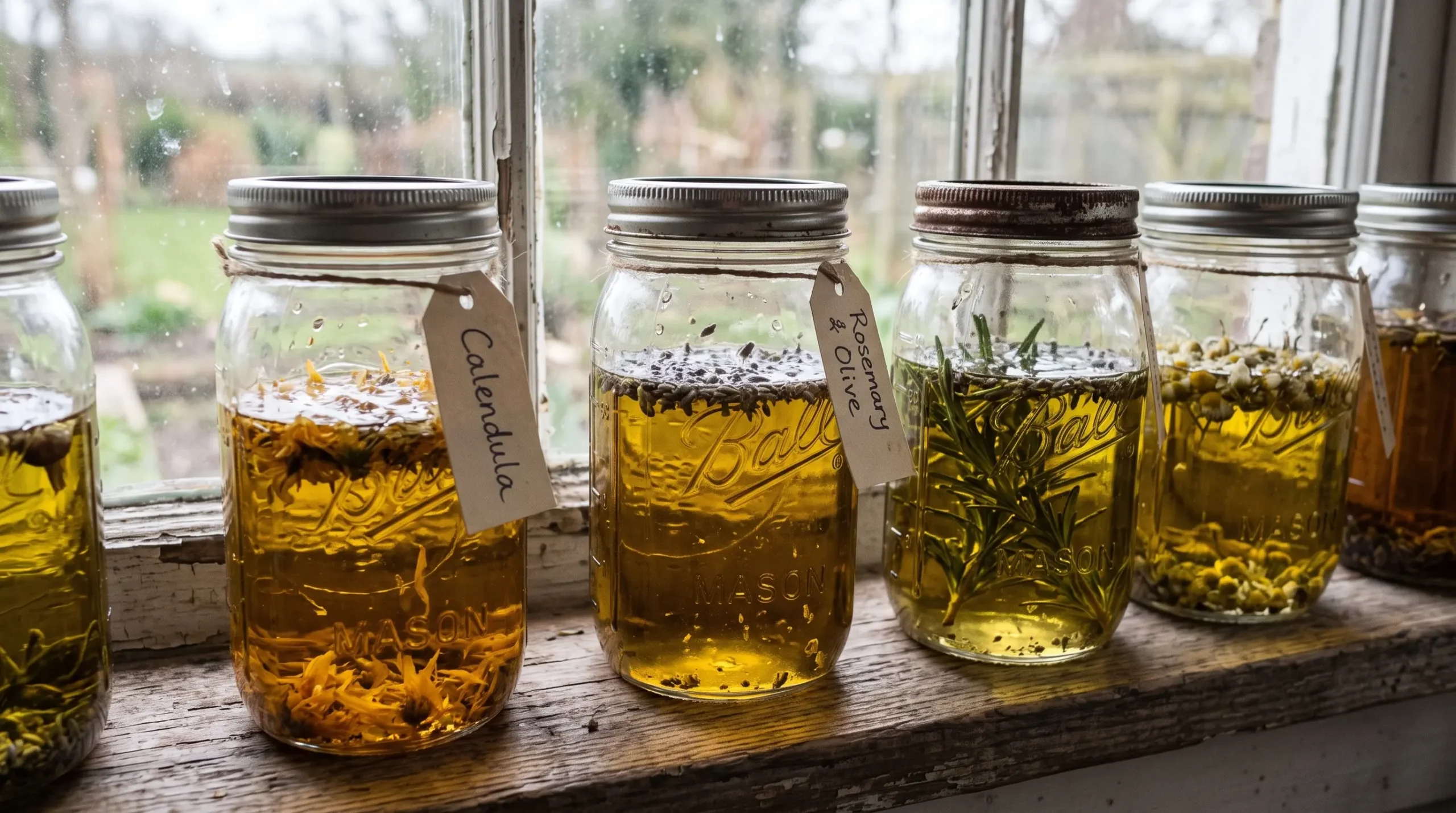
Infused (macerated) oil. “A carrier oil into which some oil-soluble compounds have been extracted from a plant or plant part by soaking. The result varies a lot depending on the plant, the preparation method, the temperature and the time. I prefer infused oils, because they’re the safest, you can control the concentration of active compounds, and they’re very well suited to massage.”
Jaafar’s honest verdict on the most popular massage oils
“Every oil has a strength, so I don’t like ranking them as if one is absolutely the best.”
- Sweet almond oil: “An excellent choice for massage, especially for its feel, good glide and wide acceptance on the skin. I prefer it for a long, comfortable session, especially when we don’t need a strong warming sensation.”
- Sesame oil: “One of the most important oils in massage blends, with a long history of traditional use; in the Levant it’s known as siraj oil. Its texture suits massage, and it can be used as a base or within a blend.”
- Coconut oil: “Good skin properties, but its physical behaviour depends on temperature, so storage and use need attention. I don’t necessarily prefer it as the only base for every massage.”
- Olive oil: “It can be used, but it’s not always my first choice for a long professional massage. Its texture, scent and behaviour on the skin can make other oils more suitable.”
- Jojoba oil: “Excellent for the skin, so I see it more in specialised products, not necessarily as an economical base for a full-body massage.”
- Black seed oil: “Very interesting from a research point of view, but I don’t treat it as a direct treatment for every pain or inflammation. It can go into specific blends, taking scent, concentration and skin tolerance into account.”
- Sunflower oil: “Usable for massage, especially since it contains linoleic acid, which gives it good skin properties, but it’s not the best choice, especially if it hasn’t been refined properly.”
“In the end, I sometimes prefer mixing more than one carrier oil to get a balance between glide, absorption, stability, cost and feel on the skin.”
Paraffin, mineral oil and refined oils in clinics
- “Paraffin or mineral oils are usually a mixture of liquid hydrocarbons derived from refined petroleum fractions. They aren’t one pure chemical, but a mixture of straight, branched and cyclic hydrocarbon chains.”
Advantages, according to Jaafar
- Good glide during massage, with less friction between hand and skin
- They stay on the skin surface a long time and don’t dry quickly
- They reduce water loss from the skin’s surface layer and feel smooth
- Relatively stable; they don’t go rancid quickly like some plant oils
- Little scent or colour when highly refined
- Usually free of plant aromatic compounds that may cause allergy
Disadvantages
- Usually petroleum-based and non-renewable, with environmental impact from extraction, refining and disposal
- They usually contain no essential fatty acids, ceramides, vitamins or nourishing compounds for the skin
- They don’t rebuild the skin barrier; they only reduce water loss temporarily, as long as the layer is there
- Limited skin absorption, so they don’t reach the muscles or offer a deep benefit in massage
- They can feel heavy and greasy, leaving shine or an uncomfortable feeling
- They can trap heat and moisture, especially under clothing or in skin folds
- In some people, they may cause local blockage or inflammation of hair follicles
- Their safety depends heavily on refining; an industrial or unknown-source product may contain harmful impurities
- Spills on the floor or massage table can cause slips and falls
“The words ‘medical’ or ‘paraffin’ alone don’t mean a product is suitable for human use. Lubricating or technical oil should never be used for body massage, whatever its colour or appearance.”
Oil, cream, lotion or ointment for massage?
“I choose according to the type of session. The real difference in massage isn’t simply that oil is ‘natural’ and cream is ‘watery’; the basic difference is in the continuous phase, viscosity, glide, friction, absorption speed, and the product’s ability to form a protective layer on the skin.”
Oil is the first choice for long manual massage. “Because it’s mainly a continuous oil phase, it gives a clear, lasting glide between the therapist’s hand and the skin. It allows long, flowing strokes like effleurage, lets the therapist control pressure without dragging the skin, and stays effective longer than lotion, especially in long sessions.” Best for: therapeutic muscle massage, sports massage, deep massage, back, neck and limbs, and sessions of 20–60 minutes.
Cream is for a balance between glide and moisture. “A cream is an emulsion, not just ‘oil diluted with water.’ It gives medium glide with moisture and a richer feel. It suits small areas, hands and feet, local massage, and people who don’t want a visible oily layer.” But: “More waxes and butters aren’t necessarily an advantage for massage. The cream becomes more resistant to the hand’s movement and turns into something closer to a barrier cream.”
Lotion is best for light, quick massage. “It’s the lighter version of cream, with more water. It spreads quickly, feels light and absorbs fast: good for quick massage, moisturising after a session, and daily use. But this advantage becomes a drawback in a long therapeutic massage: if it absorbs quickly, friction increases and the therapist has to keep adding more.”
Ointment isn’t the usual choice for massage. “An ointment based on petroleum jelly, wax, oils or butters is designed to stay on the skin and form a protective layer, not to glide. I don’t recommend it as a first choice for a full massage.”
| Product | Glide | Absorption | Greasy feel | Long massage |
|---|---|---|---|---|
| Oil | Long, continuous | Slow to medium | Medium to high | Excellent |
| Cream | Medium | Medium | Medium | Good |
| Lotion | Short | Fast | Low | Limited |
| Ointment | Resists movement | Very slow | Very high | Not preferred |
“For a 45–60 minute session, I usually prefer a base that lets the therapist control friction throughout, and oil may be more practical. For a short 15–20 minute session, cream or lotion may be more practical. And we must distinguish between the best product for the skin and the best product for massage. They’re not the same thing.”
How to use massage oil correctly
- “How you use a massage oil is just as important as its formula. The amount, temperature, how it’s spread and how long it stays on all affect comfort, glide, absorption and the chance of stained clothes.”
How much oil?
“There’s no fixed amount for every session, because it depends on the area, the type of oil and the length of the massage. As a practical rule:
- Small area like the feet or shoulders: 1–2 ml
- The back or one leg: 2–5 ml
- Full-body massage: about 10–15 ml, and you may need less if the oil glides very well.
It’s better to start with a small amount and add gradually than to flood the skin. Too much oil isn’t useful and often gives poor results, like losing control of the session because of excess glide, and over-saturating the pores. The rule: enough glide for the hands, without turning the skin into a thick oily layer.”
Should you warm the oil?
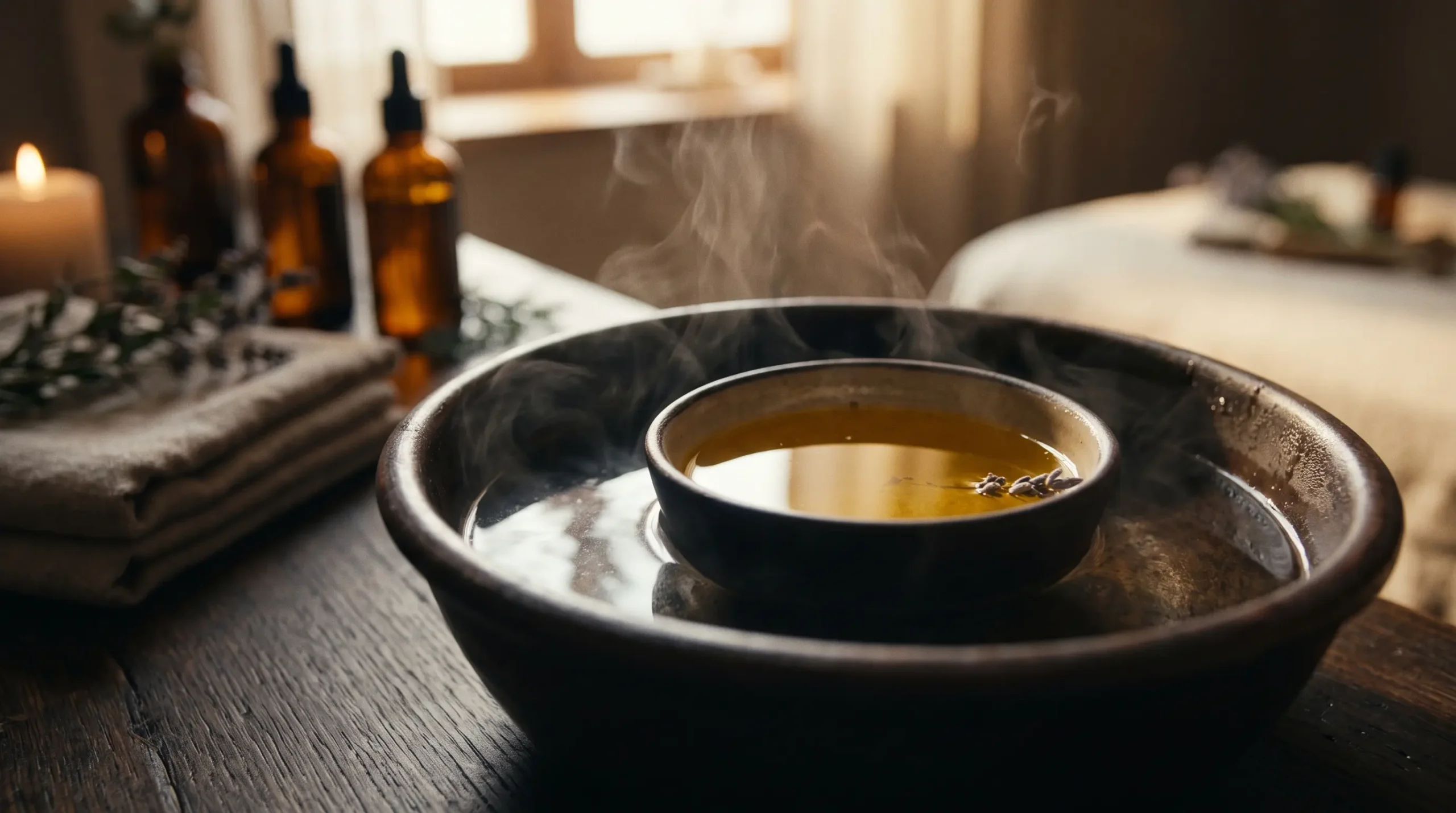
“Yes, gentle warming can make the massage more comfortable, especially before sports or relaxing massage. But I don’t recommend heating the bottle directly on a flame or in the microwave. Put the amount you need in a small bowl, warm it indirectly in a warm water bath until it’s lukewarm, close to skin temperature, and test it on the back of your hand first. Oils don’t need high heat to work; warming is mainly for comfort.”
How to apply it
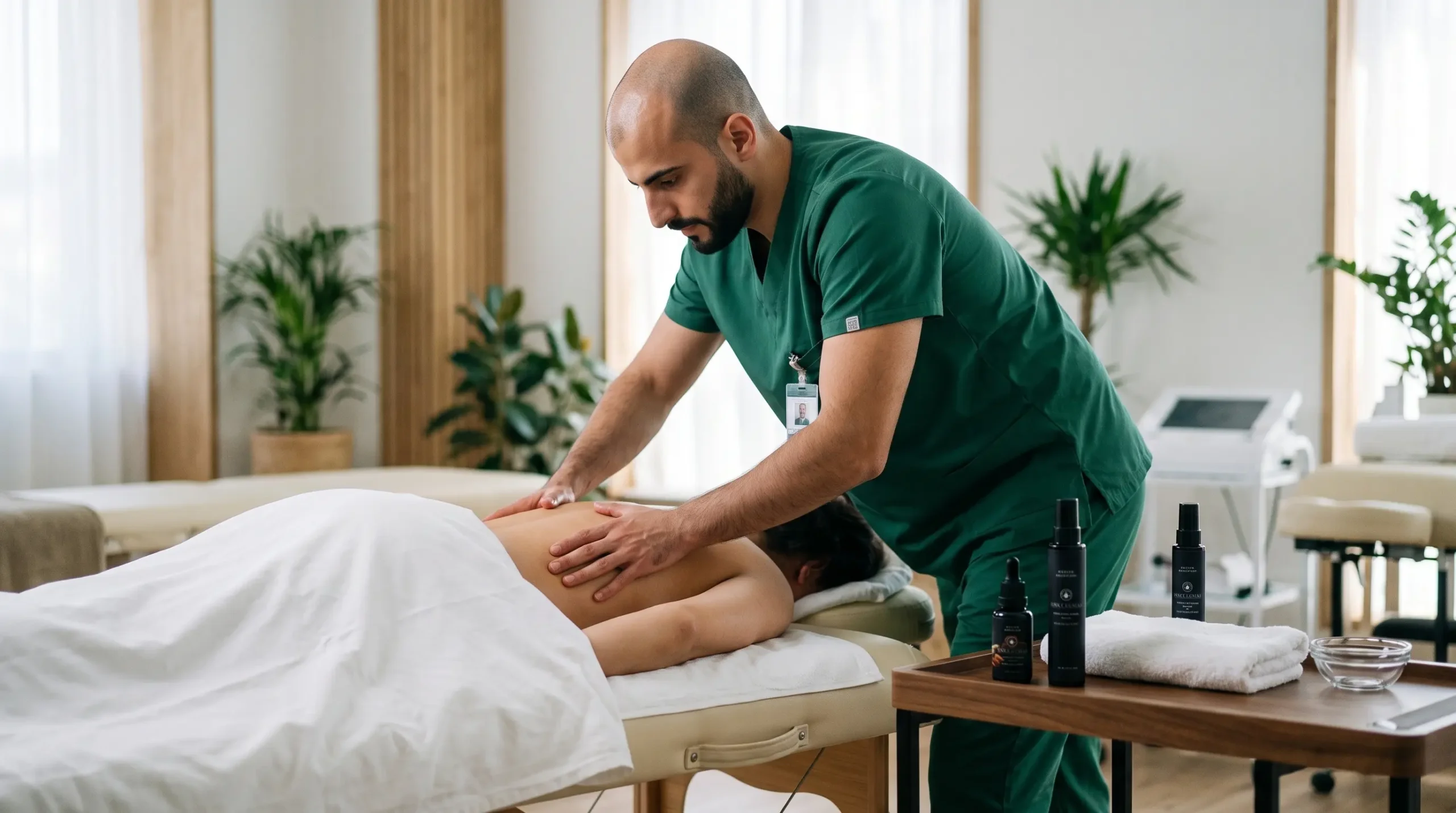
“Warm your hands, spread the oil, use long gentle or circular strokes, increase pressure gradually, work on the muscles, then ease the pressure at the end of the session. Don’t put a large amount directly on the skin: put a little in your palm, rub your hands together, then spread it. With warming oils containing mustard, black pepper, ginger or clove, massage more conservatively, because more product or strong friction can increase irritation. And strong pressure doesn’t necessarily mean a better massage.”
How long should the oil stay on?
- Relaxing massage: it can stay on the skin afterwards if it isn’t uncomfortable.
- Sports or muscle massage: leave a thin layer, then wear loose clothes once the oily feeling settles.
- Strong or warming blends: “I don’t recommend leaving a thick layer for hours or overnight without testing skin tolerance. If you feel strong burning, itching or unusual redness, remove the oil and wash the area.”
A shower isn’t necessary after a massage, but it’s better if a lot of oil was used, the oil is very greasy, you’ll sweat afterwards, or the blend contains strong warming ingredients. Avoid a very hot shower right after a warming oil, because the heat can increase the warm sensation and irritation.
Avoiding stains on clothes and sheets
- Don’t use too much oil.
- Wait 10–20 minutes before putting on tight clothes.
- Wear loose cotton clothing.
- Before bed, put a washable towel or cover over the sheet.
- “Don’t put on a lot of oil before sleeping to ‘increase its effect.’ More oil doesn’t mean more effect.”
The best time for a massage
| Timing | Best for |
|---|---|
| After a warm bath | Relaxation |
| 30–60 minutes before sleep | Relaxation and sleep |
| After sport | Muscle comfort, depending on how hard you trained |
| Morning | Energy and movement |
| Right before sport | Depends on the type of massage and oil |
“After very intense training, it’s better not to do a deep massage straight away. Wait a little until the body calms down, then use light to medium massage.”
When should you not use massage oil, or massage at all?
“This is one of the most important points. Oil or massage shouldn’t be used randomly when there is:
- An open wound
- Active skin inflammation or infection
- An undiagnosed rash
- Severe irritation
- A known allergy to one of the product’s ingredients
- Burns
- Sharp, unexplained pain
- Sudden or unusual swelling
- A recent injury that needs assessment
- Worrying neurological symptoms
Caution is also needed with some chronic conditions, people taking certain medicines, older adults, pregnancy, and circulation or bleeding disorders, which may need individual assessment.
With essential oils, caution is greater because the substance is concentrated. I don’t agree that adding a lot of essential oil makes a product ‘stronger.’ Sometimes the result is the opposite: irritation, redness, allergy or dermatitis.
As for varicose veins, I don’t treat them as something you can judge in one word: there’s a difference between visible surface veins and a vascular condition that needs medical assessment.
The rule I believe in: if we don’t know the cause of the problem, massage and oil shouldn’t just be a way of hiding the symptoms.”
A simple massage at home
“You can do a simple massage at home if there’s no contraindication or injury that needs assessment. Start with a small amount of a suitable oil and spread it with gentle movements. Then use long, slow strokes, followed by light circular movements on the muscles, increasing pressure gradually if it feels comfortable.
But I don’t advise non-professionals to imitate deep physiotherapy techniques, or to press hard on the spine, joints, or areas with nerves and blood vessels. Most important is watching how your body responds: if you feel sharp pain, numbness, dizziness or unusual symptoms, stop.
In a relaxing massage, the goal isn’t to reach pain, but a good level of comfort and relaxation. Sometimes a simple 10–20 minute massage, together with daily movement, good sleep, hydration and healthy habits, is more useful than one intense session followed by a return to whatever caused the problem.”

The biggest mistakes, and how to recognise a good massage oil
“I think the biggest mistakes start with the idea that the more ingredients, the better the product. That’s not true. A blend can contain ten or fifteen oils, but if each ingredient has no clear function, the result may be worse than a simple, well-designed blend. Blending oils isn’t random; it’s based on scientific and medical rules, on the active compounds in the oils, and on carefully studied ratios. Building a blend can sometimes take months to reach its final formula.”
- Using a high concentration of essential oils. “Strength isn’t in the quantity, but in the right dose, safety and correct concentration.”
- Choosing an oil by its name alone. “A famous plant oil isn’t suitable for every type of massage.”
- Ignoring oxidative stability. “Oils rich in unsaturated fatty acids oxidise more easily, so storage, shelf life and packaging matter.”
- Not knowing where the oil comes from. “One of the most important points: quality starts with the raw material: the plant, cultivation, extraction, storage, bottling and analysis.”
- Confusing scent with therapeutic effect. “A beautiful scent makes the experience better, but it’s not proof that it works.”
- Believing that heat means stronger treatment. “Feeling heat or cold is a sensory response, not proof on its own of a product’s effectiveness.”
- Using one oil for every case. “A professional product can have different blends for different goals: relaxation, sport, muscles, joints, skin care.”
- Skipping the skin tolerance (allergy) test, especially with essential oils or plants that can cause allergy.
- Storing oil badly. “Heat, light, air and moisture can affect the quality of some oils, so the bottle and storage conditions are part of the product’s quality.”
- Most importantly: over-promising. “A good natural product doesn’t need to claim it cures every disease. I prefer to tell the customer clearly: this oil is designed to help a massage session achieve a specific goal; this is how to use it, and these are its limits. That builds trust instead of reducing it.”
Jaafar’s conclusion
“In my view, the best massage oil isn’t necessarily the most expensive one, the one with the most ingredients, or the one that gives the strongest warming feeling. The best oil is the one whose formula suits the goal, is safe when used correctly, is stable, has a known quality, and works in harmony with the massage technique.
I believe the future of natural massage products isn’t in going back to mixing dozens of oils randomly, but in combining traditional knowledge of plants and oils with phytochemistry, dermatology, movement science and the principles of physiotherapy. That’s how a natural product can become more than a scented oil: a carefully designed, functional product with an identity, a formula and a clear purpose.”
The Ingredients
Sesame Oil
Sesamum indicumA traditional massage base (known in the Levant as siraj) with a texture well suited to long sessions.
Sweet Almond Oil
Prunus dulcisSmooth, long glide for comfortable relaxing massage. Not for people with nut allergy.
Ginger Macerated Oil
Zingiber officinaleA warming sensation for pre-training and muscle massage, used in light concentrations.
Garden Cress Oil
Lepidium sativumBase for joint-focused massage blends.
Frankincense Macerated Oil
Boswellia spp.Added in small amounts to blends for older adults and before training.
The Ritual
Warm bath
Start with a warm, not hot, bath to relax the body.
Dry the skin well
Pat the skin dry before applying oil.
Warm the oil
Warm a small amount in a water bath until lukewarm, and test it on the back of your hand.
Massage 15–30 minutes
Use long, gentle strokes, then light circular movements, increasing pressure only if comfortable.
Remove the excess
Wipe off excess oil with a towel and put on comfortable clothes.
Sleep
Ideally 30–60 minutes before bedtime.
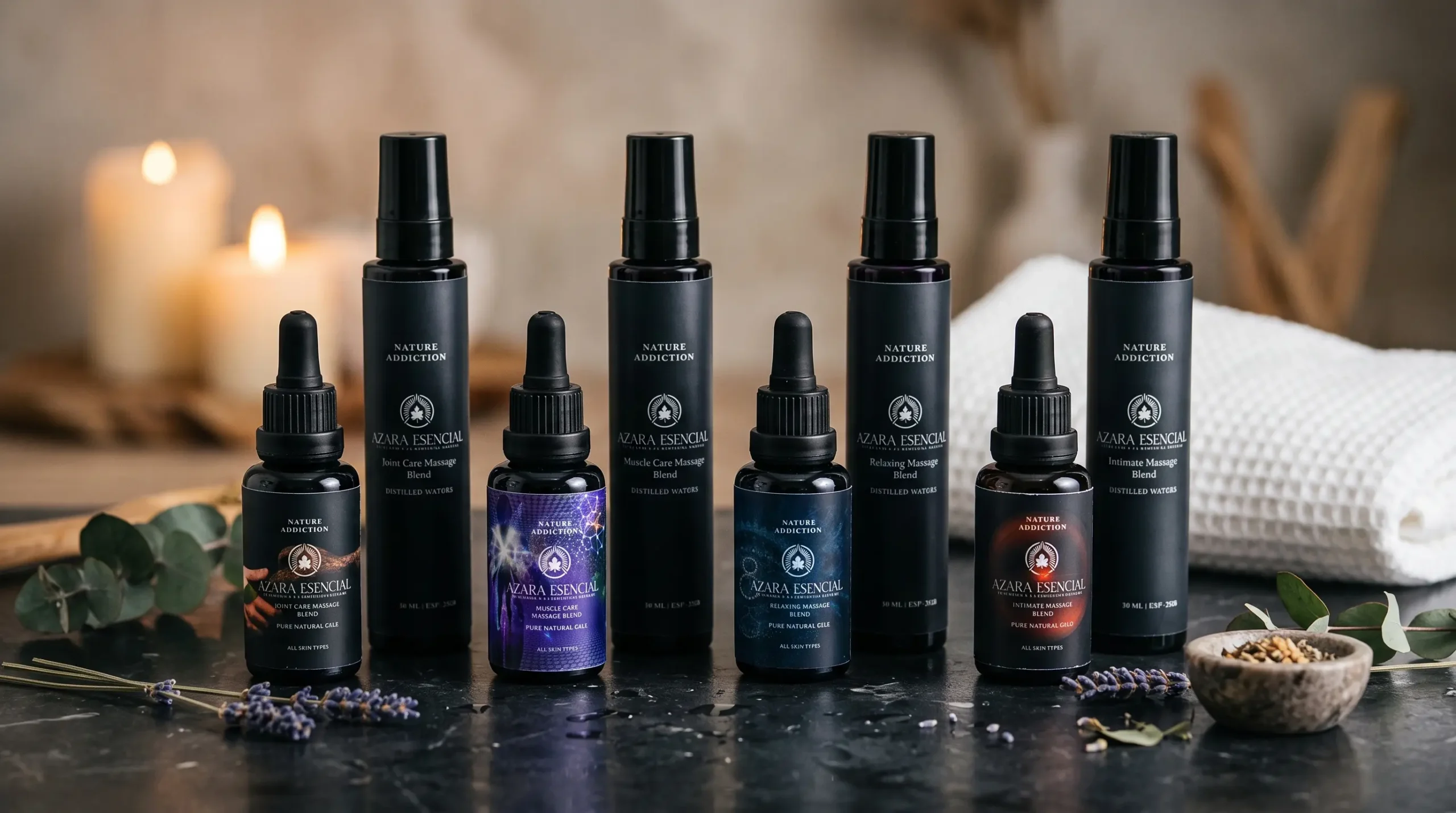
Our massage blends are built the way Jaafar describes: each one around a clear goal, from cold-pressed and macerated oils, with no random mixing.
Explore our massage blendsFrequently Asked Questions
There’s no single best oil. The right choice depends on the goal (relaxation, sport, muscle tension or joints), the technique, the session length and the person’s skin.
About 1–2 ml for a small area like the feet or shoulders, 2–5 ml for the back or one leg, and 10–15 ml for a full-body massage. Start small and add gradually.
Gentle warming makes the massage more comfortable. Warm a small amount in a water bath until lukewarm. Never heat the bottle on a flame or in the microwave.
Oil is best for long sessions of 20–60 minutes because it glides longer. Cream or lotion suits short sessions, small areas, or people who don’t want an oily feel.
No. Essential oils must be diluted, around 0.5–1% for the face and 1–2% for the body, and patch-tested on the forearm for 24 hours first.
Not necessarily. A thin layer can stay on the skin, but shower if you used a lot of oil, will sweat, or used a strong warming blend. Avoid a very hot shower right after.
It gives long glide and is stable, but it doesn’t nourish the skin, can feel heavy, and its safety depends on refining. Never use technical or lubricating oils on the body.