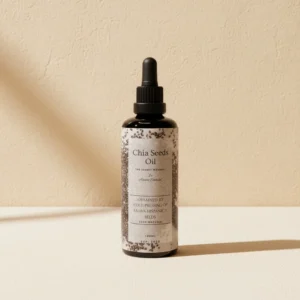
Salvia hispanica — cold-pressed chia seed oil with 60–65% ALA omega-3, one of the highest alpha-linolenic acid concentrations of any plant oil, for skin barrier repair, anti-inflammatory protection, and hair conditioning
What is chia seed oil — origin, composition, and cold-pressed quality
Salvia hispanica L. is an annual flowering plant in the mint family (Lamiaceae), native to central and southern Mexico and Guatemala. The name “hispanica” reflects its historical documentation by Spanish colonizers in the Americas — not a connection to Spain itself (Salvia hispanica is not native to the Iberian Peninsula). Chia seeds were a staple crop of Aztec and other Mesoamerican civilizations for millennia before European contact.
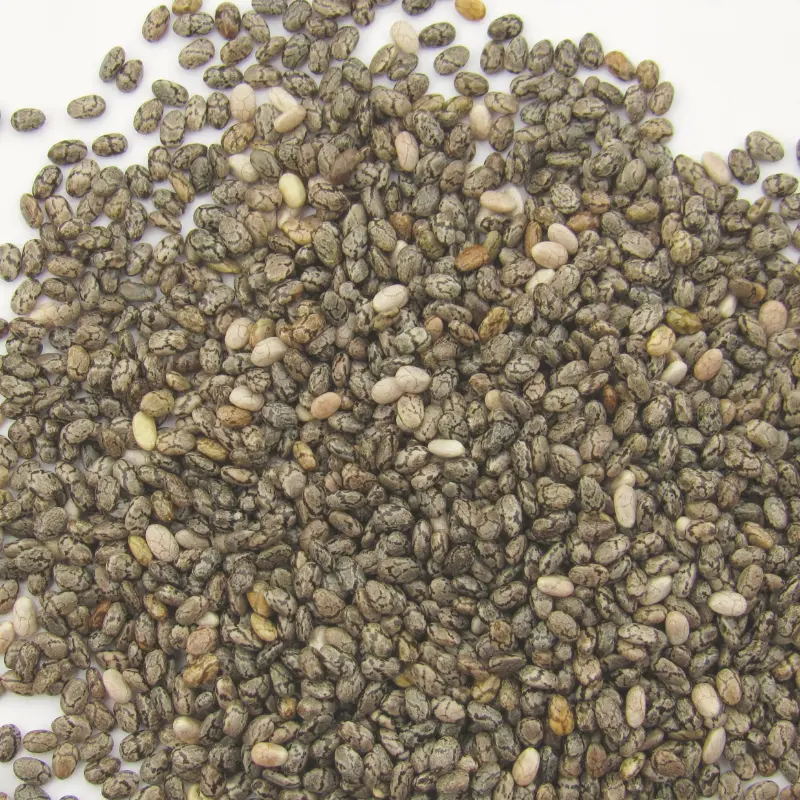
The seeds are small (approximately 1–2mm), grey to black with white spots, and hygroscopic — they form a mucilaginous gel when soaked, which is their familiar culinary property. The oil content of the seeds is approximately 30–35% by weight.
Cold-pressed chia seed oil composition:
–Alpha-linolenic acid (ALA, omega-3): 60–65% — one of the highest concentrations of any commonly available plant oil, comparable to linseed and sometimes higher
– Linoleic acid (omega-6): 17–20% — barrier-supporting, sebum-composition-relevant
– Oleic acid (omega-9): 5–8% — minor conditioning contribution
– Saturated fatty acids: 8–12% — palmitic and stearic
– Polyphenols — caffeic acid, chlorogenic acid, and quercetin derivatives (unique to chia vs linseed oil)
– Vitamin E (tocopherols) — present in cold-pressed versions; partially destroyed by heat extraction
– Phytosterols — anti-inflammatory and barrier-supportive
Chia vs linseed oil:
Both are extremely high-ALA oils with similar skin benefit profiles. Chia seed oil additionally contains caffeic acid and chlorogenic acid — polyphenol antioxidants not significantly present in linseed oil — giving it an additional antioxidant dimension. Both require careful storage due to their high PUFA content and susceptibility to oxidation.
Cold pressing is essential:
ALA oxidises rapidly under heat. Heat-extracted chia oil loses a significant proportion of its ALA content and associated benefits. Cold-pressed, unrefined chia seed oil is pale golden to yellow, with a mild, slightly nutty scent — characteristic of intact phytochemical content.
The skin science: ALA, barrier repair, and anti-inflammatory mechanisms
The skin benefits of high-ALA botanical oils like chia seed oil are grounded in established dermatological biochemistry — the same principles that explain linseed oil’s skin effects, with the addition of chia’s polyphenol content.
Alpha-linolenic acid and the skin barrier:
ALA is a structural component of the skin’s lipid bilayer — the outermost protective layer of the stratum corneum. When the barrier is deficient in omega-3 fatty acids (as is commonly found in eczema, psoriasis, and chronically reactive skin), transepidermal water loss increases, sensitivity rises, and inflammatory conditions worsen. Topical ALA from chia seed oil contributes to the barrier’s lipid composition — addressing the structural deficiency rather than masking the surface symptoms.
Anti-inflammatory mechanism:
ALA is a precursor to anti-inflammatory eicosanoids through the omega-3 metabolic pathway. Topical application of omega-3-rich oils on inflammatory skin conditions has been documented in multiple reviews including a comprehensive International Journal of Molecular Sciences review on plant phenolics and inflammatory skin diseases.
Caffeic acid and chlorogenic acid — chia’s unique polyphenol contribution:
These phenolic acids, present in chia seed oil in quantities not found in linseed oil, provide additional antioxidant and anti-inflammatory activity:
– Caffeic acid: Documented inhibitor of 5-lipoxygenase (5-LOX), an enzyme in the leukotriene synthesis pathway relevant to inflammatory skin conditions including eczema and psoriasis
– Chlorogenic acid: Antioxidant and mild tyrosinase inhibitor — contributing minor brightening activity alongside the anti-inflammatory and barrier-repair benefits
Linoleic acid (17–20%) — sebum balance:
The linoleic acid component mirrors healthy sebum composition and is relevant for oily and acne-prone skin where linoleic deficiency drives sebum overproduction. Combined with the anti-inflammatory ALA, chia seed oil addresses two simultaneous components of acne-prone skin.
Skin benefits: barrier repair, eczema calming, and anti-aging
Eczema, psoriasis, and reactive skin:
Chia seed oil’s high ALA content addresses the omega-3 deficiency associated with barrier dysfunction in eczema and psoriasis. The combination of barrier reinforcement and direct anti-inflammatory activity makes it one of the more targeted botanical oils for these conditions. Consistent daily application to affected areas reduces transepidermal water loss, decreases inflammatory reactivity, and improves the felt comfort of reactive skin over 2–4 weeks of use.
Dry and dehydrated skin:
For chronically dry skin — common in Spain’s dry interior regions, in winter central heating environments, and in mature skin — ALA’s barrier integration reduces the moisture loss that produces tightness, flaking, and discomfort.
Sensitive and reactive skin:
Of all common carrier oils, chia seed oil has one of the most consistently gentle profiles for reactive skin. Its anti-inflammatory mechanism calms baseline reactivity before exposure to triggers; its barrier-reinforcing effect reduces the skin’s permeability to irritants; and its relatively low comedogenic rating makes it appropriate even for oily skin with inflammatory sensitivity.
Antioxidant and anti-aging protection:
The combination of ALA’s anti-inflammatory properties, the caffeic and chlorogenic acid antioxidant activity, and vitamin E protection creates a comprehensive antioxidant and anti-inflammatory environment at the skin’s surface — relevant for cumulative photoaging prevention.
Combined with other oils:
Chia seed oil’s very high ALA content makes it most effective when combined with more stable carrier oils in a formulation. A blend of chia (15–20% ALA contribution) with sesame (stable oleic-dominant base) and frankincense macerate (structural anti-aging) creates a complete facial oil formulation with complementary mechanisms that individual oils cannot provide alone.
Chia seed oil in massage: gentle, anti-inflammatory carrier
Chia seed oil’s combination of high ALA anti-inflammatory content, gentle skin compatibility, and light-medium texture makes it a valuable massage carrier — particularly in therapeutic contexts where skin reactivity is a consideration.
Sensitive skin and reactive skin massage:
For clients with eczema, psoriasis, rosacea, or chronic skin reactivity, chia seed oil provides the most anti-inflammatory carrier base available. Where most carrier oils are neutral in terms of inflammatory effect, chia’s ALA content actively reduces the skin’s inflammatory reactivity during and after massage. This is clinically relevant for massage practitioners working with inflammatory skin conditions.
Facial massage carrier:
Chia seed oil’s light texture and ALA anti-inflammatory profile make it well-suited for facial massage on reactive, eczema-prone, or mature facial skin — providing active barrier reinforcement during the massage stimulation.
Blended with warming therapeutic oils:
In warming massage formulations (ginger, black pepper, mustard, camphor), adding chia seed oil at 15–25% of the carrier base provides an anti-inflammatory balance to the warming stimulation — reducing the risk of excessive reactivity in sensitive skin while maintaining the circulatory and warming benefits.
Relaxation and full-body massage:
Chia’s light texture absorbs well without excessive residue, providing comfortable glide throughout a full massage session. Blended with sweet almond oil, it creates a carrier with the conditioning properties of almond and the anti-inflammatory ALA contribution of chia.
Massage types most suited to chia seed oil:
Sensitive skin massage, eczema/psoriasis skin massage, facial massage, anti-inflammatory blended massage, relaxation massage (as part of blend).
Cold-pressed vs refined vs oxidised: what each delivers and how to spot the difference
Cold-pressed unrefined chia seed oil — the only form worth buying for skin:
Best for: dry, reactive, eczema-prone, and barrier-compromised skin care; anti-inflammatory facial and body oil; sensitive scalp treatment; hair conditioning for fine and normal hair; and blended formulations where high-ALA anti-inflammatory contribution is the goal. The pale golden colour, mild nutty scent, and 3–6 month opened shelf life are the characteristics of the genuine product. Price: €15–35 for 50–100ml of quality cold-pressed chia seed oil — accessible and appropriate for daily skin use when stored correctly.
Refined / heat-extracted chia seed oil — lower cost, lower benefit:
Used primarily in the supplement and food industry where ALA content for oral consumption (rather than topical use) is the priority, and where sensory properties matter less. For skin application, the degraded ALA content means the barrier-repair and anti-inflammatory mechanisms that make chia therapeutically interesting are significantly reduced. Price: €8–15 for 100ml — the lower price reflects the lower quality. In skincare, this price difference is meaningful: you are paying less because you are getting less.
Oxidised chia seed oil — actively harmful:
Due to its very high PUFA content, chia seed oil that has been stored incorrectly, left open too long, or sold past its useful life becomes oxidised — producing lipid peroxides and aldehydes that are pro-inflammatory and damaging rather than beneficial. This is not just a loss of benefit; an oxidised oil actively damages skin. Signs: sharp, paint-like or rancid smell distinctly different from the fresh mild nutty scent. If chia seed oil smells unpleasant — discard it. This is particularly relevant when purchasing from sellers who cannot confirm storage conditions or production dates.
Azara Natural's Chia Seed Oil is cold-pressed from Salvia hispanica seeds — preserving the full 60–65% ALA omega-3 content in UV-protecting dark glass. No refining. No solvents. The complete phytochemical profile of genuine cold-pressed aceite de chía.
Get Azara Natural Chia Seed OilFrequently Asked Questions
Yes — with an important caveat about blending. Chia seed oil’s linoleic acid (17–20%) helps rebalance sebum composition in oily skin (oily skin is frequently linoleic-deficient, driving sebum overproduction as compensation). Its ALA anti-inflammatory activity reduces the inflammatory reactivity of acne-prone skin. However, its very high ALA content makes it a fast-oxidiser — for daily leave-on use on oily skin, blend it with a more stable non-comedogenic carrier (arugula seed oil, radish seed oil) at 20–30% chia seed oil. This preserves the anti-inflammatory benefit while reducing oxidation rate and potential for comedogenicity from any oxidised lipid residue.
They have different primary mechanisms. Chia seed oil’s primary mechanism is barrier repair, ALA anti-inflammatory activity, and omega-3 structural support — most beneficial for reactive, eczema-prone, and barrier-compromised skin. Rosehip oil’s primary mechanism for anti-aging is vitamin A precursors (trans-retinoic acid and beta-carotene) for gentle cell renewal support — most beneficial for skin showing early fine line formation and mild photoaging. Both are high-PUFA oils with similar shelf life considerations. A blended approach — chia for barrier and anti-inflammatory foundation, rosehip for vitamin A cell renewal — is more effective than either alone for mature skin with inflammatory or reactive tendencies.
No — chia seeds applied topically (as a mask or paste) deliver mainly the mucilaginous polysaccharide gel from the seed’s outer coating, with limited oil penetration. Cold-pressed chia seed oil extracts the lipid fraction — the ALA, linoleic acid, polyphenols, and vitamin E — in a form that penetrates the skin barrier and delivers bioactive compounds to the stratum corneum and epidermis. The benefits are related but the delivery mechanism is completely different. The oil is the therapeutic form for skin and hair applications; the mucilage is a different (humectant/surface conditioning) application.
Chia seed oil (aceite de chía) is most specifically beneficial for dry, reactive, eczema-prone, sensitive, and barrier-compromised skin. Its 60–65% ALA omega-3 content addresses the structural lipid deficiency underlying these conditions by reinforcing the skin’s lipid bilayer — reducing transepidermal water loss and calming the inflammatory cascade. Its additional caffeic and chlorogenic acid antioxidants provide protection against UV-driven oxidative stress. For oily skin, the linoleic acid component (17–20%) complements the ALA for sebum rebalancing. Due to its high PUFA content, it is best used blended with more stable oils for daily applications where longer shelf life is needed.