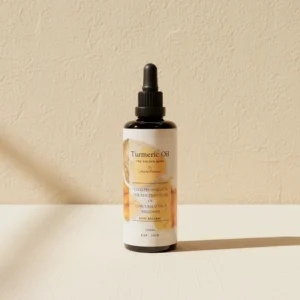
Curcuma longa — cold-macerated turmeric root oil delivering curcumin, demethoxycurcumin, and bisdemethoxycurcumin in a lipid vehicle for maximum bioavailability — for anti-inflammatory skin support, brightening, and antioxidant protection
What is turmeric oil — macerate, essential oil, and the curcumin distinction
Curcuma longa is a rhizomatous herbaceous plant of the ginger family (Zingiberaceae), native to the Indian subcontinent and cultivated across tropical Asia and parts of the Middle East. The turmeric rhizome (root) is the source of both culinary turmeric powder and the botanical oils used in natural skincare.
Three different turmeric preparations are used in skincare, with very different compositions:
Turmeric essential oil (from steam distillation):
Contains primarily ar-turmerone (40–60%), alpha-turmerone, beta-turmerone, and other sesquiterpene ketones. Does NOT contain curcumin — curcumin is a large, non-volatile polyphenol that does not carry over in steam distillation. Has aromatic properties and some anti-inflammatory activity from the turmerone fraction, but lacks the NF-κB inhibition and antioxidant mechanisms associated with curcumin specifically.
Turmeric powder / water-based preparations:
Curcumin is poorly water-soluble — its bioavailability in water-based preparations is very low regardless of concentration. Traditional Ayurvedic preparations often combined turmeric with fat (ghee, coconut oil, black pepper for piperine enhancement) specifically to improve curcumin absorption — a traditional practice that aligns with modern pharmacological understanding of lipid-enhanced curcumin delivery.
Cold-macerated turmeric oil (Azara Natural):
Turmeric rhizome material cold-infused in a carrier oil over an extended period. Curcumin is lipid-soluble — it dissolves into the oil phase during maceration, producing an oil rich in curcumin, demethoxycurcumin, and bisdemethoxycurcumin (the three curcuminoids). This is the optimal delivery format for topical curcumin application: lipid vehicle maximises skin penetration of the lipid-soluble curcuminoids.
The critical formulation detail:
For topical anti-inflammatory and antioxidant application, cold-macerated turmeric oil delivers curcumin in the form with the highest topical bioavailability. Essential oil and water-based preparations do not.
Traditional use: from Ayurveda to Mediterranean herbalism
Curcuma longa has been used in Indian Ayurvedic medicine for at least 4,000 years — documented in Sanskrit texts as Haridra, used for skin conditions, wound healing, digestive health, and as an anti-inflammatory preparation.
The Levantine connection is particularly relevant for Azara Natural. Turmeric trade routes through the Arabian Peninsula brought it into Arab medicine (known as kurkum) centuries ago — Ibn Sina documented turmeric preparations for skin and liver conditions in Al-Qanun fi al-Tibb. From Arab trade routes, it entered European herbalism through Spain during the Moorish period, and the Spanish word cúrcuma derives from the Arabic/Persian name.
In traditional Chinese medicine, turmeric (Jianghuang) is classified as having “warming blood-moving” properties — aligning with its documented anti-inflammatory and circulation-relevant mechanisms in modern pharmacology.
Topical turmeric preparations for skin brightening and anti-inflammatory skin conditions have been part of South Asian beauty ritual for millennia — the turmeric paste (haldi) applied before weddings in Indian, Pakistani, and Bangladeshi tradition represents thousands of years of empirical evidence for its skin-brightening and anti-inflammatory properties.
The curcuminoid science: mechanisms and verified evidence
NF-κB inhibition — the master anti-inflammatory mechanism:
Curcumin is among the most studied natural NF-κB inhibitors. NF-κB (nuclear factor kappa-light-chain-enhancer of activated B cells) is the transcription factor that regulates the expression of pro-inflammatory genes — controlling the production of cytokines including IL-1β, IL-6, TNF-α, and COX-2. Curcumin inhibits NF-κB activation through multiple mechanisms, reducing the downstream inflammatory cascade. This is the biochemical basis for turmeric’s anti-inflammatory reputation across conditions from acne to arthritis.
Antioxidant activity:
Curcumin is a potent free-radical scavenger — neutralizing reactive oxygen species from UV radiation and environmental pollution that drive collagen degradation and visible skin aging. Its antioxidant activity operates through both direct free-radical quenching and upregulation of the body’s endogenous antioxidant enzymes (superoxide dismutase, catalase).
Antimicrobial activity:
Curcumin and curcuminoids have documented activity against Propionibacterium acnes (C. acnes), Staphylococcus aureus, and Malassezia species — the three most clinically relevant skin pathogens for acne, eczema-related infections, and dandruff respectively.
Skin brightening — melanin synthesis modulation:
Curcumin inhibits tyrosinase — the key enzyme in melanin synthesis. This tyrosinase inhibition is the biochemical basis for turmeric’s skin-brightening and hyperpigmentation-reducing properties. It is a gentler mechanism than hydroquinone (a regulated depigmenting agent) but operates through the same enzymatic pathway.
Maximum concentration — 10% in leave-on formulas
Turmeric oil should not be used at concentrations above 10% in leave-on formulations. Above 10%, the curcumin staining of skin and fabrics becomes practically unmanageable, and the risk of skin irritation increases. At 3–10%, the anti-inflammatory and brightening benefits are active without excessive staining. For blends: 3–5% is appropriate for facial formulas; up to 10% for targeted body or scalp applications.
Skin benefits: anti-inflammatory, brightening, and anti-aging
Acne and inflammatory skin conditions:
Curcumin’s NF-κB inhibition, direct antimicrobial activity against C. acnes, and antioxidant protection address acne through three simultaneous mechanisms. Unlike many conventional acne treatments that target a single pathway, turmeric macerate’s multi-mechanism profile is particularly relevant for inflammatory acne where bacteria, inflammation, and oxidative stress are all contributing factors.
Skin brightening and hyperpigmentation:
Tyrosinase inhibition from curcumin reduces melanin production in areas of excess pigmentation — sun damage, post-inflammatory hyperpigmentation (from healed acne), and age spots. Consistent application over 4–8 weeks produces visible brightening in hyperpigmented areas. For Spain’s population exposed to one of Europe’s highest UV indices, this brightening mechanism is directly relevant for managing cumulative sun pigmentation.
Anti-aging antioxidant protection:
The combination of curcumin free-radical scavenging and NF-κB-mediated reduction of the inflammatory aging cascade (inflammaging) makes turmeric macerate relevant for structural skin aging prevention. Combined with frankincense resin macerate’s MMP inhibition and fibroblast stimulation, the two provide complementary anti-aging mechanisms at different levels of skin biology.
Wound healing and scar support:
Curcumin accelerates wound healing through anti-inflammatory, antimicrobial, and collagen-supportive mechanisms — documented in multiple wound healing studies. For minor skin repair and scar appearance improvement, turmeric macerate applied consistently (at appropriate dilution) supports the healing and remodeling process.
The staining issue:
Curcumin produces a characteristic golden-yellow stain on fabric, light skin, and light surfaces. Practical management: apply in the evening before bed; use a dark pillowcase during treatment; wash hands immediately after application; avoid application before wearing light-coloured clothing. The staining of skin fades with washing within 1–2 days. Any oil labeled “turmeric oil” that produces no skin tint contains minimal curcumin and is of questionable quality.
Hair and scalp benefits
Anti-inflammatory scalp treatment:
Curcumin’s NF-κB inhibition addresses the scalp inflammation contributing to dandruff, folliculitis, and inflammatory hair loss. Applied to the scalp at 3–8% in a carrier blend, turmeric macerate provides meaningful anti-inflammatory support at the follicle environment level.
Antimicrobial scalp action:
Curcumin’s activity against Malassezia species — the primary fungal genus in dandruff and seborrheic dermatitis — provides a botanical antimicrobial mechanism for scalp microbiome rebalancing alongside black seed oil and laurel bay.
Scalp brightening — managing scalp hyperpigmentation:
Tyrosinase inhibition from curcumin can be relevant for post-inflammatory hyperpigmentation on the scalp following resolved scalp conditions. Applied consistently in scalp treatments, it contributes to a more even scalp tone over time.
Given turmeric’s staining potential, scalp application should be planned with staining in mind — dark towels, overnight treatment with a shower cap, and two washes to remove. The beneficial effects are proportional to the time left in contact, so overnight treatments are worth the extra care with staining management.
Turmeric oil in massage: anti-inflammatory and Ayurvedic tradition
Turmeric oil has deep roots in Ayurvedic massage — abhyanga (traditional Indian full-body oil massage) historically incorporated turmeric preparations for their anti-inflammatory, skin-brightening, and auspicious cultural properties.
Anti-inflammatory massage:
At 5–10% in a massage carrier (sweet almond, sesame), turmeric macerate adds curcumin’s NF-κB anti-inflammatory mechanism to the massage application. For massage targeting inflamed joints, reactive skin areas, or post-exercise inflammation, this botanical anti-inflammatory layer complements the mechanical benefits of the massage.
Brightening body massage:
Incorporated into a body massage blend, turmeric macerate’s tyrosinase-inhibiting brightening effect can address body hyperpigmentation and uneven skin tone — particularly relevant for sun-exposed body areas (arms, décolletage, legs) in Mediterranean climates.
Massage types most suited to turmeric macerate:
Ayurvedic-inspired massage, anti-inflammatory therapeutic massage, brightening body ritual, targeted joint massage (at appropriate dilution), scalp treatment massage.
Essential oil vs macerate: what each contains, what each is genuinely best for, and price
Turmeric essential oil (ar-turmerone dominant)
Steam distillation of Curcuma longa rhizome extracts the sesquiterpene ketone fraction — primarily ar-turmerone (40–60%), alpha-turmerone, and beta-turmerone. Does NOT contain curcumin — curcumin is a large, non-volatile polyphenol that remains in the spent plant material after distillation.
Best for: aromatherapy diffusion, warm aromatic massage blends at appropriate dilution, and applications where the turmerone aromatic-anti-inflammatory mechanism is the intent. The turmerone fraction has its own genuine anti-inflammatory activity and some documented neuroprotective properties through cerebral blood flow research. The honest assessment of brightening and NF-κB inhibition claims on turmeric essential oil: these mechanisms belong to curcumin, not to ar-turmerone. Products claiming melanin reduction or major anti-inflammatory NF-κB effects on the basis of “turmeric essential oil” are applying the curcumin research to the wrong compound and the wrong form.
Price: €15–30 for 10ml of genuine steam-distilled turmeric essential oil.
Cold-macerated turmeric oil (Azara Natural)
Turmeric rhizome cold-infused in a carrier oil — curcumin is lipid-soluble and dissolves into the oil during maceration, producing an oil rich in curcumin, demethoxycurcumin, and bisdemethoxycurcumin. This is the form where the NF-κB inhibition, tyrosinase-inhibiting brightening, and antimicrobial evidence applies. Maximum 10% in leave-on formulas — effective within 3–10%, staining manageable at lower concentrations.
Best for: anti-inflammatory skin treatment for acne, eczema, and psoriasis; skin brightening and post-inflammatory hyperpigmentation; scalp anti-inflammatory care; joint and muscle massage where curcumin’s COX and NF-κB inhibition complements the warming compounds; and wound healing support. The deep golden colour is the primary quality verification — it confirms curcumin content without needing an analytical certificate.
Price: €20–45 for 50–100ml of quality cold macerate. A pale or colourless “turmeric oil” at lower price has been refined, contains minimal curcumin, and the anti-inflammatory and brightening claims do not apply to it.
Turmeric powder water-based preparations
Applied in water-based masks or pastes, curcumin’s very poor water solubility means skin bioavailability is minimal regardless of concentration. Traditional Ayurvedic preparations combined turmeric with fat (ghee, coconut oil) specifically because practitioners understood — empirically before the pharmacology was known — that curcumin needed a lipid vehicle. Water-based turmeric preparations are better for their exfoliating and surface-brightening physical action than for curcumin delivery.
Best for: surface-level exfoliating masks when combined with clay or gentle physical exfoliants. Not the appropriate form for delivering curcumin’s documented anti-inflammatory and melanin-inhibiting mechanisms.
Azara Natural's Turmeric Oil is cold-macerated from Curcuma longa rhizome — delivering curcuminoids in a lipid vehicle that maximises topical bioavailability. Formulated into the Joint Care Blend and Facial Care Blend for its documented NF-κB anti-inflammatory and tyrosinase-inhibiting brightening mechanisms.
Get Azara Natural Turmeric OilFrequently Asked Questions
No — the curcumin staining is temporary and washes away with gentle cleansing. The golden tint on skin typically fades within 1–2 washes. On fabric (towels, pillowcases, sheets), curcumin can be more persistent — particularly on white or light-coloured materials where it produces a yellow-orange stain that may require multiple washes or specialized stain treatment to fully remove. Practical management: use dark-coloured fabrics during and after turmeric oil application, apply in the evening rather than the morning, and wash hands immediately. The temporary staining is a visible confirmation of curcumin content — an oil that produces no staining contains minimal curcumin.
Yes — at appropriate concentrations (3–5% in a facial oil blend) and with staining management. Daily evening use delivers the most consistent anti-inflammatory and brightening benefit. For daytime use, staining management is more challenging — the tint will be visible on the skin until it fades, which is typically 30–60 minutes. If daytime application is preferred, use at the lower end of the concentration range (3%) blended with lighter-coloured oils and allow time for the tint to absorb before applying additional skincare or makeup. Always use broad-spectrum SPF in the morning — turmeric’s antioxidant protection is a complement to sun protection, not a substitute.
They are different delivery routes for the same compound family. Oral curcumin supplements deliver curcumin systemically — through digestion and blood circulation — with potential systemic anti-inflammatory benefits. Their challenge is poor oral bioavailability: curcumin is rapidly metabolized and poorly absorbed from the gut without enhancement (black pepper’s piperine or specialized formulations improve this). Topical cold-macerated turmeric oil delivers curcumin directly to the skin surface and superficial dermal tissue, where it acts at the site of application. For skin and scalp conditions specifically, topical delivery is more direct and produces higher local concentrations than systemic absorption from oral supplementation. The two routes are complementary for different purposes.