
☀️ Summer at Azara — The sun dries, our oils nourish — 15 % off your first order with code  ·  Code: VERANO15 Shop now →
🤝 Para Centros profesionales — empieza pagando solo el primer mes  ·  sin cuota anual.  ·  Plazas limitadas 2026 Ver programa →

Azara Natural

The biological reason cold-pressed and macerated oils outperform synthetic moisturizers — explained without marketing language

Here is something the skincare industry rarely says directly: most moisturizers don't actually moisturize. They create the feeling of moisture by forming a film on the skin's surface — using silicones, polymers, and humectants that feel immediately satisfying but do not reach the tissue layers where the skin's biology actually operates. Cold-pressed and macerated botanical oils work differently, because structurally they are not foreign to the skin. They are composed of the same fatty acid families the skin already uses — which is what makes them genuinely absorbable rather than merely pleasant.

The biological compatibility argument — and why it holds up

Human sebum — the skin’s own lipid secretion — is composed primarily of triglycerides, fatty acids, wax esters, and squalene. Cold-pressed botanical oils contain the same lipid families. This is why the skin does not treat them as foreign substances requiring active transport mechanisms: they integrate with the skin’s existing lipid matrix through passive diffusion, following the same pathways the skin uses for its own lipids.

Synthetic moisturizers work differently. Silicone compounds — dimethicone, cyclomethicone — form a film on the stratum corneum’s surface that prevents water evaporation and creates a smoothing effect. They are not biocompatible in the same sense; they don’t integrate with skin lipids, they sit on top of them. This produces an immediate sensory improvement but doesn’t address the barrier’s structural composition.

The practical difference: when a cold-pressed oil is absorbed, it contributes to the lipid bilayer structure of the skin barrier — literally becoming part of the barrier material. When a synthetic film-former is applied, the barrier underneath is largely unchanged; the film evaporates or washes away, and the skin returns to its baseline state.

A study published in Dermatology and Therapy (2018) found that cold-pressed oils improve skin barrier function and hydration significantly more than synthetic moisturizers over time — a finding consistent with the lipid integration hypothesis.

Cold-pressed oils don't coat the skin's surface — they integrate with the skin's own lipid bilayer. That structural difference is why their effects accumulate with consistent use rather than disappearing when the product is washed off.

What cold-pressed and macerated oils actually contain

Understanding the composition of botanical oils explains their functional range more clearly than any marketing claim.

Fatty acids make up more than 90–95% of a cold-pressed oil’s composition. The specific fatty acid profile of each oil determines its skin compatibility, absorption rate, and functional role. Linoleic acid (omega-6) — found in high concentrations in black seed, chia, and hemp seed oils — mirrors the composition of healthy sebum and is associated with barrier integrity and reduced inflammation. Oleic acid (omega-9) — dominant in olive, macadamia, and avocado oils — penetrates more slowly and is closer to the lipid composition of mature and dry skin. These aren’t interchangeable; selecting the right fatty acid profile for a skin type or condition is a formulation decision with real biological consequences.

Phytosterols are plant compounds structurally analogous to human cholesterol. They support barrier repair, reduce transepidermal water loss, and contribute mild anti-inflammatory properties. Oils rich in phytosterols — sesame, avocado, shea — are particularly effective for mature or compromised skin.

Fat-soluble vitamins— primarily vitamin E (tocopherols) and vitamin A precursors (carotenoids) — are preserved by cold pressing, the absence of heat being critical here. Heat-extracted oils lose a significant portion of their tocopherol content, which is the primary reason cold-pressed is not merely a marketing distinction but a functional one. Vitamin E simultaneously functions as a skin antioxidant and as an oxidative stabilizer of the oil itself.

Phenolic and terpenic compounds — present in macerated oils especially — provide antioxidant, antimicrobial, and circulatory-supportive activity. These compounds explain why a rosemary macerated oil does something different from a plain sunflower seed carrier: the maceration process extracts the plant’s phytochemical profile into the oil base.

Understanding the composition of botanical oils explains their functional range more clearly than any marketing claim.


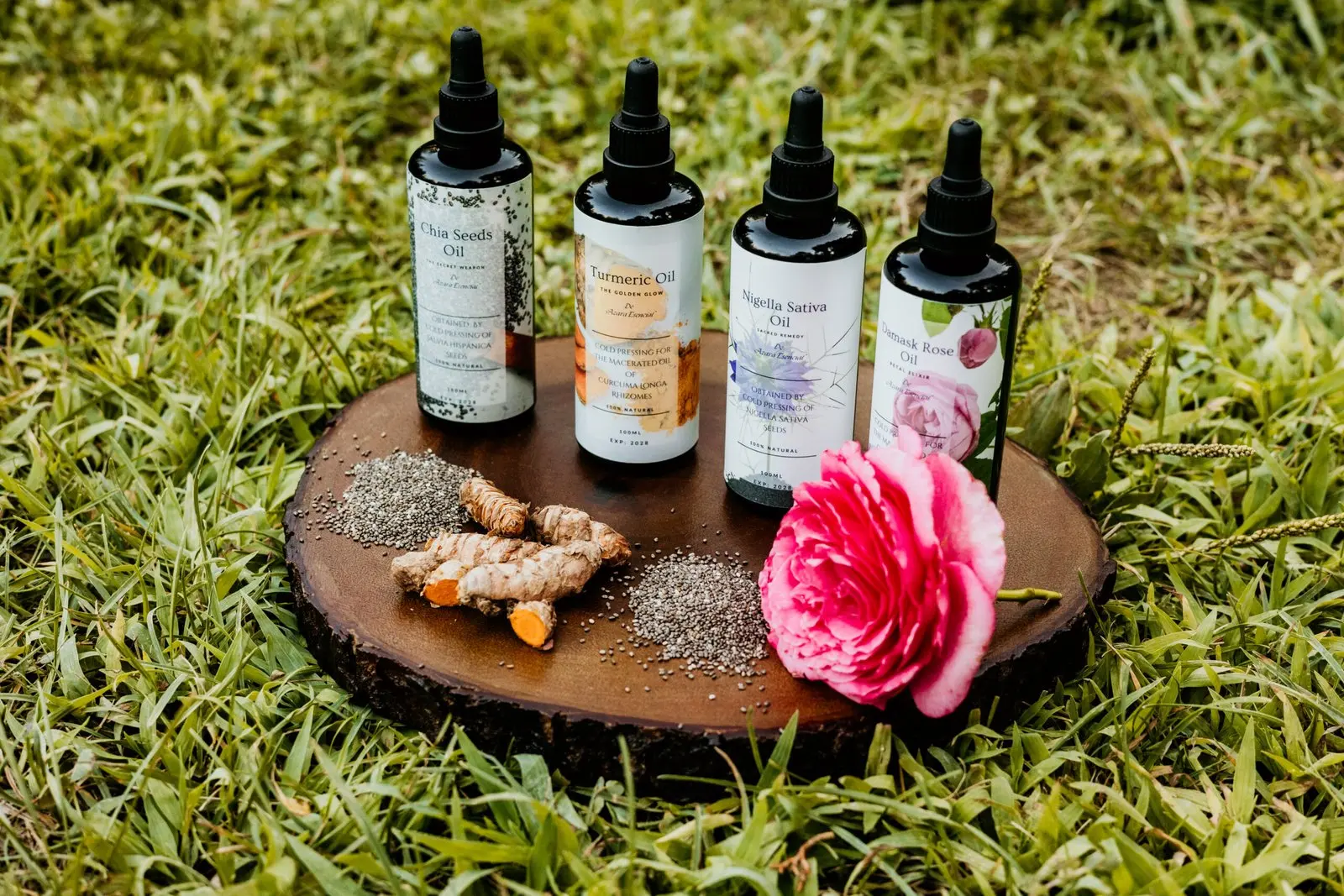
cold pressed and macerated oils bottles from Azara Natural
Cold pressing matters because heat destroys vitamin E (tocopherols) and degrades delicate fatty acids. An oil produced without heat retains its full phytochemical profile — including the antioxidant compounds that both benefit the skin and protect the oil's own stability.

Why blending oils produces better results than any single oil

The most important principle in multi-oil formulation is that the benefit comes from differences, not similarities. Each cold-pressed oil has a distinct fatty acid profile, vitamin content, phytochemical composition, viscosity, and absorption speed. When combined strategically, these differences create a more complete and balanced product than any single oil can provide.

A formula combining a high-linoleic oil (black seed, chia) with a high-oleic oil (sesame, avocado) and a lighter fast-absorbing oil (radish seed, arugula) achieves three things simultaneously: it delivers linoleic acid for barrier repair and inflammation reduction, oleic acid for deep conditioning, and ensures the overall texture absorbs without leaving an uncomfortable residue. No single oil delivers all three.

Stability is another reason blending matters. Highly polyunsaturated oils — those richest in omega-3 and omega-6 fatty acids — are also the most susceptible to oxidation. Vitamin E-rich oils, when blended in appropriate proportion, provide natural oxidative protection that extends the stability of the more delicate active oils. A well-formulated blend is inherently more stable than its most fragile component.

This is the formulation logic behind every Azara Natural product: not a single oil chosen for its reputation, but a combination of oils chosen for what each one contributes that the others don’t.

cinematic image in the garden for some of azara natural products (oil bottles inside an old wooden wheelbarrow)

Azara Natural's cold-pressed and macerated oil range contains 23 individual oils and blends — each selected for a specific skin, hair, or massage function, with no synthetic additives, fillers, or preservatives.

Explore the Full Oil Range

Frequently Asked Questions